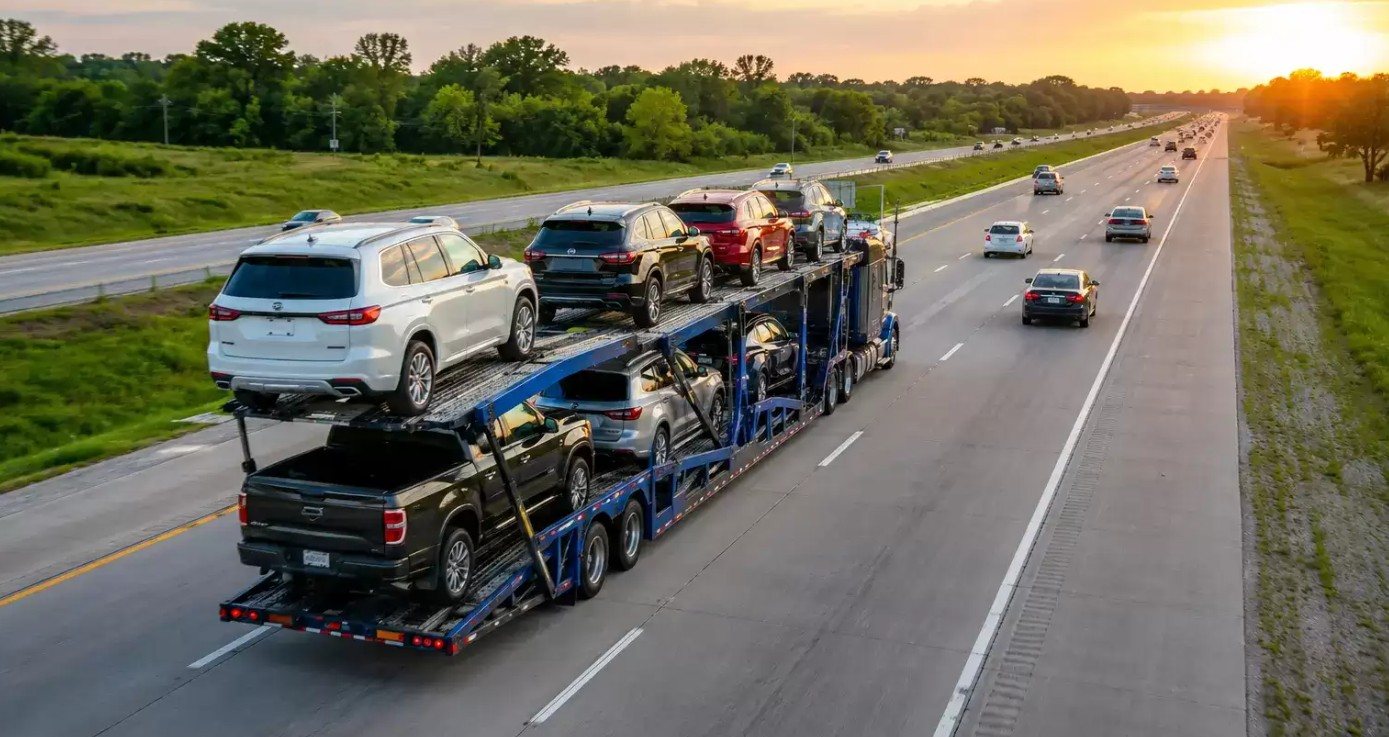
Door-to-door car shipping to and from the Valley of the Sun — vetted, insured carriers, upfront pricing, and no deposit to book.
Licensed Broker & Fully Insured
FMCSA Registered
Vetted Carrier Network
Real-Time Tracking & 24/7 Support
50+States Served
100%Insured Transport
24/7Support & Tracking
Phoenix sits at the crossroads of the American Southwest — where I-10 meets I-17, six hours from the ports of Los Angeles, and square in the middle of one of the largest seasonal migrations in the country. That geography makes the Valley one of the busiest, and cheapest, auto transport markets anywhere in the United States.
Quick answerShipping a standard sedan to or from Phoenix runs $300–$500 to Southern California, $600–$950 to Texas or Colorado, and $900–$1,650 to the Midwest or East Coast on open transport. Pickup typically happens within 1–4 days. Winter visitor season (Oct–Jan inbound, Mar–May outbound) moves prices 15–35% in the peak direction — price your exact route in about two minutes.
Ship Guy arranges car shipping across Phoenix, Scottsdale, Mesa, and the entire Valley from our office on Camelback Road. Because so many carriers stage in the Phoenix metro between coastal runs, this is a market where the right broker can usually find you a truck fast — often faster than the national average — and at rates most other big cities can't touch.
What makes Phoenix genuinely different from shipping anywhere else? Three things: a desert summer that changes how and when vehicles get loaded, a winter migration that swings prices by direction, and one week every January when the collector car world descends on Scottsdale and enclosed trailers become the hottest commodity in Arizona. This page covers all three, plus current lane rates and the local logistics nobody explains until the truck is outside.
Popular Phoenix Auto Transport Routes & Current Rates
The lanes we run most from the Valley. Estimates below are for a standard sedan, running condition, open transport — your quote pins the exact number for your dates.
RouteApprox. distanceEst. transitEst. open rate*
Phoenix, AZ → Los Angeles, CA~370 mi1–2 days$300–$500Get price
Phoenix, AZ → Las Vegas, NV~300 mi1–2 days$300–$450Get price
Phoenix, AZ → Denver, CO~820 mi2–3 days$600–$850Get price
Phoenix, AZ → Dallas, TX~1,065 mi2–4 days$700–$950Get price
Phoenix, AZ → Seattle, WA~1,420 mi3–5 days$900–$1,300Get price
Phoenix, AZ → Minneapolis, MN~1,650 mi4–6 days$900–$1,300Get price
Phoenix, AZ → Chicago, IL~1,750 mi4–6 days$950–$1,350Get price
Phoenix, AZ → New York, NY~2,400 mi6–9 days$1,150–$1,650Get price
*Ranges shown are for a sedan that runs and drives, current as of July 2026. SUVs and full-size trucks add roughly 10–25%; lifted or oversized vehicles are quoted individually. Inoperable vehicles add $100–$200 for winch loading.
Why Phoenix Is One of the Cheapest Places in America to Ship a Car
It isn't luck — it's a map. Phoenix sits on I-10, the busiest coast-to-coast trucking corridor in the southern United States, roughly a day's drive from the ports and auction houses of Los Angeles. Nearly every car carrier working the Southwest passes through or near the Valley on its way somewhere else, and a passing truck with an empty spot is the cheapest capacity in the industry. Where a shipment out of a spur market means paying a carrier to detour, a shipment out of Phoenix usually means filling a space that was driving by anyway.
The Los Angeles connection compounds the advantage. The Phoenix–LA lane is so short and so heavily trafficked that it operates almost like a shuttle — which is why you'll see it priced closer to a long tow than to typical state-to-state transport. And for cross-country moves, that same density means quick handoffs: carriers running the I-10 or I-40 corridors east pick up Valley freight constantly, so a Phoenix-to-East-Coast shipment rarely waits long for a truck.
The practical takeaway: if you're comparing quotes and a company tells you Phoenix is a hard market that justifies a premium price, that's a negotiating story, not a logistics fact. This is a carrier-rich metro on the country's main southern artery. Price accordingly.
Winter Visitor Season: How the Valley's Great Migration Moves Prices
Every fall, hundreds of thousands of seasonal residents from the Midwest, the Mountain states, and Canada head for Phoenix, Scottsdale, Mesa, and the Sun Cities — and a lot of their vehicles ride down on transport trucks.
Inbound peak • Oct–Jan
Demand into the Valley surges as winter visitors arrive. Rates from the Midwest, Pacific Northwest, and Mountain states climb 15–35%, and pickup windows tighten as trucks fill.
Outbound peak • Mar–May
The flow reverses in spring as visitors head home before the heat. Northbound and eastbound rates firm up while inbound becomes the bargain direction.
Play the calendar: ship into Phoenix in spring or out of Phoenix in fall and the market works in your favor — carriers hate deadheading empty against the migration and will price aggressively to avoid it. Traveling with the flow? Book two to three weeks out; the last-minute premium in late October and late April is real. Our seasonal shipping guide covers the full playbook.
Shipping a Car Through Desert Heat: What 115°F Actually Changes
First, the reassurance: transport itself doesn't cook your car. It rides with the engine off, and a summer afternoon on a trailer is no harsher than a summer afternoon in your driveway. The heat changes the logistics, not the risk to the vehicle — and knowing how keeps your shipment smooth from June through September.
Loading moves to the edges of the day
Strapping down vehicles is physical work on black steel decks that can hit 160°F in afternoon sun. Valley drivers sensibly schedule summer pickups for early morning or evening, so don't be surprised by a 6:30 AM call — it's the sign of a driver who knows the market. If you're offered a dawn window, take it; you'll beat both the heat and the I-10 traffic.
Weak batteries fail here first
Extreme heat is harder on batteries than extreme cold, and a battery that limps along in Michigan will often refuse to start after a few days in an Arizona summer. A dead vehicle can't drive off the trailer, which turns a routine delivery into a winch job. If your battery is more than three or four years old, have it tested before shipping into Phoenix in summer — a $20 check that prevents a $150 problem.
Empty the cabin completely
Cabin temperatures in a parked or transported car can pass 150°F here. Aerosol cans can burst, electronics and medications are ruined, candles and crayons become upholstery damage, and even sealed drinks can pop. In summer especially, ship the car empty — whatever the item is, it travels better in your luggage.
Tires and sun exposure on multi-day waits
If your delivery timing means the car will sit at our end for a stretch before you arrive — common for winter visitors flying in after the vehicle — tell us. Prolonged desert sun is the one thing worth planning around for soft-top convertibles and older paint, and a covered or shaded holding arrangement is an easy fix when we know in advance.
Monsoon Season and Haboobs: The Weather Window Nobody Warns Newcomers About
From roughly June 15 through September 30, the Sonoran Desert runs on a daily rhythm: clear scorching mornings, building afternoon clouds, and — some days — a wall of dust rolling across the Valley followed by a violent hour of rain and wind. Phoenicians call the dust walls haboobs, and if you've never seen one, the videos are worth a search.
For auto transport, monsoon season means occasional, short delays rather than disruption. When a dust storm drops visibility on I-10 to near zero, smart drivers do exactly what ADOT tells everyone to do: pull off, lights off, and wait it out — usually twenty minutes to an hour. Afternoon loading may push to evening on storm days. What it does not mean is days-long delays or damage risk; a monsoon downpour on an open trailer is a rinse, and the dust washes off. If your shipment is in transit during a big storm cell, expect delivery to slide by hours, occasionally to the next morning, and expect your driver to communicate. We'd far rather a truck sit out a haboob than push through one.
Open or Enclosed in Phoenix? The Desert Version of the Question
The open-vs-enclosed decision reads differently in Arizona than anywhere else — here it's less about weather protection and more about what's on the trailer.
The Valley default
Open Transport
Arizona is arguably the best climate in America for open transport: no road salt, no ice, and outside monsoon season, barely any rain. The dust film your car may pick up crossing the desert is the full extent of the exposure — a $15 wash at delivery.
Right choice for virtually every daily driver in this market
Deepest carrier supply and lowest rates, especially on the LA and Texas lanes
Ships everything from commuter sedans to lifted trucks headed to the high country
Auction week royalty
Enclosed Transport
Scottsdale is one of the collector-car capitals of the world, and the Valley's enclosed fleet exists to serve it: museum-grade classics, auction consignments, and low-slung exotics that need a liftgate, soft straps, and zero road grit.
Standard for six-figure vehicles, fresh restorations, and anything bought or sold at auction
Roughly 40–60% above open rates, with cargo insurance typically $250K–$1M
Book early for January — see the auction week section below for why
The Phoenix rule of thumb: in a market with no salt and 300 sunny days, enclosed is about the vehicle, not the weather. If yours is a daily driver, open transport and the money you save is the right call. If it's the kind of car that gets a trickle charger and a fitted cover, it should travel the way it lives — covered. Details on both: open transport and enclosed transport.
Arizona Auction Week: Shipping for Barrett-Jackson, Mecum & the January Frenzy
For one stretch every January, metro Phoenix becomes the center of the collector car universe. Barrett-Jackson's Scottsdale sale alone runs nine days and moves close to two thousand vehicles; add the other Arizona Auction Week sales running the same window and thousands of cars need to arrive in the Valley beforehand and leave for their new homes after — many of them on enclosed trailers, many on tight deadlines, all at once.
If you're consigning a vehicle to auction
Work backward from your check-in date, not the auction date — consignments have delivery windows, and arriving late can cost you your lot position. We recommend booking transport four to six weeks out for January arrival, enclosed for anything with real value, and building in a buffer day. Tell us it's an auction consignment at booking: delivery goes to a staging address with receiving procedures, not a house.
If you're buying at auction
The post-auction scramble is real: thousands of new owners all need trucks out of Scottsdale the same week, and outbound enclosed capacity sells out. Line up your transport before the hammer falls if you can — we can hold a tentative slot against your bidding plans — or call us the moment you win. We coordinate directly with auction logistics offices on release paperwork and gate passes, so your only job is enjoying the purchase.
Outside January, the same enclosed network serves the Valley's year-round collector scene — the Scottsdale dealerships, the restoration shops in Tempe and Chandler, and the private collections from Paradise Valley to Carefree. If it's special, we ship it like it's special. See our auction transport and dealer transport services.
Valley Communities We Serve
Pickup and delivery across Maricopa County and beyond — from central Phoenix to the far East and West Valley.
ScottsdaleTempeMesaChandlerGilbertGlendalePeoriaParadise ValleySun CitySun City WestSurpriseGoodyearAvondaleBuckeyeQueen CreekCave CreekFountain HillsAhwatukee
Gated and 55+ communities: plan the handoff
The Valley may have more gated and age-restricted communities than any metro in the country, and most of them restrict commercial trucks — even when the gate would physically fit a 75-foot rig, the HOA usually says no. The fix is routine: meet the driver just outside the gate, at the clubhouse lot with a quick okay from the office, or at the nearest park-and-ride. Arriving after your car does? Any adult you authorize — a neighbor, a family member, the community office — can sign for it.
Edge-of-the-Valley addresses
North Scottsdale hillsides, Cave Creek dirt roads, new construction in Queen Creek and Buckeye where the pavement hasn't caught up to the houses — full-size carriers can't always reach them, and a good driver won't risk a ten-car trailer on washboard gravel. We'll flag it at booking and set a paved meeting point a few minutes away, usually a school, church, or grocery lot with room to load safely.
ASU students and Luke AFB moves
Tempe fills with student vehicles every August and empties every May — if you're shipping a car for a semester, those same weeks are when everyone else is too, so book a couple of weeks ahead. For military families PCSing to or from Luke Air Force Base, we handle POV shipments with the paperwork and timing flexibility a PCS actually requires; see our military shipping page for how we handle date changes when orders shift.
Booking to Delivery: How It Works From Our Side
Rather than the generic three steps, here's the honest version of what happens after you book with us in Phoenix.
Hours one through forty-eight: your order goes out to the carrier network running your lane. In a market this dense, most Phoenix shipments match with a truck inside two days — the LA lane often matches same-day. You pay nothing until this happens; when it does, you get the carrier's name, direct phone, and insurance certificate, and only then does any deposit apply.
The pickup: the driver calls ahead with a window, walks the vehicle with you (or whoever you've authorized), and records its condition with photos on the inspection report before loading. Keep a key, keep your own photos, and keep the gas at about a quarter tank — full tanks are just weight, and empty tanks can't drive off the trailer at the other end. One Arizona-specific note: if the vehicle has been baking on a summer driveway, give the driver a minute to let the cab air out before they climb in. They'll thank you.
In transit: you have the driver's cell, and we're on the other line seven days a week from 6 AM if you'd rather check in with us. Federal hours-of-service rules cap driving at eleven hours a day, which is why Phoenix to Chicago genuinely takes four-plus days — anyone promising it in two is promising something illegal or imaginary.
The delivery: same walk-around, in reverse, against the pickup report. Ninety-nine times out of a hundred it's a handshake and keys. On the hundredth, the protection is simple: note anything new on the report before signing, photograph it, and the carrier's cargo policy takes it from there. A clean signature followed by a phone call the next day is the one sequence that weakens a legitimate claim — so take the extra five minutes at the truck.
Why Ship with Ship Guy in Phoenix
Licensed & bonded
FMCSA-registered broker with the federally required $75,000 surety bond — and we encourage you to verify us in the SAFER database before booking.
A real Valley office
On Camelback Road in the Biltmore corridor, staffed seven days a week — not a call center three time zones away guessing what a haboob is.
Carriers we know
Every carrier's authority, insurance, and safety record is verified before dispatch — and on Valley lanes, we're often placing your car with a truck we've worked with dozens of times.
The quote is the price
No deposit until a carrier is assigned, and no we-found-a-truck-but-it-costs-more phone call. If a number sounds too good on this lane, ask us why — we'll show you the market.
Our Phoenix office sits in the Camelback Corridor at 24th Street — the Biltmore side of town. Call the local line or stop by; we're here seven days a week.
How much does it cost to ship a car to or from Phoenix?
Phoenix is one of the cheapest major markets in the country to ship from. Typical open-transport ranges for a sedan: $300–$500 to Southern California, $600–$900 to Denver or Dallas, $900–$1,300 to the Midwest, and $1,150–$1,650 to the East Coast. Enclosed runs about 40–60% more. Get a free quote for an exact price on your dates.
How long does car shipping from Phoenix take?
Pickup usually happens within 1–4 days of booking — the LA lane often matches same-day. Transit runs about 1–2 days to Los Angeles or Las Vegas, 2–3 days to Texas or Colorado, 4–6 days to the Midwest, and 6–9 days to the East Coast.
Will the Arizona heat damage my car during transport?
No — vehicles ride with engines off, and transport is no harder on a car than a parking lot. The heat affects logistics instead: summer loading happens early morning or evening, weak batteries that survive mild climates fail at 115°F, and anything left in the cabin (aerosols, electronics, medications) can be ruined. Empty the car and have an older battery tested before summer shipping.
Do monsoon storms delay auto transport in Phoenix?
Occasionally, and briefly. From mid-June through September, afternoon dust storms and downpours can pause loading or slow I-10 for a few hours — drivers pull off and wait out haboobs, exactly as they should. Delays are measured in hours, not days.
Can the carrier pick up inside my gated or 55+ community?
Often no — most Valley HOAs restrict commercial trucks even where the streets would fit one. The standard fix takes minutes: meet the driver outside the gate, at the clubhouse lot with permission, or at a nearby park-and-ride. Any adult you authorize can hand off or receive the vehicle.
I'm a winter visitor from Canada — can you ship my car across the border?
U.S. carriers don't cross the border, but there's a standard two-step: a Canadian carrier brings the vehicle to a border-area hub (or you drive it across yourself), and we run the U.S. leg to Phoenix. Plenty of our winter-visitor customers do this every season — call us and we'll walk you through the handoff.
Can you ship golf carts, motorcycles, or a second vehicle?
Yes — golf carts and motorcycles are everyday freight in the Valley, and shipping two vehicles on one order usually earns a multi-car discount, since carriers love filling adjacent spots with a single stop.
Where is Ship Guy located in Phoenix?
Our Phoenix office is at 198 E Camelback Rd #1450, Phoenix, AZ 85016, in the Camelback Corridor. We're open seven days a week, 6:00 AM to 11:00 PM — reach us locally at (623) 294-7745.
Ship Guy is a licensed, bonded auto transport broker (MC #[XXXXXX] • USDOT #[XXXXXX]) with a Phoenix office at 198 E Camelback Rd #1450, Phoenix, AZ 85016 • (623) 294-7745 • open 7 days, 6 AM–11 PM, serving the entire Valley and all of Arizona. Verify our operating authority anytime in the FMCSA SAFER database. Rate estimates on this page reflect current Phoenix lane conditions and are refreshed quarterly.
Written & reviewed by [Full Name], [Title], [X] years in vehicle logistics • Last updated: