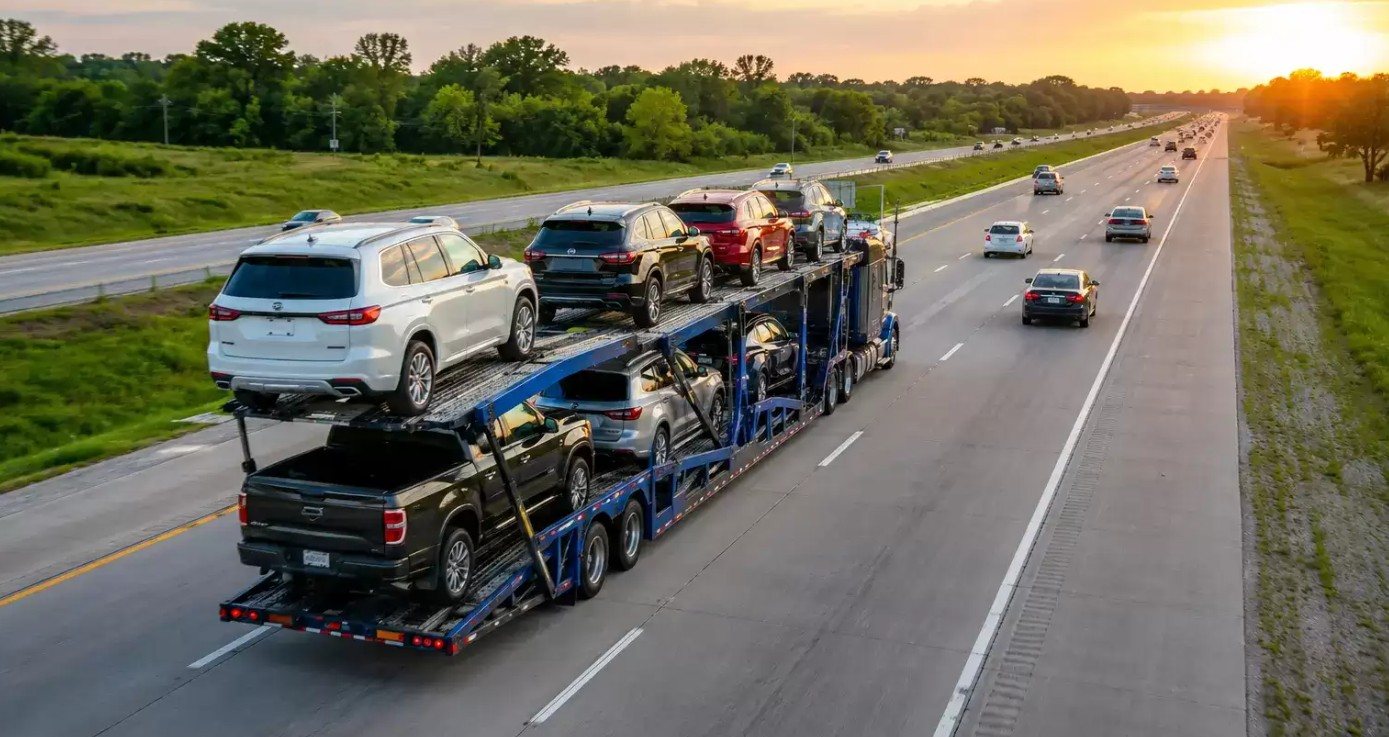
The Midwest’s capital, shipped with street-and-season fluency — alley-wise, tide-timed, February-proof.
Licensed Broker & Fully Insured
FMCSA Registered
Vetted Carrier Network
Real-Time Tracking & 24/7 Support
50+States Served
100%Insured Transport
24/7Support & Tracking
Chicago is where the Midwest keeps its capital — of freight, of neighborhoods, of winters that mean it — and its auto transport market runs at matching scale: six interstates converging, the region’s largest carrier population, and lanes to everywhere that reload daily. What separates good shipping here from merely adequate is street-level fluency: knowing that alleys don’t take trailers, that snow routes rewrite the curb map by ordinance, that tower docks book like conference rooms, and that the city’s great southbound tides move real money for whoever times them. This page is that fluency, written down.
Quick answerChicago runs the Midwest’s deepest shipping market — six interstates, the region’s largest carrier pool — so a sedan moves for $220–$510 around the Midwest ring, $460–$880 to the coasts’ approaches and Florida, and $900–$1,500 to the far Southwest and West, pickup in 1–3 days. The local craft is street-and-season: alleys, snow routes, tower docks, and the great southbound tides — all decoded below. Price your lane in two minutes.
Ship Guy works Chicagoland from the Loop — the city’s seventy-seven neighborhoods, the suburban ring from the North Shore to Northwest Indiana, and the corridors between. Below: the deep-market economics, the street-and-season dispatch craft, the honest winter protocol, the snowbird-and-relocation tides, and the rate table on the lanes the Midwest’s capital actually books.
Typical pickup1–3 days
Nearest listed laneIndianapolis, IN · $220–$360
Longest listed lanePhoenix, AZ · $900–$1,300
Enclosed option+40–60% over open
Local desk(872) 278-6748 · 6a–11p CT
Updated July 25, 2026 · rate figures: July 2026 board.
Chicago Shipping Lanes & Current Rates
The Midwest capital’s working routes — the southbound rows firm up each fall when the great tides run. Sedan baseline, open trailer.
RouteApprox. distanceEst. transitEst. open rate*
Chicago, IL → Indianapolis, IN~185 mi1 day$220–$360Get price
Chicago, IL → Detroit, MI~280 mi1 day$250–$400Get price
Chicago, IL → Minneapolis, MN~400 mi1–2 days$330–$510Get price
Chicago, IL → St. Louis, MO~300 mi1 day$265–$425Get price
Chicago, IL → Nashville, TN~475 mi1–2 days$390–$580Get price
Chicago, IL → New York / New Jersey~790 mi2–3 days$460–$680Get price
Chicago, IL → Atlanta, GA~720 mi2–3 days$480–$700Get price
Chicago, IL → Dallas, TX~925 mi3–4 days$560–$820Get price
Chicago, IL → Tampa, FL~1,175 mi3–4 days$600–$880Get price
Chicago, IL → Phoenix, AZ~1,750 mi4–5 days$900–$1,300Get price
*Rates current to July 2026 for a running sedan; SUVs and trucks add 10–25%, oversized vehicles quote by dimensions, and winch loading runs $100–$200 when needed. October–January southbound lanes (Florida, Arizona, Texas) reward 2–3 weeks’ notice; the reverse directions ride the same season at bargain depth.
Best time to book from here
Summer carries the year’s volume; deep-winter storms add window flexibility. The honest bargain: November, after the fall rush and before the freeze.
The Deep Market: Scale as a Customer Advantage
Freight has organized itself around Chicago since before the automobile, and the inheritance compounds: the expressway spokes collect every regional lane, the industrial corridors host the Midwest’s thickest carrier base, and the metro’s sheer volume keeps every route liquid in both directions. For customers the arithmetic is simple — matches in one to three days on nearly anything, replacement capacity that answers the same afternoon, and pricing disciplined by more competition than any market between the coasts.
Scale also buys specialization. Chicagoland’s equipment pool includes everything the trade makes — enclosed fleets for the collector corridor, liftgate rigs, winch trucks for the project-car set, multi-car units cycling the auction and dealer economy — so unusual requests that strand smaller markets simply route to the right unit here. And the metro’s position as the Midwest’s relay complement to Indianapolis (a one-day lane apart, and our Indianapolis page maps that midpoint’s own gifts) means long-haul equipment cycles through constantly, empty slots hunting loads. Depth, variety, and turnover: the three ingredients of a market that never makes its customers wait, priced by a competition that never lets it overcharge.
Street and Season: The Dispatch Craft of a Complicated City
Chicago’s residential geography is a study in eras, and each era ships its own way. The bungalow belt — the great brick crescent of the Northwest and Southwest Sides — loads at the curb with midcentury ease, its alley-fed garages keeping street parking workable. The dense North Side lattice of two-flats and courtyard buildings shifts handoffs to the boulevards and commercial strips a block over, arranged by text an hour out. Tower country runs on docks and appointments per the callout below. And the suburban ring, from Evanston’s streets to Naperville’s cul-de-sacs, ships driveway-simple, the way most of America does.
Layer the calendar on top and the craft completes: summer is pure logistics, autumn adds the southbound crush, and winter rewrites the street map by ordinance — snow routes, ban hours, plowing rhythms — which dispatch reads the way pilots read weather: before departure, not during. None of this costs extra and none of it should impress you; it’s simply what shipping competence looks like in a city with this much texture, and the difference shows up as windows that hold in February exactly as they held in June.
The Southbound Tides: Chicago’s Great Seasonal Trade
Every October, the Midwest’s capital begins its annual export of sunshine-seekers, and the shipping lanes swell accordingly: the snowbird river to Florida’s coasts, the retiree and relocation flows to Arizona and Texas, and the year-round out-migration that has made Chicago-to-Sunbelt among the busiest lane families in America. The economics run exactly as our destination pages describe from their ends — southbound capacity tightens October through January, reverse directions turn bargain — and the Chicago-side craft is timing: book the southbound leg two to three weeks out in season, or slide flexible dates to the shoulders and pocket the difference.
The tide’s composition is worth knowing because each stream books differently. Snowbirds run the round-trip playbook our snowbird page details, with the return leg booked alongside the departure. Relocations — the households trading lake winters for Tampa or Phoenix permanently — ship as family fleets, sequenced and paired onto shared trucks. And the reverse current matters more than people expect: boomerang returns, job moves into the city’s corporate core, and students arriving from everywhere keep the northbound lanes honest, riding the tide’s cheap direction. In a market this deep, even the countercurrents run at full service. Whichever stream carries you, the corridor depth is the same — and our Tampa, Orlando, and Phoenix pages cover the far ends in matching detail.
The Collector Corridor: Chicagoland’s Enclosed Economy
Scale breeds connoisseurship, and the metro’s collector scene runs deep enough to sustain its own logistics ecosystem: the region hosts some of the country’s marquee collector auctions, the North Shore and western suburbs shelter serious private collections, and the restoration-shop belt keeps a constant shuttle of projects and finished pieces moving between craftsmen and clients. Enclosed equipment cycles through Chicagoland year-round in response — liftgate fleets, single-car specials, the whole premium tier — which means the collector booking that waits weeks in thinner markets matches here in days.
The corridor’s calendar has a rhythm worth knowing: auction seasons cluster the trade’s peaks, spring’s show circuit wakes the garages, and autumn runs the great southern migration of precious machines — collections heading to winter storage or Arizona’s January lawns, riding walls-first past the salt per the comparison section’s local argument. Provenance-grade condition records, drivers briefed to each machine’s quirks, and scheduling that honors preview days: the standards are national, but the volume that keeps them sharp is distinctly Chicagoan. Sellers consigning to the auction calendar get one scheduling grace note: preview-day arrival beats sale-morning arrival by exactly the margin your reserve price hopes for.
Corporate Core, Campus Ring: The Professional Tides
The Loop’s corporate concentration keeps a transferee current running through this market year-round — headquarters rotations, consulting-class arrivals, the finance and legal migrations between here and the coasts — shipping on the professional machinery our headquarters-town pages describe: relocation-provider invoicing, start-date scheduling, tower-dock deliveries booked to building rules. The city’s corporate calendar shapes it gently: fiscal-year starts and post-bonus springs cluster the moves, and the transferee who books at offer-letter rather than lease-signing gets the calm version, here as everywhere.
The campus ring adds its twice-yearly tide at Big Ten scale: the universities within and around the metro move a small city’s worth of student vehicles each August and May, with the standard collegiate clauses — remote parent booking, local student signature, corridor meets over quad ambitions, move-in weekend inviolate — and one Chicago inflection: many “campus” shipments here are actually first-job arrivals, graduates from everywhere landing in the corporate core with a car following the lease. The tide and the transfer current merge in September, which is why that month books like January flies: early.
Both tides share the metro’s great receiving asset: housing variety with matching handoff customs already mapped — the transferee’s River North tower, the graduate’s Lakeview walk-up, the returning family’s Naperville colonial each have their practiced answer from the street-and-season section above. Arrival in a complicated city is mostly a matter of arriving somewhere the complications are already solved; that, in one sentence, is what a Loop dispatch desk is for. (The desk’s other specialty: translating between the arriving customer’s expectations and the city’s realities gently — yes, the truck really can’t use your alley; yes, the corner works beautifully; no, February will not be a problem, and here’s exactly why.) Complicated cities reward institutional memory, and ours has been compounding since the first booking on this side of the lake. The lake, for its part, remains unimpressed — but it hasn’t stopped a delivery yet. Neither, for the record, has anything else this city has thrown at the schedule in living memory — strikes, storms, and Super Bowls of construction season included.
Winter, Professionally Considered
Chicago winter deserves a section without euphemism, because the trade’s relationship with it is professional rather than adversarial. Carriers run all season — commerce here never stopped for weather in a century and a half — with adjustments that amount to respect: windows widen a half-day around major systems, deep-cold snaps move loading into the day’s warmest hours (hydraulics and rubber both prefer it), lake-effect bands get driven around rather than through, and the city’s parking ordinances reroute curb handoffs per the snow-route callout. What winter almost never does here is cancel; what it always does is reward planning.
The customer’s winter kit is short and non-negotiable: a battery that tests strong (the season’s great auditor, and it grades in January), washer fluid rated for genuine cold, a quarter tank against idling waits, and the post-transit wash — underbody included — that keeps a salted trip from becoming a rust deposit. Vehicles arriving from gentle climates get the acclimation brief with their booking; vehicles departing for them get our congratulations and a reminder that the southbound tide section above is where their pricing lives.
Open or Enclosed in the Midwest’s Capital?
The deep market runs both fleets at scale — the split is the usual one, with a lakefront accent.
The city’s answer
Open Transport
Commuters, family fleets, the tides’ seasonal volume: open trailers on the Midwest’s deepest equipment, priced by its stiffest competition. Winter rides along as scheduling wisdom rather than risk — and the salt washes off, which is more than the savings ever do. Fleet-scale open capacity also means multi-car family bookings pair onto shared trucks here more readily than almost anywhere.
Six-interstate depth on every lane family
Tide-aware timing advice standard at booking
Cargo coverage typically $100K–$250K
The collector’s answer
Enclosed Transport
The metro’s deep collector scene — garage finds to concours entries — ships enclosed year-round, with winter adding its own clientele: precious machines heading to southern storage or shows, riding walls-first past the salt the whole way down.
Roughly 40–60% above open rates
Winter’s salt is enclosed’s best local argument
Cargo coverage $250K–$1M, higher arranged
Capital rule: the daily driver rides open and takes the wash; the collection piece rides enclosed and skips the argument. Full comparison: open vs. enclosed.
Seventy-Seven Neighborhoods and the Ring Beyond: Where We Pick Up
The city’s eras and the suburbs’ ease, each with its practiced answer.
The Loop / River NorthLincoln ParkLakeviewWicker Park / BucktownLogan SquareHyde ParkBridgeportPilsenBeverlyNorwood ParkEvanstonOak ParkNapervilleSchaumburgArlington HeightsOrland ParkSkokieDes Plaines
Alley city, curb handoffs
Chicago runs on the largest alley network on Earth — and none of it fits a car hauler, which is why city handoffs live at the front curb, the corner, and the boulevard. The alley’s gift to shipping is indirect: garages face it, which keeps the street side clear, which makes the curb meet work. The system understands itself; so do we.
Snow routes and the winter curb
From the first ban of the season, the city’s curbs run on rules — snow routes clear by ordinance, plows own their schedules, and a handoff planned on the wrong stretch meets a tow truck instead of a trailer. Winter dispatch reads the route map before quoting the block; customers just show up to cleared, legal ground. (Dibs chairs, we should note, hold no legal standing with a 75-foot rig — but we respect the folklore from a distance.)
Tower country, dock country
The Loop, River North, and the lakefront high-rise wall ship by appointment: loading docks and zones booked through building management, movers’ hours honored, and the handoff compressed to minutes of signature and photographs. Give us your building’s rules and the choreography arranges itself — doormen, in our experience, appreciate a broker who called ahead.
And greater Chicagoland, daily
AuroraJolietElginWaukeganCiceroBerwynHammond, INGary, IN
Why Ship with Ship Guy in Chicago
Licensed & bonded
FMCSA broker authority with the $75,000 surety bond, both sitting in SAFER for your lookup — in the city that invented commodity trading, verification is the culture.
Street-and-season fluent
Alley truths, snow-route maps, dock appointments, tide timing — the complicated city’s whole codebook, run from a Loop office that lives by it.
Deep-market leverage
The Midwest’s largest equipment pool, filtered through service records — scale spent on standards, which is the only way scale should be spent.
February-grade promises
Windows that hold in the hard season hold everywhere — and nothing is owed until a carrier is assigned, in any month the lake can throw.
Find Us on La Salle
Our Chicago office sits in the Loop across from City Hall — the expressway spokes minutes away, the whole metro in working range, and the lake keeping us honest about winter. Daily on the local line, Central time.
Ship Guy Auto Transport — Chicago
Address134 N La Salle St, STE 1408 Chicago, IL 60602
What does it cost to ship a car to or from Chicago?
Sedan on open transport: about $220–$360 to Indianapolis or Milwaukee, $250–$400 to Detroit or St. Louis, $480–$700 to Atlanta, $460–$680 to the New York/New Jersey corridor, $560–$820 to Dallas or Denver, $600–$880 to Florida's metros, $900–$1,300 to Phoenix, and $1,050–$1,500 to the West Coast. Enclosed adds 40–60%. The Midwest's capital runs the region's deepest carrier pool, and the pricing reflects it.
How fast is pickup across Chicagoland?
Usually 1–3 days, metro-wide. Six interstates converge here and the region hosts the Midwest's largest carrier population, so equipment is never the question. The craft is street-level: which block, which season, and — from November to April — which side of a snow-route sign. Dispatch here reads all three before quoting a window.
How do pickups work on a typical Chicago street — and what about the alleys?
The city's famous alleys are for garbage trucks and garages, not 75-foot haulers — so city handoffs happen at the front curb, the corner, or a nearby wide street, arranged by text an hour out. Bungalow-belt blocks usually take the truck at the curb directly; dense North Side streets shift to the boulevard or a lot; and tower residents downtown or on the lakefront use loading docks and zones by appointment, exactly as their building managers prefer.
What's the winter protocol, honestly?
Chicago winter is a professional opponent and the trade respects it. Carriers run all season; windows widen a half-day around majors; lake-effect bands and deep-cold snaps shift loading to the day's warmest hours; and — the city-specific clause — snow-route parking bans and plowing schedules move curb handoffs to legal, cleared ground, planned in advance rather than negotiated with a tow truck. Your prep: a strong battery, washer fluid rated for real cold, and a wash after any salted transit.
Is there a best season to ship out of Chicago?
The great outbound tides tell the story: Florida- and Arizona-bound shipments surge October through January as the snowbird and relocation flows run south and west, firming those directional windows. Booking those lanes two to three weeks ahead in season is wise; riding the reverse direction — into Chicago in fall, out in spring — is one of the Midwest's quiet bargains.
Do you cover the whole metro — suburbs and all?
All of Chicagoland, daily: the North Shore, the O'Hare corridor, DuPage's office-park belt, Naperville and the western towns, the southwest and south suburbs, and over the line into Northwest Indiana. Suburban logistics run driveway-simple; the city's choreography stays inside the city.
Can you time a delivery to a flight at O'Hare or Midway?
The fly-and-drive works at both: land, meet your delivered car minutes from the terminal, skip the rental counter and the Kiss 'n' Fly. O'Hare's flight-crew population runs the pattern on repeat, and Midway's Southwest schedules pair with it neatly. Flight number in, window out.
Where is Ship Guy located in Chicago?
134 N La Salle St, STE 1408, Chicago, IL 60602 — in the Loop, across from City Hall. Local line (872) 278-6748, staffed daily 6:00 AM to 11:00 PM Central.
Get a free, no-obligation quote in about 60 seconds — or call and talk to a real specialist right now.
Licensed & insured
No upfront deposit
24/7 support
Ship Guy is a licensed, bonded auto transport broker (MC #1457715 • USDOT #3932149) with a local office at 134 N La Salle St STE 1408, Chicago, IL 60602 • (872) 278-6748 • open 7 days, 6 AM–11 PM, serving Chicago’s seventy-seven neighborhoods and all of Chicagoland. Verify our operating authority anytime in the FMCSA SAFER database. Rate estimates on this page reflect current lane conditions and are refreshed quarterly. Learn how insurance & claims work and who we are.
Written & reviewed by [Full Name], [Title], [X] years in vehicle logistics • Last updated: