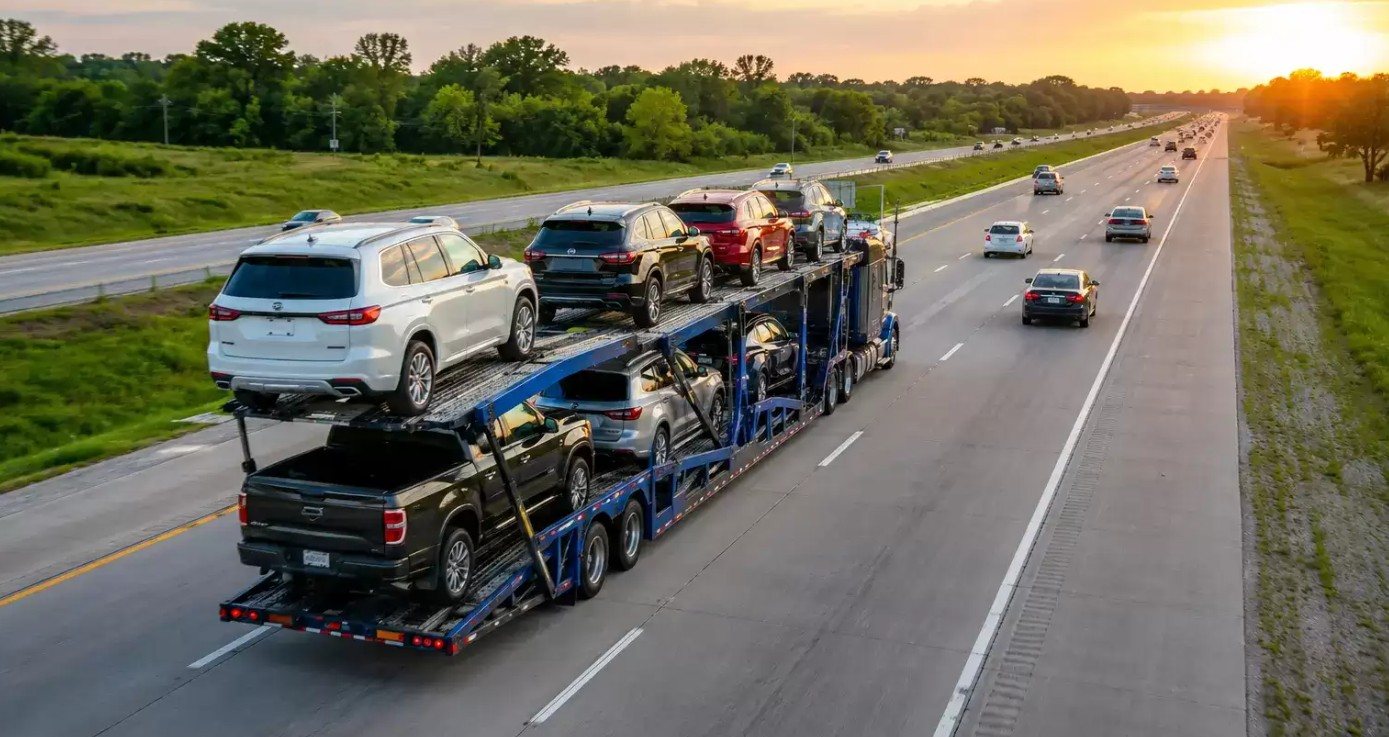
The pass the interstate runs through — corridor-blessed, Bliss-fluent, and honest on its own clock.
Licensed Broker & Fully Insured
FMCSA Registered
Vetted Carrier Network
Real-Time Tracking & 24/7 Support
50+States Served
100%Insured Transport
24/7Support & Tracking
El Paso ships from the pass the interstate was built through: I-10’s transcontinental river runs both horizons daily, turning West Texas distance into through-route depth no spur market could dream of; Fort Bliss anchors an Army-scale military trade whose cadence never pauses; the Borderplex — one region, two nations, two states — keeps Las Cruces on the same pool and the border economy’s freight beneath everything; and the whole arrangement runs on Mountain time, the far-west clock this city has kept without apology for a century. The Sun City’s book is candid, corridor-blessed, and entirely its own.
Quick answerEl Paso ships from the I-10 transcontinental with both horizons at through-route depth: $195–$420 up the Rio Grande and across the desert Southwest, $360–$910 to Phoenix, the Texas Triangle, and the California coast, and $980–$1,430 east of the plains — pickup in 1–3 days, better than the map suggests and honestly explained below. Bliss’s cadence, the Borderplex’s reach, Mountain-time clarity: the Sun City’s book. Price your lane in two minutes.
Ship Guy works the Borderplex from Kansas Street downtown — the post’s corridors, the west side’s mesas and the east side’s growth, the mission valley’s old road, Las Cruces up the interstate, and the desert reach both directions on I-10. Below: the through-route economics that make the map misleading, the Bliss cadence at full protocol, the Borderplex’s honest boundaries, the Chihuahuan almanac, and the Sun City year on its own clock.
Typical pickup1–3 days
Nearest listed laneLas Cruces, NM · $195–$315
Longest listed laneLos Angeles, CA · $620–$910
Enclosed option+40–60% over open
Local desk(915) 465-4628 · 6a–11p MT
Updated July 25, 2026 · rate figures: July 2026 board.
El Paso Shipping Lanes & Current Rates
The pass’s working routes — note both horizons price like the through-route they share. Sedan baseline, open trailer.
RouteApprox. distanceEst. transitEst. open rate*
El Paso, TX → Las Cruces, NM~45 mi1 day$195–$315Get price
El Paso, TX → Albuquerque, NM~265 mi1 day$245–$395Get price
El Paso, TX → Tucson, AZ~315 mi1 day$260–$420Get price
El Paso, TX → Phoenix, AZ~430 mi1–2 days$360–$560Get price
El Paso, TX → San Antonio, TX~550 mi2 days$400–$610Get price
El Paso, TX → Dallas / Fort Worth, TX~635 mi2 days$425–$645Get price
El Paso, TX → Houston, TX~745 mi2–3 days$470–$700Get price
El Paso, TX → San Diego, CA~725 mi2–3 days$560–$830Get price
El Paso, TX → Los Angeles, CA~800 mi2–3 days$620–$910Get price
El Paso, TX → Denver, CO~640 mi2 days$560–$830Get price
*Borderplex board, July 2026, sedan basis, Mountain-time windows; SUVs and pickups carry 10–25% premiums, oversized units quote by dimensions, winch loading adds $100–$200. PCS season runs heavy June–August — book to the report date; spring wind advisories occasionally ask high-profile loads an hour’s patience.
Best time to book from here
Report dates thicken June–August at Army scale; spring wind season asks occasional patience. Winter runs the pass’s softest, sunniest board.
The Pass’s Economics: Why the Map Misleads
Six hundred miles of West Texas separate this city from the Triangle, and the naive read says thin market; the interstate says otherwise. I-10 runs the southern transcontinental through the pass — the Franklins parting exactly here is why the city exists — and coast-to-coast equipment cycles both directions daily: the California legs price at through-route depth (San Diego and Los Angeles closer than Houston, and the rate table says so plainly), the Texas legs ride the same corridor east, and the north-south connections — the Rio Grande corridor to Albuquerque, the Denver reach via the passes — keep the compass honest. No positioning waits, no spur premium: the pass collects the continent’s traffic and the market drinks from the river.
The local currents fill the book: the border economy’s manufacturing professionals rotating on maquiladora calendars, the university’s tide and its mining-heritage engineering pipeline, the healthcare systems serving a bi-national region, and the steady arrival current of families discovering what the Sun City’s arithmetic buys. The counter-flows price kindly for flexible dates in every season — corridor towns always keep both directions honest — and the whole arrangement runs warmer than any market this far from its state’s center has a right to. The mountains made the pass; the pass made the market; the market, candidly served, makes this page.
The Bliss Book: PCS Season, Deployment Cycles, and the Full Protocol
The post’s scale sets the market’s baseline: one of the Army’s largest installations rotates soldiers and families year-round with the summer PCS wave as the annual crescendo, and the program’s full protocol runs as the daily standard — report dates anchoring every schedule, documentation shipped claim-ready for the government’s reimbursement machinery, re-timing penalty-free when orders amend, and handoffs at the commercial corridors outside the gates by custom older than the interstate. The deployment cycle adds the layer few markets practice at this volume: storage coordination for the deployed soldier’s vehicle, deliveries timed to homecoming dates with the care those mornings deserve, and the family-logistics support — a spouse managing a move solo, a POV shipped to meet a returning unit — handled with the patience this community has more than earned.
The veteran arc completes the book: separations landing families who choose the Sun City permanently, the retiree community’s steady trade, and the multigenerational military families for whom the post is simply the family business. Serving an Army town at Army scale means the protocol is muscle memory, the flexibility is structural, and the respect is the baseline — three standards this office holds daily, because the community across the corridor holds harder ones. Standards borrowed from soldiers tend to hold; ours have. Inspection-ready daily, no notice required.
The Borderplex: One Region, Honest Boundaries
The region runs as one metro across two nations and two states, and the trade serves the U.S. side of that reality with regional fluency: Las Cruces books on the shared pool forty-five minutes up the corridor, the Mesilla Valley’s communities meeting at practiced junctions; the White Sands corridor’s federal traffic runs program protocols for the missile range’s civilian and military rotations; the cross-border economy’s professional class — managers and engineers working the maquiladora corridors, commuting a bridge instead of a beltway — ships on manufacturing calendars with the vehicle-essential logic of a region where the car crosses daily even when the household doesn’t; and the honest boundary holds: vehicles crossing into Mexico route through customs brokers and import specialists we’re glad to point toward, while everything on this side of the bridge — which is everything this page prices — is home territory served daily.
The bi-national texture shapes the craft in small fluencies: bilingual coordination as a standing courtesy, purchase deliveries documented for buyers navigating either side’s paperwork traditions, and a dispatch desk that understands the region’s families live across the map the way other cities’ families live across town. One river, one region, two flags: the Borderplex’s arrangement predates every border debate, and the freight has always simply worked. Commerce is the border’s oldest common language; we speak it with a local accent. Bilingual by courtesy, punctual by creed, and neighborly by the region’s own long example. Two nations have shared this valley’s work for centuries without the freight ever caring which bank it loaded on; the trade’s oldest lesson is that commerce, done courteously, is just neighborliness with paperwork.
The Chihuahuan Almanac: Sun City Weather, Honestly Kept
The high Chihuahuan desert runs the gentlest almanac on the Texas map: three-hundred-plus days of sun setting the baseline; summer heat counseling morning loading without the low-desert furnace’s extremes, the monsoon’s afternoon theater arriving on schedule and leaving politely; spring carrying the almanac’s one working caution — the wind season, when advisories occasionally ask high-profile equipment an hour’s patience and the dust rides the mesa; fall running the year’s finest corridors under light photographers cross states for; and winter mild enough that the rare snow dusting the Franklins makes the front page and melts before the second edition. Different desert than Phoenix’s low-country extremes, milder-wintered than Albuquerque’s mile-high seasons: the Sun City’s nickname is meteorology, not marketing.
The customer kit runs light: battery health for the summer, the post-dust rinse after wind season, washer fluid that handles the occasional freeze — and the almanac’s real gift is scheduling freedom, because a market with this few weather vetoes lets windows keep themselves. We’ll take the boring forecast every time; boring forecasts build perfect records. Ours reads like the weather report: clear, repetitive, and exactly what everyone hoped. Three hundred sunny days deserve three hundred kept windows; the ledger matches. Sun City arithmetic at its plainest: weather that cooperates, corridors that deliver, and a dispatch desk with no excuses in inventory because the climate never stocks any. Excuses require weather, and the inventory here runs permanently sunny. What the desert withholds in drama it pays out in dependability, and we bank the difference into every window.
The Sun City Year
The calendar, straight through: winter ships mild and bright, the counter-flow lanes riding the year’s softest rates and the post’s steady rotations beneath; spring runs the wind season’s occasional patience alongside the year’s first PCS movements; summer peaks the military wave — report dates thick from June through August, the program at full volume, morning loading through the warmest weeks — while the monsoon’s theater rinses the afternoons; and fall settles into the light the region is famous for, the university’s tide landed, the corridors running the year’s smoothest windows.
The constants: through-route depth both horizons, the Bliss cadence never pausing, the Borderplex’s regional reach, and a dispatch desk keeping Mountain time in a Central-time state with the far-west self-assurance this city bottled long ago. El Paso never needed the rest of Texas to validate its address; the interstate delivers the validation daily, both directions, and we just work the dock. Gladly, in the sunshine, three hundred days a year.
Open or Enclosed at the Pass?
The corridor ships open at through-route depth; the enclosed tier serves the garages the sun preserves.
The corridor answer
Open Transport
PCS moves, Borderplex rotations, both-horizon hauls: open trailers on the transcontinental’s constant cycle, through the gentlest almanac in Texas — sun as the default, wind as the footnote.
Through-route depth to both coasts
Military protocol as the daily standard
Cargo coverage typically $100K–$250K
The Franklin-view answer
Enclosed Transport
The desert-kept classics a dry climate preserves beautifully, the lowrider heritage’s show-grade craft, and the collections of a city with its own aesthetic traditions: enclosed protection, liftgate care for the low-slung, and paperwork worthy of the show field.
Roughly 40–60% above open rates
Show and heritage moves booked to event calendars
Cargo coverage $250K–$1M, higher arranged
Sun City rule: the commuter rides open through the pass; the showpiece rides enclosed to its next admirer. Full comparison: open vs. enclosed.
The Mesas to the Valley: Where We Pick Up
The pass’s quadrants and the region beyond — each with its practiced answer.
Downtown / Union PlazaKern Place / UTEPWest Side / CoronadoUpper ValleyNortheast / Franklin foothillsFort Bliss corridorEast SideMission Valley / YsletaSocorroHorizon CityCanutilloAnthonySunland Park, NMSanta Teresa, NMLas Cruces, NM
Through-route, both horizons
The map shows West Texas distance; the interstate shows the answer: I-10’s transcontinental river runs through the pass daily in both directions, so the California coast and the Texas Triangle both price at genuine through-route depth — no spur premium, no positioning waits, just the corridor’s constant cycle. Six hundred miles from the Triangle turns out to matter less than six lanes of coast-to-coast traffic; geography’s consolation prizes don’t come better. The mountains took the shortcut’s scenery; the interstate kept the schedule. Fair trade; schedules pay better. The pass has collected tolls in reliability for a hundred and forty years of rail and road; we’re simply the current concessionaires, and the terms — keep the promise, both horizons, every day — haven’t changed since steam. The Southern Pacific would recognize the job description immediately; only the horsepower moved. Same pass, same promise, four generations of equipment — continuity is the far west’s quiet specialty. Ours too: same standards at the same desk, kept in the same sunshine, on the same honest Mountain-time clock. Set once, kept always.
Bliss cadence, Army scale
One of the Army’s largest posts runs this market’s steadiest current: PCS season heavy every summer, rotations constant beneath it, and the deployment cycle’s own logistics — storage for the deployed, homecoming-timed deliveries, family moves handled with earned care — layered throughout. The program’s protocol is the daily standard here, not the special request, and the post-adjacent corridors have hosted the handoffs for generations.
Mountain time, plainly kept
The only major Texas city on Mountain time keeps its own clock without apology, and so does this office: windows quote local, hours run 6 to 11 Mountain, and coordination with Central-time Texas notes the hour’s difference the way the city has since the railroads standardized the zones. Far-west Texas was always its own country; the timekeeping is just the paperwork.
FMCSA brokerage authority behind the $75,000 surety bond, standing in SAFER for anyone’s inspection — border-town diligence: verify at the crossing, then proceed with confidence.
Pass-and-post fluent
Through-route rhythms, Bliss protocols, Borderplex boundaries, Mountain-time clarity — the far west’s whole grammar, kept from Kansas Street.
Transcontinental depth
The I-10 river’s daily cycle behind every booking — both coasts at through-route rates, and the map’s distances answered by the corridor’s traffic.
Homecoming dependable
Report dates honored, deployments accommodated, deliveries timed to the mornings that matter most — and nothing owed until a carrier is assigned. The Sun City’s standard, kept in its own time zone.
Find Us on Kansas Street
Our El Paso office sits downtown blocks from the border — I-10 threading the pass above, the Franklins standing north, and the Borderplex from Las Cruces to the valley in working range. Daily on the local line, Mountain time.
What does it cost to ship a car to or from El Paso?
Sedan reference points on open transport: $230–$370 to Las Cruces or the border region, $305–$480 to Albuquerque or Tucson, $360–$560 to Phoenix, $400–$610 to San Antonio, $425–$645 to Dallas–Fort Worth or Austin, $470–$700 to Houston, $560–$830 to Denver or San Diego, $620–$910 to Los Angeles, and $980–$1,430 to the East Coast. Enclosed adds 40–60%. I-10's transcontinental traffic keeps both horizons at genuine through-route depth.
How fast is pickup in El Paso?
Usually 1–3 days — better than the map suggests, and here's the honest why: this city sits ON the I-10 transcontinental, not off a spur, so coast-to-coast equipment passes daily in both directions and the lane never depends on Texas-triangle cycles alone. Add Fort Bliss's constant PCS volume and the border economy's freight, and West Texas isolation turns out to be a corridor blessing wearing a disguise.
How does Fort Bliss shape the market?
At the scale of one of the Army's largest posts: PCS season runs heavy every summer with year-round rotations beneath it, the program's full protocol is the daily standard — report dates anchoring, documentation claim-ready, re-timing penalty-free on amended orders — and the deployment cycle adds its own layer: storage coordination for the deployed, single-vehicle moves timed to homecomings, and family logistics handled with the care the community has earned. Post-adjacent handoffs run the commercial corridors by long custom.
What's the Borderplex — and does it matter for shipping?
The region thinks of itself as one metro across two nations and two states — El Paso, Juárez, Las Cruces — and the shipping trade serves the U.S. side of that reality daily: Las Cruces books on the same pool forty-five minutes up the corridor, the cross-border commuter culture keeps vehicle ownership essential, and the maquiladora economy's professional class rotates on manufacturing calendars. What we don't do: ship vehicles into Mexico ourselves — international crossings run through customs brokers we're glad to point toward — but everything on this side of the bridge is home territory.
Is El Paso really on Mountain time?
Really — the only major Texas city that is, and the detail matters for scheduling: our office runs 6:00 AM to 11:00 PM Mountain, windows quote in local time, and coordination with Central-time Texas simply notes the hour's difference the way this city has for a century. Far-west Texas keeps its own clock; so do we.
What's the desert almanac here?
The Chihuahuan high desert's gentle book: three-hundred-plus days of sun, summer heat that counsels morning loading without the low-desert furnace's extremes, a monsoon whose afternoon theater passes politely, spring wind season asking the occasional high-profile patience, and winters mild enough that the rare snow dusting the Franklins makes the front page. Different desert than Phoenix's, milder than Albuquerque's winters — the sun city earns the nickname honestly.
Can you reach Las Cruces and southern New Mexico?
As the Borderplex's own geography: Las Cruces rides the corridor on the shared pool, the Mesilla Valley's communities meet at the practiced junctions, and the White Sands corridor's federal traffic runs the program protocols our military and labs pages describe. One El Paso booking covers the region both directions on the interstate.
Where is Ship Guy located in El Paso?
221 N Kansas St #1200, El Paso, TX 79901 — downtown, blocks from the border. Local line (915) 465-4628, staffed daily 6:00 AM to 11:00 PM Mountain.
Get a free, no-obligation quote in about 60 seconds — or call and talk to a real specialist right now.
Licensed & insured
No upfront deposit
24/7 support
Ship Guy is a licensed, bonded auto transport broker (MC #1457715 • USDOT #3932149) with a local office at 221 N Kansas St # 1200, El Paso, TX 79901 • (915) 465-4628 • open 7 days, 6 AM–11 PM, serving El Paso, Fort Bliss, and the Borderplex on Mountain time. Verify our operating authority anytime in the FMCSA SAFER database. Rate estimates on this page reflect current lane conditions and are refreshed quarterly. Learn how insurance & claims work and who we are.
Written & reviewed by [Full Name], [Title], [X] years in vehicle logistics • Last updated: