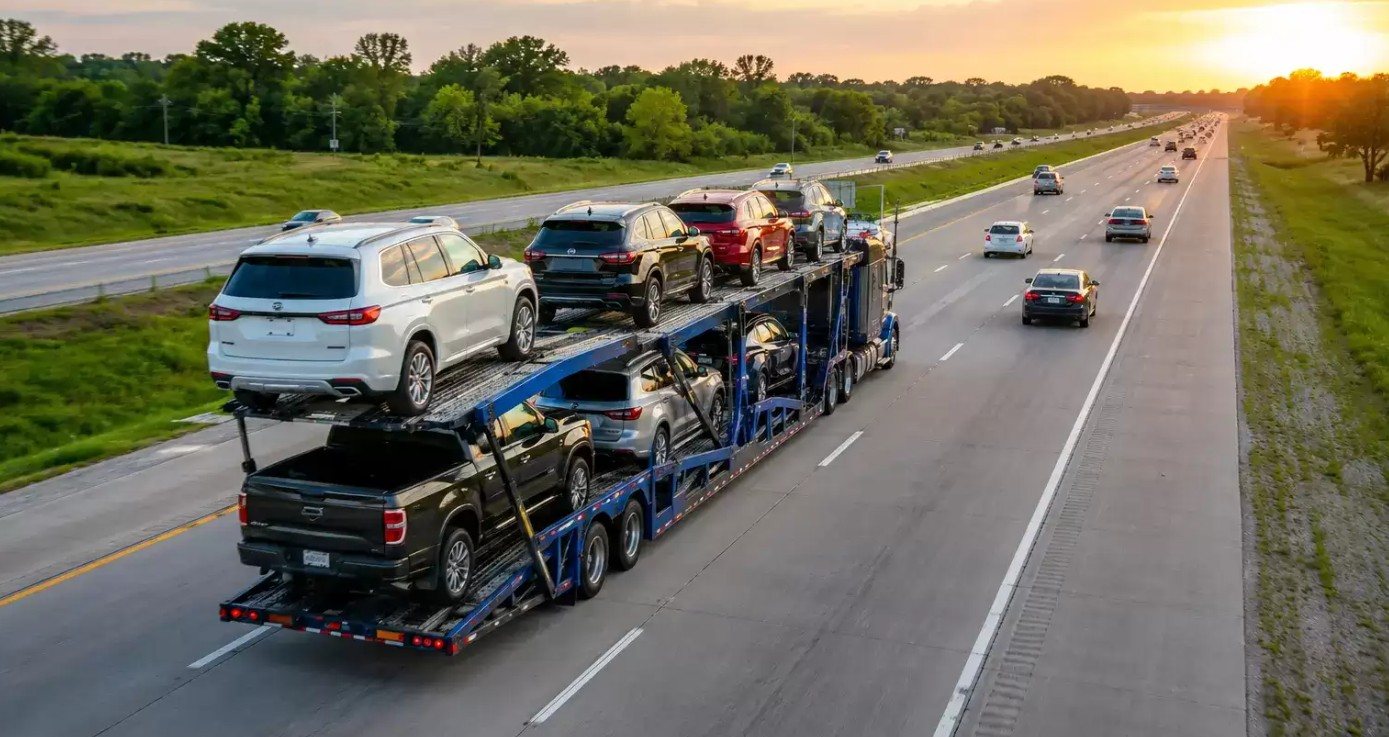
The hardest city in America to move a car through — and the system that makes it easy. Vetted carriers, no deposit to book.
Licensed Broker & Fully Insured
FMCSA Registered
Vetted Carrier Network
Real-Time Tracking & 24/7 Support
50+States Served
100%Insured Transport
24/7Support & Tracking
Every city page on this site explains how its market prices. San Francisco needs a different opening: this is the hardest city in America to physically move a car in and out of — a seven-by-seven-mile square of 20-plus-percent grades, electrified wires ceiling whole districts, permit zones, one-ways, and parking enforcement of legendary efficiency. And yet thousands of vehicles enter and leave every month, smoothly, because the industry long ago worked out the system this page teaches: the staging corridor, the timed meet, the text thread with the driver. Learn it in five minutes; use it for life.
Quick answerSan Francisco shipping costs what the mileage says — $375–$675 within California, $600–$1,000 up the coast, $1,150–$1,750 heading east on an open trailer — but runs on a system the mileage doesn’t show: staging-corridor handoffs, because a 75-foot carrier and a 24% grade with trolley wires overhead were never going to meet at your front door. Pickup in 1–4 days, meeting spot by text, and the whole method explained below. Price your lane in two minutes.
Ship Guy runs San Francisco — and Marin, the Peninsula, and the near East Bay — from an office at 1000 Van Ness, on the exact corridor where half the city’s handoffs happen. Below: real lane rates (spoiler: the city’s difficulty costs you minutes, not money), the complete access playbook by neighborhood type, why SF shipping is really transition shipping, the Port of Oakland truth about international moves, and the honest ship-versus-sell talk this city’s barely-driven cars deserve.
Typical pickup1–3 days
Nearest listed laneLos Angeles, CA · $375–$575
Longest listed laneNew York, NY · $1,275–$1,750
Enclosed option+40–60% over open
Local desk(415) 992-7297 · 6a–11p PT
Updated July 25, 2026 · rate figures: July 2026 board.
San Francisco Shipping Lanes & Current Rates
The lanes the city moves on. Sedan baseline, running condition, open trailer — city addresses and suburban ones price the same.
RouteApprox. distanceEst. transitEst. open rate*
San Francisco, CA → Los Angeles, CA~380 mi1–2 days$375–$575Get price
San Francisco, CA → San Diego, CA~500 mi1–2 days$450–$675Get price
San Francisco, CA → Las Vegas, NV~570 mi2–3 days$550–$800Get price
San Francisco, CA → Portland, OR~635 mi2–3 days$600–$850Get price
San Francisco, CA → Seattle, WA~810 mi2–4 days$700–$1,000Get price
San Francisco, CA → Denver, CO~1,250 mi3–5 days$900–$1,275Get price
San Francisco, CA → Austin, TX~1,750 mi4–6 days$1,150–$1,550Get price
San Francisco, CA → Chicago, IL~2,130 mi4–7 days$1,175–$1,575Get price
San Francisco, CA → New York, NY~2,900 mi6–8 days$1,275–$1,750Get price
*Reflecting July 2026 conditions for a standard sedan; add 10–25% for SUVs and trucks, more for oversized, $100–$200 for non-runners. What SF never adds: an access surcharge — the staging-corridor system is standard method here, not an upsell.
Best time to book from here
Corporate and academic calendars drive late-summer peaks; winter runs the year’s calmest board. Flexible dates catch the softest coast-lane pricing January–February.
The Staging-Corridor System: How Cars Actually Enter and Leave SF
Start with the physics. A loaded auto carrier is seventy-five feet long and thirteen and a half tall; San Francisco offers it streets that crest like waves, intersections where four hills meet, blocks where the legal parking wouldn’t fit a panel van, and — the constraint out-of-towners never see coming — district after district roofed in transit wires with clearances measured in inches. No amount of driver skill changes the arithmetic. The truck does not come to your door. The city comes a few blocks to the truck.
So the working system, refined by every carrier who survives here: staging corridors — the handful of wide, wire-free, truck-tolerant arteries and edges where a rig can hold position and load safely. Van Ness. The Marina’s flat northern edge. SoMa’s broad blocks. The Bayview’s industrial streets. The park panhandle’s margins. And for anyone who prefers zero city friction at all, the over-the-line option: a lot in Daly City or South San Francisco, five minutes and one county away, where the whole exercise feels like shipping from a normal place.
The choreography is simpler than it sounds. We match your neighborhood to its natural corridor at booking; the driver texts an hour out with the precise spot; you walk or ride the last blocks; inspection, signature, keys, done — ten minutes, most of them spent on the walk-around photos. Delivery reverses it. Nobody circles for parking, nobody threads a hill, and — worth repeating — nobody pays extra: the corridor method is how this market works, not a premium service. A quote that promises literal to-your-door service on a Nob Hill block isn’t offering better logistics; it’s revealing that nobody there has seen the block.
Transition Shipping: Why the Car-Free City Ships So Many Cars
San Francisco has America’s most famous car-optional lifestyle, and paradoxically that’s exactly why it ships so many of them — because here, vehicles move at life’s hinges rather than on a season’s schedule. The car arrives when a job pulls you in from a driving city and you’re not ready to let it go. It leaves when the lease ends, the return-to-office reverses, the family grows past a Muni-shaped life, or you finally audit how often the thing leaves its $400-a-month spot. It arrives as a parental hand-me-down and departs as a graduation gift running the other way.
Transition shipping has its own etiquette, and we’ve built the practice around it. Timing bends around leases, closings, and start dates rather than carrier convenience. The ship-or-sell conversation is offered honestly on the outbound side: for a rarely driven car of modest value, selling in the Bay’s strong used market and buying at the destination sometimes beats paying to move it — and we’ll run that math with you even though one answer pays us and the other doesn’t. And for the inbound crowd, the welcome-to-SF brief comes free: yes the garage costs that much, yes street parking is a lifestyle, and yes, the sweeping schedule is real and it is watching.
Transitions also explain SF’s distinctive shipping pairs: the two-city households splitting time with Tahoe, LA, or New York, rotating one car seasonally along a lane they come to know by heart; the corporate circulation between here and Seattle that runs both directions every quarter; and the empty-nest downsizers whose move out of a Noe Valley Victorian finally frees the garage — and the car that lived in it — for lives elsewhere. Repeat lanes get repeat treatment: same corridor, same routine, a booking that takes four minutes because the hard thinking happened the first time.
A closing word on timing: the city’s event calendar — marathon Sundays, fleet-week weekends, the parades that own Market Street — closes corridors the way weather closes them elsewhere, on schedules published months ahead. We keep that calendar so you don’t have to; if your dates collide with one, the fix is a different corridor or a different morning, never a different price. The city makes the rules; we just memorized them, which turns out to be most of the job here. Everything else is ordinary logistics wearing an extraordinary postcard.
International Moves: The Port With Your Name On It Is Across the Bay
A recurring surprise for SF customers shipping overseas: the vehicle’s ocean journey doesn’t start at San Francisco’s postcard waterfront. Bay Area vehicle freight sails from the Port of Oakland, the container-and-RO/RO workhorse across the water — and that’s where our domestic precision meets your forwarder’s ocean booking.
The division of labor matches every port market we serve: your licensed freight forwarder owns the crossing — vessel space, customs, export title work; we own the land — pickup anywhere in the fifty states, delivery to the forwarder’s facility or the Oakland terminal exactly inside their receiving window, paperwork matching to the letter. Inbound, once customs releases your import at Oakland, we collect and deliver anywhere — and the enthusiast imports that clear there tend to roll straight onto enclosed trailers for the last leg home. Forwarder-less and starting from zero? We’ll map the process before you commit a dollar to any of it.
A Field Guide to Your First SF Handoff
For the uninitiated, here’s the whole experience, minute by minute. At booking, we match your address to its corridor and flag anything on the calendar — a street fair swallowing the Marina, a game day gridlocking Mission Bay, the sweeping schedule’s non-negotiable hour. The day before, you get the carrier’s name and truck details; run the SAFER lookup if you like, we’ll wait. An hour out, the driver texts the precise spot — “Van Ness at Broadway, west side, white Peterbilt” — and you walk, roll, or rideshare the last blocks with the key, a copy of your ID, and five spare minutes.
At the truck, the walk-around happens in daylight and on camera: the driver’s inspection report, your own phone’s photo lap around the car, dents and quirks noted in writing before anything rolls up a ramp. Hand over one key — never your only key — mention the parking brake’s personality and the alarm’s temper, sign, done. In transit, you’ll have the driver’s number and ours; SF departures typically clear the Bay the same day. At delivery, the ritual reverses at the far end: walk the car against your pickup photos before signing, in light good enough to trust. Ten minutes of ceremony on each coast, and the hardest shipping city in America turns out to be… a short walk to a wide street.
Weather, Fog, and the One Honest Coastal Warning
As a transit risk, San Francisco weather barely registers: the marine layer is a damp breath that dries by the Caldecott, winter rain is ordinary rain, and the city’s famous microclimates matter enormously to your afternoon and not at all to a car strapped on a trailer. Open transport here is as low-drama as the method gets, which the rate table quietly reflects.
The honest warning applies to the car’s life after the trailer, and only near the water: a vehicle that will live outdoors in the fog belt — the outer Richmond and Sunset, ocean-facing blocks — is signing up for years of salt-air exposure, which is a genuine corrosion story no transport method influences and a garage entirely solves. Our advice pattern for coastal moves is consistent: ship open, save the enclosed premium, and spend it on covered parking — the only party in this equation that can actually protect the car from the ocean is a roof.
Open or Enclosed for a San Francisco Move?
The climate makes open easy; the city’s garages make enclosed occasionally mandatory.
The right answer, usually
Open Transport
The commuter that survived SF parking deserves an uneventful exit, and open transport provides one: benign coastal weather, deep Bay-corridor carrier supply, and rates the table above shows plainly. The staging-corridor handoff works identically for open loads — it’s the city that dictates the meet, not the trailer type.
Best supply on every lane out of the Bay
Fog and drizzle are cosmetic, not risks
Cargo coverage typically $100K–$250K
For the garage kept
Enclosed Transport
Pacific Heights collections, the classics that summer at Monterey, low-clearance exotics that scrape on the city’s own driveways: enclosed service brings liftgates, soft straps, and walls — plus discreet handling for owners who’d rather the neighborhood not catalog the garage. August’s Car Week borrows the coast’s best trailers; book ahead.
Roughly 40–60% above open rates
Liftgate loading solves steep-driveway clearances
Cargo coverage $250K–$1M, higher arranged
City rule: the daily driver ships open from the corridor; the collection piece ships enclosed from wherever its liftgate needs to be — and in August, everything enclosed books two weeks early or waits for Car Week to end. Full detail: open vs. enclosed.
The 7x7 and Beyond: Where We Pick Up and Deliver
Every neighborhood pairs with its natural staging corridor — and the wider Bay works on easy mode.
Pacific HeightsMarina / Cow HollowRussian HillNob HillNorth BeachSoMaMissionCastro / Noe ValleyHaightRichmondSunsetWest PortalBernal HeightsPotrero HillBayviewPresidioTreasure IslandTwin Peaks
The wire ceiling
San Francisco’s least-discussed access constraint hangs overhead: the electrified web of Muni and trolley wires strung across whole districts at heights that give a 13’6” loaded carrier no margin for error. Entire avenues of the Richmond and Sunset are effectively wire-roofed — one more reason the staging corridors, chosen for clearance as much as width, do the real work.
North and south of the bridges
Marin deliveries cross the Golden Gate to Sausalito’s flats and the 101 corridor towns — easy terrain once across, with the hillside lanes above following the meet-below rule. Southward, Daly City and South San Francisco serve as the city’s relief valve: five minutes over the county line, the streets widen, and more than a few SF residents choose a lot there for the calmest possible handoff.
Street-sweeping o’clock
Every SF resident’s calendar has the sacred hours marked, and so does every driver who works here: handoffs get timed around sweeping schedules, because the one predictable parking opening on a packed block is the hour after the sweeper passes — and the one guaranteed ticket is ignoring it.
Across the bridges and down the Peninsula, daily
Daly CitySouth San FranciscoSausalitoMill ValleySan RafaelOaklandBerkeleySan Mateo
Why Ship with Ship Guy in San Francisco
Licensed & bonded
FMCSA broker authority, $75,000 surety bond, verifiable in SAFER before you book — skepticism is a Bay Area virtue and we cater to it.
An office on the corridor
We work from 1000 Van Ness — the street half this city’s handoffs use — and the neighborhood-to-corridor matching that defines SF shipping is muscle memory here.
City-proof scheduling
Sweeping calendars, event closures, wire-clearance routing, bridge timing — the frictions that derail amateur hour here are simply variables in our dispatch notes.
Ship-or-sell honesty
For the car you drive twice a year, we’ll run the leave-it-behind math before quoting the move — and no deposit changes hands until a carrier is actually assigned either way.
Find Us on Van Ness
Our office sits at 1000 Van Ness — on the very corridor where half the city’s vehicle handoffs happen, which is either irony or destiny. Daily on the local line.
What does car shipping cost to or from San Francisco?
Sedan on open transport: roughly $375–$575 to Los Angeles, $450–$675 to San Diego, $600–$850 to Portland, $700–$1,000 to Seattle, $900–$1,275 to Denver, $1,150–$1,550 to Austin or Chicago, and $1,275–$1,750 to the East Coast. Enclosed adds 40–60%. City pickups price identically to suburban ones — the access game changes the meeting spot, not the rate.
Can a car carrier actually drive into San Francisco?
Into the city, yes; onto your street, almost certainly not. Between the grades, the overhead Muni and trolley wires, the one-ways, and the permit zones, most of the 7x7 is physically off-limits to a 75-foot rig. Shipping here runs on staging corridors — wide streets like Van Ness or the Marina's edge, SoMa's truck-friendly blocks, or lots just south in Daly City — coordinated by text. It's how every car enters and leaves this city, and it works.
Which SF neighborhoods are hardest, and what's the workaround?
The hills crown the list — Russian Hill, Nob Hill, Twin Peaks, anything with a grade warning sign — followed by the permit-dense flats of the Mission, the Haight, and the Richmond and Sunset avenues with their overhead wires. The workaround is the same everywhere: a handoff point on the nearest wide corridor, a short walk or ride from home, agreed an hour ahead. Budget ten extra minutes, not extra dollars.
I live car-free — why would I ever ship a car here?
You're the classic SF shipping customer, actually: the car that arrives when a job brings you from a driving city, the one that leaves when you finally admit you've driven it twice this year, the parents' hand-me-down, the vehicle a life change adds or subtracts. SF shipping is transition shipping — and the departure side often includes our honest take on whether shipping a rarely-driven car out beats selling it here.
Does fog or coastal weather affect the shipment?
The marine layer is cosmetic at most — a damp film that dries by Oakland. The real coastal note is for the car's life after delivery: if it'll park outdoors near the ocean long-term, salt air is a corrosion story that a garage solves and a transport method doesn't. Ship open, budget for covered parking.
Can you handle an international shipment for me?
The domestic leg, yes — and here's the Bay-specific detail: vehicle ocean freight runs through the Port of Oakland, across the Bay, not through San Francisco's waterfront. Exports: we deliver to your freight forwarder or the Oakland terminal on their receiving schedule. Imports: we collect after customs release and deliver anywhere. The ocean booking and customs work belong to your forwarder; precision trucking is our part.
How do Peninsula, Marin, and East Bay pickups compare to the city?
Easier, universally. Marin's flats, the Peninsula corridor, and the East Bay grid all offer normal suburban access — it's crossing into the 7x7 that changes the game. Households splitting a move between SF and anywhere else in the Bay often anchor the vehicle handoff at the easier end; we'll suggest it when it saves you hassle.
Where is Ship Guy located in San Francisco?
1000 Van Ness #303, San Francisco, CA 94109 — on the city's great staging corridor itself, fittingly. The local line is (415) 992-7297, staffed daily from 6:00 AM to 11:00 PM.
Get a free, no-obligation quote in about 60 seconds — or call and talk to a real specialist right now.
Licensed & insured
No upfront deposit
24/7 support
Ship Guy is a licensed, bonded auto transport broker (MC #1457715 • USDOT #3932149) with a local office at 1000 Van Ness #303, San Francisco, CA 94109 • (415) 992-7297 • open 7 days, 6 AM–11 PM, serving San Francisco, Marin, the Peninsula, and the near East Bay. Verify our operating authority anytime in the FMCSA SAFER database. Rate estimates on this page reflect current lane conditions and are refreshed quarterly. Learn how insurance & claims work and who we are.
Written & reviewed by [Full Name], [Title], [X] years in vehicle logistics • Last updated: