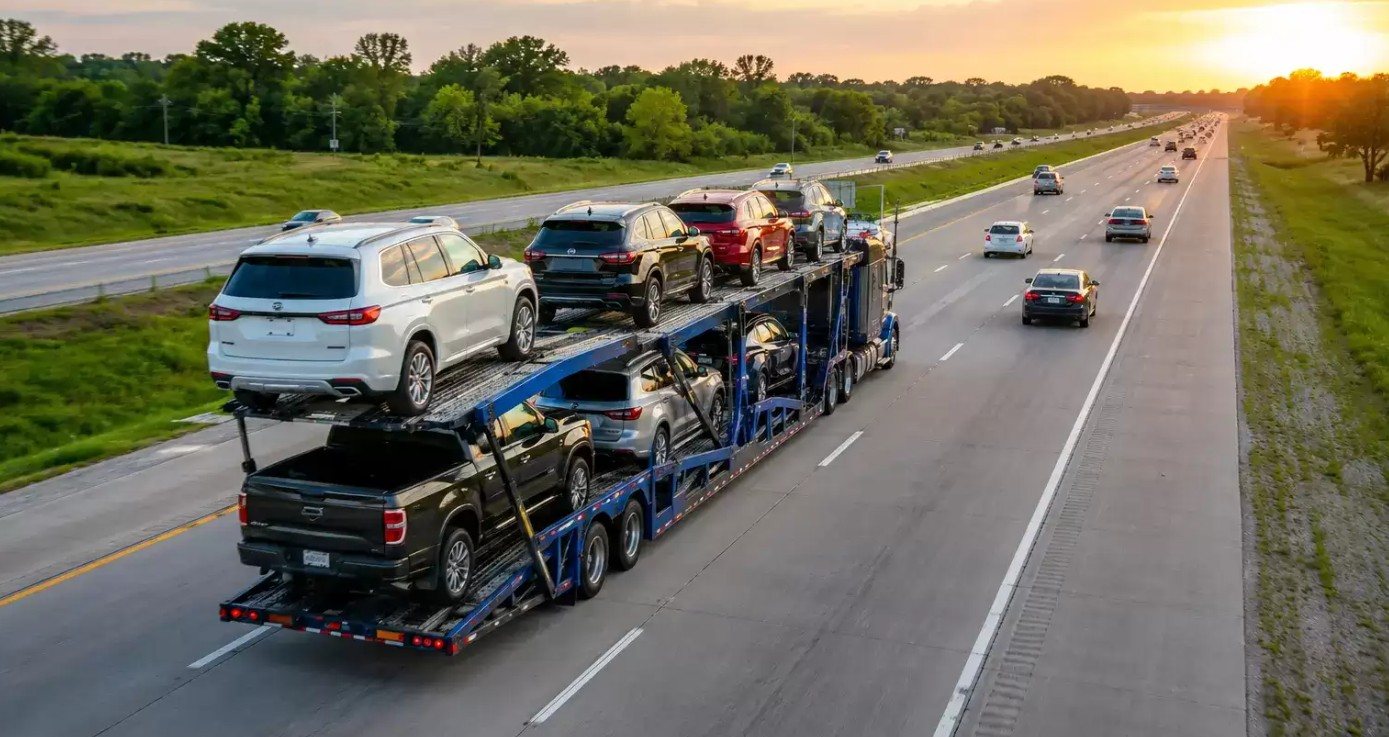
Silicon Valley auto transport on tech’s calendar — relo-ready, EV-fluent, and priced by the easiest streets in the Bay.
Licensed Broker & Fully Insured
FMCSA Registered
Vetted Carrier Network
Real-Time Tracking & 24/7 Support
50+States Served
100%Insured Transport
24/7Support & Tracking
San Jose is the biggest city in the Bay Area and the easiest one to ship a car in — two facts that surprise people in that order. The capital of Silicon Valley runs on a migration economy: new grads arriving every summer, engineers following offers in from every state and half the world, households following vesting schedules out to Austin and Seattle. All of them move vehicles, and they do it across the widest, flattest, most carrier-friendly street grid in Northern California.
Quick answerSilicon Valley ships on tech’s calendar: a sedan runs $250–$650 within California, $650–$1,050 up the coast, $1,100–$1,500 on the well-worn Austin lane, and $1,150–$1,700 to the East Coast on an open trailer, with pickup in 1–3 days — often faster, because carriers love the South Bay’s easy streets. Get your number in two minutes.
Ship Guy runs the South Bay from our office on The Alameda — the Valley’s campuses and cul-de-sacs, the Peninsula up through Palo Alto, and the ranchland south to Gilroy. Below: the lanes tech actually moves on (Austin included), how relocation-package shipping works when a start date is the deadline, the honest guidance we give international arrivals, why carriers quietly prefer this end of the Bay, and the EV notes for the most electrified zip codes in America.
Typical pickup1–3 days
Nearest listed laneSacramento, CA · $250–$400
Longest listed laneNew York, NY · $1,250–$1,700
Enclosed option+40–60% over open
Local desk(669) 279-3481 · 6a–11p PT
Updated July 25, 2026 · rate figures: July 2026 board.
San Jose Auto Transport Lanes & Current Rates
The Valley’s working lanes, including the tech-migration corridors. Sedan baseline, running condition, open trailer.
RouteApprox. distanceEst. transitEst. open rate*
San Jose, CA → Sacramento, CA~120 mi1 day$250–$400Get price
San Jose, CA → Los Angeles, CA~340 mi1–2 days$350–$550Get price
San Jose, CA → San Diego, CA~460 mi1–2 days$425–$650Get price
San Jose, CA → Portland, OR~640 mi2–3 days$650–$900Get price
San Jose, CA → Seattle, WA~840 mi2–4 days$750–$1,050Get price
San Jose, CA → Denver, CO~1,250 mi3–5 days$900–$1,250Get price
San Jose, CA → Austin, TX~1,720 mi4–6 days$1,100–$1,500Get price
San Jose, CA → Chicago, IL~2,130 mi4–7 days$1,150–$1,550Get price
San Jose, CA → New York, NY~2,900 mi6–8 days$1,250–$1,700Get price
*July 2026 lane conditions, standard sedan. Figure 10–25% more for SUVs and trucks; EVs price near their gas equivalents when the model is disclosed up front (battery weight belongs in the load plan, not in a surprise). Non-runners add $100–$200 for winch loading.
Best time to book from here
Tech relocation waves follow hiring cycles more than seasons; August still stacks student and family moves. Counter-flow legs price kindly year-round for flexible dates.
The Easy End of the Bay: Why Carriers Prefer the South Bay
Here’s an industry secret that works entirely in your favor: when a car hauler plans a Bay Area loop, the South Bay is the part they look forward to. San Jose and its neighbors were built in the automobile era — broad arterials, generous turning radii, driveways, parking lots, a freeway grid that actually connects. The same truck that inches around San Francisco’s hills with white knuckles cruises Stevens Creek Boulevard like it was designed for the job, because it was.
The practical payoff shows up in scheduling. Bay Area loads often get sequenced South-Bay-first: your pickup lands early in the truck’s day, your delivery window holds, and “between 9 and 11” means between 9 and 11. It also shows up at the margins of price — an easy stop is a cheap stop, and dispatchers bid accordingly. If you’re coordinating a move with a household member in San Francisco proper, it’s genuinely worth knowing that the same shipment often runs a touch smoother anchored at the San Jose end; our San Francisco page explains what the truck is up against over there.
The one local geometry note: the hills do exist — the Santa Cruz Mountains fringe along Highway 17, Almaden’s upper reaches, the east foothills — and addresses up the winding parts follow the universal rule: meet at the boulevard below. Everywhere else, the Valley floor is about as good as American last-mile terrain gets.
The grid pays a second dividend most shippers never see: weather immunity meets schedule integrity. With no season that closes roads and streets that never bottleneck a trailer, South Bay dispatch plans hold together at a rate that flatters everyone involved — the on-time percentage here isn’t heroism, it’s geography. When we quote a Tuesday window in Sunnyvale, the main risk to it is the 101 having opinions, and even those resolve by mid-morning.
Relocation Season, All Year: Shipping on Tech’s Calendar
Most markets have a weather season; Silicon Valley has an employment cycle, and it moves more vehicles than any climate could. The waves are legible if you live here: the new-grad summer, when June diplomas become July start dates and thousands of first cars roll west; the autumn start-date cluster, as post-Labor-Day offers activate; and the year-end shuffle, when vesting schedules quietly unlock a season of job changes and the households that come with them.
For the arriving: we work backward from the start date — car lands a day or two after you do, invoiced to relocation-provider requirements when a package is paying, second vehicle sharing the truck when the family fleet moves together. The campus-delivery option in the callouts below is real and popular. For the departing: the Austin lane has become a genuine corridor with genuinely good carrier coverage; Seattle and Denver likewise. Outbound moves book the same machinery in reverse, and the year-end wave rewards early booking — December’s trucks fill with the newly vested.
For the arriving-from-abroad: the honest brief we give every international hire: importing your foreign-market car is almost never practical under U.S. federalization rules, so the realistic paths are buying here or buying remotely in another state and shipping it in — the latter being a service we run weekly, complete with the stranger-to-stranger documentation that long-distance purchases deserve. Two minutes on the phone sorts which path fits before anyone spends a dollar.
And for the interns: every summer, a small city’s worth of ten-week arrivals materializes across the Valley, and a surprising share ship a car for the season — usually a parent’s spare, usually booked by the parent. Both directions of that round trip are routine for us: out in late May, home in mid-August, the same vehicle bracketing a summer that will look very good on a resume. Book the return leg when you book the arrival and the August crunch never touches you.
Housing turnover adds the last current: the Valley’s rental churn moves vehicles between sublets, corporate housing, and first apartments year-round, in moves too small for a van line but exactly the size of one car on one truck. Those book fastest of all — often quoted at lunch, dispatched by dinner, and delivered before the security deposit clears.
The Barely-Driven Car: Shuttle Life and the Honest Math
The Valley invented a specific automotive condition: the perfectly good car that never moves. Between corporate shuttles, campus bikes, and a workday that starts on a laptop at 7 AM, thousands of South Bay vehicles log fewer miles per year than their software updates — and when a move or a life change forces the question, the household suddenly needs real numbers on three options.
Ship it when the car is newer, loved, or financially underwater relative to its replacement cost at the destination — moving a $30,000 vehicle for $1,300 is obvious math. Sell it here when it’s older, modest, and the destination has its own strong used market; the Bay’s demand for clean low-mileage cars is exceptional, and “one owner, 4,100 miles a year” is a listing that writes itself. Store it almost never — Bay Area storage rates devour a modest car’s value within a couple of years, and stored cars age badly in ways parked-and-driven ones don’t: flat-spotted tires, sulfated batteries, seals drying while nobody watches.
We run this comparison without a thumb on the scale — the sell recommendation costs us a booking and we make it weekly — because the customer who got honest math on the Corolla calls us for the household’s real shipments for the next decade. It’s the best marketing we’ve found, and it happens to be free.
The Dispersal Lanes: Where the Valley Moves When It Moves On
Migration out of Silicon Valley has become its own geography, and the carrier market has organized around it. The Austin lane leads — a genuine corridor now, with coverage and pricing that reflect years of steady volume. Seattle and Denver follow close, tech’s other gravity wells. And the quieter dispersal runs inside California: Sacramento and the foothills, where remote-capable households traded commutes for square footage, and the Tahoe corridor, where the ski-lease crowd became year-round and the second car followed. Short intra-state hops carry carrier minimums rather than mileage pricing — a Sacramento move costs what the table shows because a truck spot is a truck spot — but they book easily and deliver fast.
Outbound timing follows the employment cycle in reverse: the year-end vesting shuffle fills December’s eastbound trucks, late summer’s lease turnovers add their share, and the wise book ten days ahead of both. One dispersal-specific tip: if your destination is flexible within a metro — a suburb on the carrier corridor versus a canyon town off it — tell us; the delivery-end geography moves long-lane quotes more than most shippers expect. And wherever the Valley scatters you, the return trip someday is the same booking in reverse; a striking share of our outbound customers become inbound ones within five years, which may be the most Silicon Valley statistic on this page.
The boomerang share is high enough that we’ve started saying so at outbound pickups: keep the paperwork, remember the corridor, and don’t sell the surfboard rack. Keep our number too — the second booking with us skips the setup questions entirely, because your addresses, preferences, and that one tricky gate code are already in the file. The Valley has a way of calling people back, and when it does, the shipment that returns them is usually the easiest one we run all week — a known customer, a known lane, and a car that already knows the way.
The Most Electric Market in America (Briefly)
By driveway census, the South Bay may be the most electrified shipping market in the country, and every carrier who works it has loaded more EVs than most fleets. The rules travel well and fit in a paragraph: name the exact model when you book, because battery weight is real weight and a trailer’s axle math is federal law; hand the car over at 30–60% charge; and disable sentry-style monitoring unless you enjoy a week of alerts starring a trucker doing his job. Rates land at or near gas-equivalent when the weight is disclosed up front — surprises are the only surcharge.
For the full treatment — loading physics, charging-gear logistics, the works — our Los Angeles page carries the complete EV section; the same rules govern every electron-powered shipment out of the Valley. What’s distinct here is simply volume: two-EV households shipping both cars on one booking is a weekly event, and the shared-truck pricing usually makes the second car the cheap one.
Open or Enclosed in the Valley?
A market of daily-driven Teslas and weekend-driven classics splits the question neatly.
The commute fleet
Open Transport
The Model Y, the family SUV, the new grad’s hand-me-down: open transport moves the Valley’s working fleet economically, in a climate that treats an open trailer as gently as any in the nation. Fog is a rinse; rain is seasonal and brief; the sun does the drying.
South Bay ease keeps matches quick and windows honest
Two-car household bookings routinely share a truck
Cargo coverage typically $100K–$250K
The weekend hangar
Enclosed Transport
The Valley’s garages hide serious metal — air-cooled classics, low-slung exotics, the concours entry bound for Monterey each August. Enclosed trailers circulate the Bay constantly, thickest around Car Week, with liftgates and soft straps for anything precious or ground-hugging.
Roughly 40–60% above open rates
Book two-plus weeks out for August’s Monterey crunch
Cargo coverage typically $250K–$1M
Valley rule: if it charges in the driveway, open; if it summers on a show lawn, enclosed — and mention August early, because Car Week borrows every good trailer on the coast. Comparison in full: open vs. enclosed.
From Palo Alto to Gilroy: Where We Pick Up
The Valley floor, the Peninsula edge, and the countryside south.
The Valley’s corporate campuses sit on wide arterials with visitor lots and loading access — which makes the “ship it to work” handoff a genuine option here in a way it isn’t in most cities. Plenty of relocating engineers take delivery a parking row from their new badge reader, sign the inspection on a lunch break, and drive home in a car that beat their furniture to California.
South of the sprawl
Morgan Hill, Gilroy, and the ranchland edges of the county trade the Valley’s grid for country roads and gravel drives — where the familiar paved-meeting-point rule applies, usually a US-101 exit lot. The garlic-scented stretch of the drive is complimentary.
SJC and the fly-in delivery
Mineta San Jose sits ten minutes from our office, and the arrival pattern writes itself: land at SJC, meet your car at a lot minutes from the terminal, skip the rental counter entirely. For families landing at SFO instead, we time Peninsula deliveries to the flight the same way — just with more 101 in the middle.
Why Ship with Ship Guy in San Jose
Licensed & bonded
FMCSA authority, $75,000 surety bond, SAFER-verifiable in less time than a standup meeting — due diligence we actively encourage.
Relo-package fluent
Provider invoicing, start-date scheduling, campus deliveries, international-arrival straight talk — the Valley’s move patterns are our daily work, run from The Alameda.
EV-literate carriers
Axle math, charge-state guidance, monitoring-mode etiquette — the electric details handled by carriers who load EVs daily, priced without surprise surcharges.
No deposit, no theater
You pay when a carrier is assigned — not when a countdown timer on someone’s quote page says the “special rate” expires. This industry has enough dark patterns; we sell logistics.
Find Us on The Alameda
Our San Jose office sits on The Alameda between downtown and Santa Clara — minutes from the 880, the 87, and most of the Valley’s campuses. Seven days a week on the local line.
How much does it cost to ship a car to or from San Jose?
Sedan, open trailer: about $350–$550 to Los Angeles or points south, $250–$400 up to Sacramento, $650–$900 to Portland, $750–$1,050 to Seattle, $900–$1,250 to Denver, $1,100–$1,500 on the tech-migration lane to Austin, and $1,150–$1,650 to Chicago or the East Coast. Enclosed runs 40–60% more. A quote locks your lane and dates in two minutes.
How fast can you pick up in the South Bay?
Usually 1–3 days — and often on the early side, because carriers running Bay Area loops genuinely prefer the South Bay's wide suburban streets and easy freeway grid. Your Sunnyvale cul-de-sac is a luxury assignment compared to a Russian Hill one-way, and dispatchers schedule accordingly.
My company is relocating me to Silicon Valley — how does vehicle shipping fit a relo package?
Smoothly, if the paperwork matches. We invoice to relocation-provider requirements, coordinate pickup around your start date, and time delivery for a day or two after you land. If the package covers one vehicle and you're shipping two, the second usually rides the same truck at a better combined rate — ask when you quote.
I'm arriving from overseas for a new job — should I ship a car here or buy one?
Honest answer: for arrivals from abroad, buying locally usually beats importing — U.S. federalization requirements make importing most foreign-market cars impractical. Where we help internationals: shipping a car you buy remotely from another state, moving a vehicle you already own in the U.S., or the domestic leg of a compliant import. We'll tell you which category you're in before anyone spends money.
Anything special about shipping an EV from San Jose?
The Valley probably ships more EVs per capita than anywhere, and the rules are simple: disclose the exact model (battery weight matters to the trailer's axle math), ship at 30–60% charge, and switch off sentry-style monitoring for the trip. Our Los Angeles page covers the full EV rundown; the same physics applies from every Bay Area driveway.
When are the busy seasons here?
Tech's calendar, not the weather's: late summer brings the new-grad and intern-turnover wave, early fall the start-date cluster, and year-end the vesting-schedule job changes that quietly move a lot of households. None of it rivals a snowbird surge — flexibility of a few days matters more than the month.
Do you cover the whole South Bay and the Peninsula?
Daily — San Jose across all its districts, plus Santa Clara, Sunnyvale, Cupertino, Mountain View, Palo Alto, Milpitas, Fremont, and down through Morgan Hill and Gilroy. Peninsula and campus-adjacent pickups follow the same easy suburban logic that makes the South Bay a carrier favorite.
Where is Ship Guy located in San Jose?
1625 The Alameda #686, San Jose, CA 95126 — on The Alameda between downtown and Santa Clara. Local line (669) 279-3481, answered every day from 6:00 AM to 11:00 PM.
Get a free, no-obligation quote in about 60 seconds — or call and talk to a real specialist right now.
Licensed & insured
No upfront deposit
24/7 support
Ship Guy is a licensed, bonded auto transport broker (MC #1457715 • USDOT #3932149) with a local office at 1625 The Alameda #686, San Jose, CA 95126 • (669) 279-3481 • open 7 days, 6 AM–11 PM, serving San Jose, the South Bay, and the Peninsula. Verify our operating authority anytime in the FMCSA SAFER database. Rate estimates on this page reflect current lane conditions and are refreshed quarterly. Learn how insurance & claims work and who we are.
Written & reviewed by [Full Name], [Title], [X] years in vehicle logistics • Last updated: