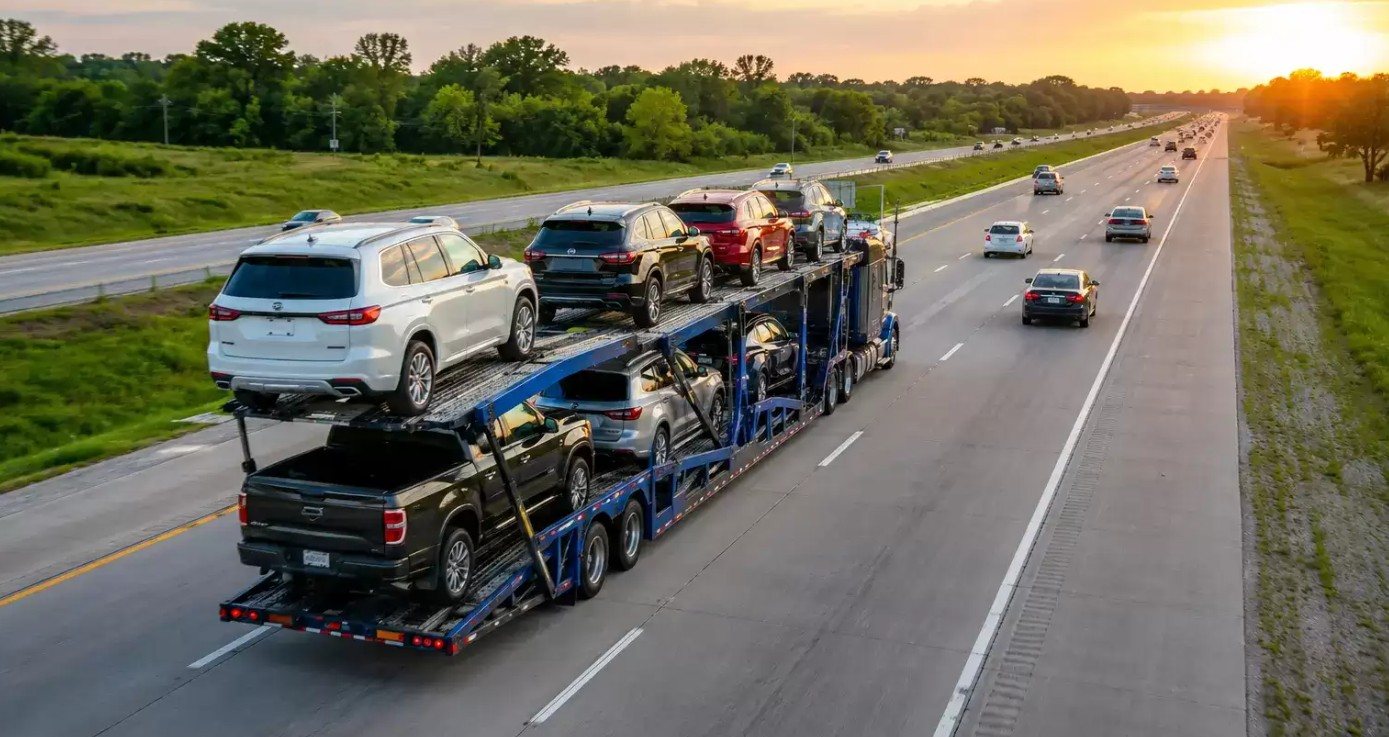
Inland Empire car shipping from where the long-haul begins — heartland depth, eastbound geometry, no deposit to book.
Licensed Broker & Fully Insured
FMCSA Registered
Vetted Carrier Network
Real-Time Tracking & 24/7 Support
50+States Served
100%Insured Transport
24/7Support & Tracking
If Southern California’s freight economy has a beating heart, it beats in the Inland Empire: the warehouse corridors radiating from Riverside stage, sort, and launch more truck traffic than anywhere between the coasts, and the region’s freeway web — the 91, 60, 215, and 10 braided together — is where the basin’s eastbound long-haul actually begins. Living here means living at the departure gate, and for auto transport that translates into a genuine, measurable advantage this page will happily quantify.
Quick answerRiverside sits where the West’s long-haul actually begins — the Inland Empire’s warehouse corridors stage more trucks than anywhere between the coasts — so a sedan ships for $280–$600 across the Southwest and to the Bay, $700–$1,120 to the Rockies, Northwest, and Texas, and $1,040–$1,540 coast-to-coast, with pickup routinely inside 24–48 hours. Eastbound especially, this is the departure gate. Price your lane in two minutes.
Ship Guy covers the Inland Empire from our office on Vine Street near downtown Riverside — the city’s historic districts and hillside edges, the commuter-belt cities around it, and the eastbound lanes that make this region special. Below: the logistics-heartland economics, the departure-gate advantage explained honestly, the receiving-end guide for the coastal exodus, heat-country summer craft, and the heritage-street access notes unique to a city older than its freeways.
Typical pickup1–3 days
Nearest listed laneLas Vegas, NV · $280–$450
Longest listed laneNew York, NY · $1,140–$1,540
Enclosed option+40–60% over open
Local desk(951) 561-3013 · 6a–11p PT
Updated July 25, 2026 · rate figures: July 2026 board.
Riverside Shipping Lanes & Current Rates
The Inland Empire’s working routes — note how the eastbound board reads, because this is the region those lanes launch from. Sedan baseline, open trailer.
RouteApprox. distanceEst. transitEst. open rate*
Riverside, CA → Las Vegas, NV~235 mi1 day$280–$450Get price
Riverside, CA → Phoenix, AZ~310 mi1 day$285–$460Get price
Riverside, CA → Tucson, AZ~420 mi1–2 days$380–$580Get price
Riverside, CA → San Francisco Bay Area~430 mi1–2 days$380–$600Get price
Riverside, CA → Albuquerque, NM~695 mi2–3 days$630–$880Get price
Riverside, CA → Denver, CO~985 mi3–4 days$760–$1,060Get price
Riverside, CA → Portland, OR~1,000 mi2–4 days$700–$960Get price
Riverside, CA → Dallas, TX~1,375 mi3–5 days$810–$1,120Get price
Riverside, CA → Chicago, IL~1,975 mi4–6 days$1,040–$1,390Get price
Riverside, CA → New York, NY~2,750 mi5–8 days$1,140–$1,540Get price
*July 2026 conditions, standard sedan baseline; count 10–25% extra for SUVs and pickups, dimensions-based quotes for oversized rigs, and a $100–$200 winch charge when the vehicle can’t load under its own power. Summer quotes assume early-day loading windows — the inland heat sets the workday, not the price.
Best time to book from here
Inland Empire logistics keep equipment dense year-round; summer heat argues early handoffs. The soft window: late fall through midwinter, school-year moves landed.
The Logistics Heartland: Shipping from Warehouse Country
The Inland Empire’s transformation into America’s distribution engine is the region’s defining economic story, and auto transport rides the same infrastructure that moves everything else: fuel networks built for fleets, staging yards measured in acres, and a driver population that calls the region home base. Car haulers are a modest slice of that ecosystem, but they inherit its depth — equipment positioned locally, dispatch options plural, and the kind of same-week certainty that thin markets can only promise.
For customers, the heartland dividend pays three ways. Response: flatland IE pickups routinely match inside 24–48 hours, competitive with any zone in the state. Resilience: when a plan shifts, replacement equipment is a corridor away, not a market away. Realism: drivers based here quote windows they can keep, because they’re not fighting through two counties of coastal traffic to reach you — you’re on the way to everywhere they’re going anyway.
The regional honesty that completes the picture: the IE prices as part of the greater Southern California market, so the rates themselves track the metro pool — the advantage lives in speed, certainty, and the eastbound geometry the next section explains, not in a magically different rate card. We’d rather you know exactly which kind of edge you’re getting.
One heartland habit worth borrowing: the region’s professional shippers book by the week’s shape, not the day’s — Monday-through-Wednesday pickups ride the freshest equipment rotations, while Friday promises anywhere in freight country deserve gentle skepticism. Residential customers who adopt the rhythm inherit the reliability; it costs nothing but a preference stated at booking.
The Departure-Gate Advantage: Eastbound from the IE
Watch how an eastbound load actually assembles in Southern California: pickups scattered across the coastal basin, a slow gathering through LA and Orange County traffic, and then — always — the funnel through the Inland Empire before the desert miles begin. The 10 and the 91/60 corridors are the region’s eastbound doors, and Riverside sits in the doorway.
Boarding here instead of at the coast changes your shipment’s arithmetic in small, pleasant ways. Your car joins the truck after the coastal slog, so pickup timing is more predictable and less hostage to basin traffic. Trucks topping off their loads before the crossing treat IE pickups as the easy final seats — which is why eastbound matches here run quick and why, on some lanes and some weeks, the quote shades friendlier than the same car would draw from the coast. And transit clocks start closer to the open road: a Phoenix delivery is genuinely a same-day-tomorrow affair, Texas a clean three-to-five.
Westbound and coastal moves work fine in reverse — the same corridors carry both directions — but the structural gift runs east, and households out here shipping to Arizona, Texas, or the Southeast are playing the region’s best card. Our Phoenix page describes the far end of the region’s busiest such lane; from Riverside, that lane is practically a neighborhood street.
The gate swings for arrivals too: vehicles inbound from the east clear the desert and reach IE addresses a beat before coastal ones, which occasionally decides where a split household takes delivery. Families coordinating moves across the basin sometimes anchor the vehicle here for exactly that reason — the IE end of a Southern California move is reliably the simpler end. The corridors run all night, too — freight country never fully sleeps — which is why early-morning delivery windows here are offers, not apologies. Take one once and the habit sticks: a car in the driveway before the heat, the paperwork signed over coffee, the whole day still ahead of you — freight country’s little luxuries, available to anyone who asks. Ask at booking and the dispatch notes carry it forward on every shipment after — the IE rewards regulars, and so do we. In a region built on repeat freight, being somebody’s standing arrangement is the highest compliment the trade pays.
Receiving the Coastal Wave: The IE as Destination
For two decades the region’s human story has matched its freight story: households arriving from LA and Orange County in search of square footage, yards, and mortgages that parse — the commuter belt’s great settling. Our coastal pages describe the departure ends; here’s the arrival manual, written from the receiving dock.
The move itself is short-haul simple — basin-to-IE shipments routinely deliver same-day or next-day at minimum-tier rates — and the receiving end relaxes everything: driveways, wide streets, and none of the coastal choreography. Two-car households should book as pairs (the short lane makes same-truck pairing nearly automatic), and arriving families get the standard IE welcome brief: summer heat is real and battery-auditing (the coastal-mild car meets inland August honestly), distances between things stretch, and the address precision that barely mattered in a coastal grid genuinely helps here, where a single city spans valley floor, historic canopy, and hillside rim.
The belt’s second act runs through our books too: IE households launching the next move — to Phoenix, Texas, Idaho, the Southeast — playing the departure-gate card described above. The region that receives California’s coastal wave also launches its interstate one, and we work both ends of the pipeline weekly.
The Ontario Option: Fly-In Freight Country
Ontario International sits twenty minutes up the corridor, and its cargo-heavy, congestion-light character makes it the Inland Empire’s natural fly-and-drive anchor: land at ONT, meet your delivered vehicle at a lot minutes from the terminal, and be on the 10 before an LAX arrival would have cleared the parking structure. Arriving households, returning seasonal residents, and the business travelers who’ve discovered the airport’s easy rhythm all run the pattern; flight number in, delivery window out.
The airport’s freight identity pays a second dividend: the corridors around it concentrate exactly the staging depth this page keeps mentioning, so airport-adjacent handoffs draw from the region’s thickest equipment pool. For travelers connecting a flight to a vehicle in either direction — the car shipped ahead of a move, the car retrieved at a season’s end — the IE’s quietest advantage is an airport built for logistics serving customers who’ve become, briefly, logistics themselves.
Raceway Ghosts: The IE’s Motor Heritage, Still Shipping
Ask an older Riversider about the raceway and watch the eyes change: for three decades the Riverside International circuit made this region a capital of American road racing, and though the track surrendered to development long ago, the culture it seeded never left. The Inland Empire’s garages remain dense with the heritage — period racers and their tributes, hot rods in every stage of becoming, restoration shops that learned their trades when the grandstands still stood, and a car-show calendar that keeps the valley’s weekends full of chrome.
That heritage ships, constantly. Finished builds head to shows and the January auction lawns one state east; project cars change hands across the country’s forums and arrive here for their next chapter (the non-runner disciplines our Oakland page details apply identically in this zip code); and the estate-and-barn pipeline — a collection surfacing when a garage finally opens after decades — produces some of our most careful bookings, vehicles whose value is half metal and half memory. Enclosed equipment, liftgate patience, and documentation worthy of the provenance: the raceway’s ghosts get the treatment the grandstands would have expected.
For the heritage crowd’s practical question — open or enclosed for the show run one state over — the comparison section below holds the framework, but the short version every builder already knows: the car that took four years to finish doesn’t ride behind a gravel truck for four hundred miles. Auction-season proximity is the IE’s gift to its own garages; the enclosed trailer is how the gift gets unwrapped intact.
Heat Craft: The Inland Summer, Handled
The Inland Empire’s summer is honest inland heat — triple digits arrive annually and stay for stretches — and the shipping trade here practices the warm-country disciplines seasonally that desert markets run year-round: loading concentrated in the early hours, staging in shade where it exists, tire pressures watched on the worst afternoons, and delivery windows that respect the difference between a 9 AM handoff and a 4 PM one.
The customer’s half of the craft is short and familiar: a battery that tests strong (inland heat is the great auditor of marginal batteries, and it grades harshly), fluids topped, and full disclosure of anything temperamental — the car that “sometimes needs a second try” needs that fact in the booking notes, not discovered at a 105-degree curb. Vehicles arriving from milder climates get the welcome-audit advice above; vehicles departing in summer want the same checkup as a courtesy to whoever meets them at the far end. None of it is exotic — it’s the same list every IE household runs each June, applied to a truck schedule.
Open or Enclosed in the Inland Empire?
Warehouse country keeps both answers in stock — and the region’s hot-rod heritage keeps the enclosed side busier than outsiders expect.
The working answer
Open Transport
Commuter fleets, family SUVs, the belt’s arriving and departing households: open trailers staged throughout the corridors move the region’s working vehicles at metro rates with heartland response times. Dry inland weather keeps transit gentle ten months a year; summer just moves the workday earlier.
24–48-hour flatland matches as the norm
Eastbound lanes load at the departure gate
Cargo coverage typically $100K–$250K
The heritage answer
Enclosed Transport
The IE’s racing and hot-rod lineage never left — the garages here hold restorations, customs, and track builds that ship enclosed to shows, sales, and January’s Arizona auctions a convenient corridor away. Liftgates for the lowered, walls for the precious, soft straps as standard grammar.
Roughly 40–60% above open rates
Auction-season proximity is a scheduling gift
Cargo coverage $250K–$1M, higher arranged
IE rule: the commuter ships open with the region’s freight; the build ships enclosed with its dignity intact — and Arizona’s auction lawns are close enough to tempt everyone eventually. Full detail: open vs. enclosed.
Across the Empire: Where We Pick Up and Deliver
Riverside’s districts and the corridor cities of the region’s web.
Riverside’s citrus-era legacy survives in its landmark streets — Victoria Avenue’s miles of historic plantings above all — where century-old canopy and preservation-minded narrowness move handoffs to the wider cross streets. The trees predate the automobile itself; a car hauler defers gracefully.
Box Springs and the hillside edges
Where the city climbs toward Box Springs and the canyon rims, grades and cul-de-sacs invoke the universal custom: meet on the arterial below. The valley-floor majority — most of Riverside — loads at the curb like the truck-friendly grid it is.
March Field’s steady trade
March Air Reserve Base keeps a modest, dependable current of military and reserve-family vehicle moves in the local mix — report-date scheduling, claim-ready paperwork, the full program our military page details, sized to a reserve installation’s gentler rhythm.
And the wider Empire, daily
San BernardinoFontanaOntarioRancho CucamongaRedlandsMenifeePerrisTemecula
Why Ship with Ship Guy in Riverside
Licensed & bonded
FMCSA broker authority and the $75,000 surety bond — verifiable in SAFER, and in freight country, everyone checks. Please do.
Heartland positioning
An office inside the West’s densest staging region, spending its depth on carriers whose records earn the load — speed with standards, the local way.
Eastbound fluency
The departure-gate lanes are our home game — Phoenix like a neighborhood street, Texas a clean three-to-five, and the geometry explained before you book, not after.
Heat-smart, heritage-aware
Early-window summers, canopy-respecting handoffs, hillside customs honored — and payment owed only when a carrier is assigned, in any month on the thermometer.
Find Us on Vine Street
Our Riverside office sits near the downtown core — the Mission Inn’s bells in earshot, the 91/60/215 web minutes away, and the whole Inland Empire in working range. Daily on the local line.
What's the cost to ship a car to or from Riverside?
Sedan on open transport: about $280–$450 to Phoenix or Las Vegas, $380–$600 to the Bay Area, $760–$1,060 to Denver, $810–$1,120 into Texas, $700–$960 to the Pacific Northwest, and $1,040–$1,540 for cross-country runs. Enclosed adds 40–60%. Eastbound lanes especially benefit from the Inland Empire's position — this is where those routes actually begin.
How fast can a carrier reach Riverside?
Frequently within 24–48 hours, and often faster than the coast: the Inland Empire is the West's logistics heartland, and car haulers stage among its warehouse corridors the way ships anchor in a harbor. A Riverside pickup slots into equipment that's already positioned — this is the region long-haul departs from.
Why are eastbound quotes from Riverside sometimes better than from LA?
Geography's honest arithmetic: eastbound loads assembled in the LA basin funnel through the IE before the desert crossing, and a Riverside pickup joins the truck after it's escaped coastal traffic but before the long miles begin. You're boarding at the departure gate rather than the shuttle lot — same flight, simpler boarding, occasionally a friendlier fare.
We just moved out here from LA/OC — anything different about shipping in the IE?
Mostly relief. Wide streets, real driveways, and staging depth make IE logistics some of the easiest in California — the access choreography the coastal pages describe barely applies. What's new: summer heat that's genuinely inland (healthy-battery rules apply), and distances that stretch — 'Riverside' addresses run from historic downtown to hillside tracts, so precise addresses help quotes more here than most places.
Does the summer heat affect shipments?
It shapes the workday more than the outcome: inland summers run hot enough that carriers load early, stage in shade, and watch tire pressures — the desert-market disciplines, applied seasonally. Your prep is the standard hot-country pair: a battery that tests strong and honesty about anything marginal, because a no-start at a 105-degree handoff helps no one.
Can you reach the hillside neighborhoods and the citrus-heritage streets?
With the usual translations. Hillside tracts around Box Springs and the canyon edges meet the driver on the arterials below; the historic districts' older, tree-lined streets — Victoria Avenue's landmark rows especially — shift handoffs to wider cross streets in deference to century-old canopy. The grid majority of the city loads without ceremony.
Do you handle UCR student shipments?
Every term. UC Riverside adds the academic tide — fall arrivals, June departures, parents booking from afar — with campus-adjacent handoffs working the wide corridors off University Avenue and never the move-in weekend crush. The playbook matches every college town's; the weather's just better in December.
Where is Ship Guy located in Riverside?
3850 Vine St #509, Riverside, CA 92507, near the downtown core. The local line is (951) 561-3013, answered daily from 6:00 AM to 11:00 PM.
Get a free, no-obligation quote in about 60 seconds — or call and talk to a real specialist right now.
Licensed & insured
No upfront deposit
24/7 support
Ship Guy is a licensed, bonded auto transport broker (MC #1457715 • USDOT #3932149) with a local office at 3850 Vine St #509, Riverside, CA 92507 • (951) 561-3013 • open 7 days, 6 AM–11 PM, serving Riverside and the Inland Empire. Verify our operating authority anytime in the FMCSA SAFER database. Rate estimates on this page reflect current lane conditions and are refreshed quarterly. Learn how insurance & claims work and who we are.
Written & reviewed by [Full Name], [Title], [X] years in vehicle logistics • Last updated: