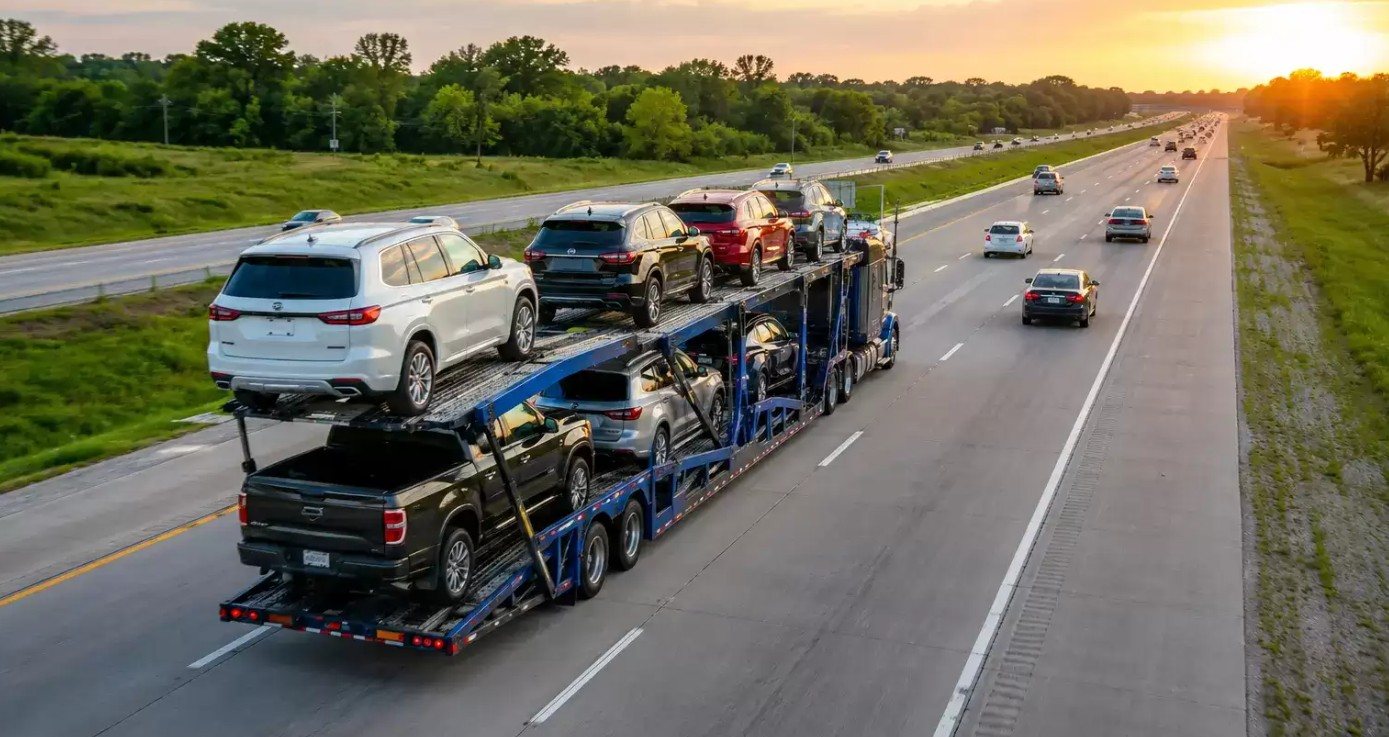
The river junction, shipped to overnight standards — ring-priced, Derby-literate, both banks covered.
Licensed Broker & Fully Insured
FMCSA Registered
Vetted Carrier Network
Real-Time Tracking & 24/7 Support
50+States Served
100%Insured Transport
24/7Support & Tracking
Louisville sits where three interstates meet a working river, next door to the airfield that sorts half of America’s overnight packages — a city whose logistics culture runs so deep that punctuality here isn’t a virtue, it’s the water supply. Add an auto-manufacturing economy, a bourbon boom, a fort down the road, and one week each May when the whole world arrives wearing hats, and you have a shipping market with more character per square mile than metros three times its size. This page pours it all out properly.
Quick answerLouisville ships from the Ohio River’s great junction — I-65, I-64, and I-71 meet at the water — so a sedan runs $210–$430 around a five-city one-day ring, $400–$860 to the Southeast, the seaboard, and Florida, and $1,000–$1,440 to the far coast, with pickup in 1–3 days and the overnight economy’s punctuality baked into the culture. Derby week has its own paragraph, as it should. Price your lane in two minutes.
Ship Guy works Kentuckiana from Jefferson Street downtown — both banks of the river, the plant corridors, the parkway routes into bourbon country, and Knox’s rotations to the south. Below: the river-junction economics and the one-day ring, the overnight economy’s inheritance, the manufacturing-town relocation trade, Derby week decoded, and the regional reach that keeps the whole Bluegrass approach within one booking.
Typical pickup1–3 days
Nearest listed laneCincinnati, OH · $210–$345
Longest listed laneOrlando, FL · $600–$860
Enclosed option+40–60% over open
Local desk(502) 200-1676 · 6a–11p ET
Updated July 25, 2026 · rate figures: July 2026 board.
Louisville Shipping Lanes & Current Rates
The river junction’s working routes — a one-day ring nearly as generous as its neighbor’s upriver. Sedan baseline, open trailer.
RouteApprox. distanceEst. transitEst. open rate*
Louisville, KY → Cincinnati, OH~100 mi1 day$210–$345Get price
Louisville, KY → Indianapolis, IN~115 mi1 day$215–$350Get price
Louisville, KY → Nashville, TN~175 mi1 day$240–$390Get price
Louisville, KY → St. Louis, MO~260 mi1 day$250–$400Get price
Louisville, KY → Chicago, IL~300 mi1 day$270–$430Get price
Louisville, KY → Atlanta, GA~420 mi1–2 days$400–$600Get price
Louisville, KY → Washington, DC~610 mi2–3 days$440–$660Get price
Louisville, KY → New York / New Jersey~740 mi2–3 days$470–$700Get price
Louisville, KY → Orlando, FL~875 mi2–3 days$600–$860Get price
Louisville, KY → Dallas, TX~820 mi2–3 days$580–$840Get price
*Pricing reflects July 2026 for a running sedan; add 10–25% for SUVs and trucks, dimensional quotes for oversized, $100–$200 winch service where needed. Derby-week bookings near the track and downtown lock morning windows early — reserve that week the way the city does everything else about it: well ahead.
Best time to book from here
Derby fortnight reroutes downtown each spring; summer stacks the family season. Best windows: late summer’s lull and the post-holiday board.
The River Junction: Three Interstates and a One-Day Ring
Geography dealt Louisville the eastern network’s tidy hand: I-65 running the great north-south river of commerce, I-64 crossing east-west from the seaboard to the Mississippi, and I-71 angling toward the Great Lakes — all converging at the Ohio’s falls, where the city has worked the junction trade since flatboat days. The modern dividend reads straight off the rate table: Cincinnati, Indianapolis, Nashville, St. Louis, and Chicago all sit inside a single transit day, a ring that makes regional moves book like errands, and the longer lanes ride the junction’s constant through-traffic at depth few markets this size enjoy.
The junction shares its neighborhood with the midpoint upriver — our Indianapolis page maps that market’s own relay gifts, and the 115-mile lane between the two runs so routinely it barely counts as shipping — which gives this whole stretch of the map a useful property: equipment circulates between the junctions daily, so capacity borrowed is capacity delivered, and a Louisville booking draws on the corridor’s combined depth rather than one city’s alone. River towns learned pooling before the interstates existed; the trucks just formalized it.
The Overnight Inheritance: Living Next to the Sort
Every night while the city sleeps, the airfield across town runs one of the planet’s great logistics ballets — hundreds of aircraft, millions of packages, a sort that finishes before dawn because it must — and the culture that operation breeds soaks into everything logistical in this region. Louisville’s freight economy runs on overnight-grade habits: schedules kept to the minute, handoffs rehearsed, infrastructure maintained like flight equipment, and a workforce for whom “the window” is a sacred text rather than a suggestion.
Auto transport inherits the whole ethic secondhand and gratefully. Carriers based here run on the region’s clock discipline; support infrastructure — fuel, maintenance, staging — operates at air-hub standards around the calendar; and the customer-facing result is the quiet one that matters: windows quoted in Louisville hold in Louisville, at a rate that would flatter markets twice this size. We’d love to claim the credit, but honesty pours better here: the city taught everyone who works in it that overnight means overnight, and your Tuesday pickup window is simply drinking from that well.
The inheritance shows up in small mechanics customers can actually feel: confirmation texts that arrive when promised, drivers who call at the mile marker they said they would, and the region-wide habit of treating a missed window as an incident to be explained rather than a norm to be shrugged at. Cultures are caught, not taught — and this one was caught from the best deadline-keepers on the planet. If the industry ever hands out a geographic award for windows kept, this zip code should clear its mantel. Until then, the reviews section does the collecting. We’re content with that arrangement. Kentuckians generally prefer the proof poured rather than promised, and we bottle ours one kept window at a time.
The Town That Builds Trucks: Manufacturing’s Shipping Rhythm
Louisville assembles vehicles at national scale, and while the factory-fresh inventory moves in the manufacturers’ own rail-and-haulaway world, the human economy around the plants is very much our trade: production workforce relocations arriving with every hiring wave, the supplier network’s engineers and managers circulating between auto towns on career arcs, and the multigenerational plant families whose vehicles move for all the ordinary American reasons at extraordinary local density. When the plants breathe — a shift added, a line retooled, a launch staffed — our booking calendar inhales two weeks later, as reliable a leading indicator as this industry owns.
Serving a manufacturing town well means honoring its rhythms: shift-schedule handoff windows (a 6 AM signing before first shift is a normal request here, cheerfully met), plant-calendar awareness in scheduling around shutdown weeks and launch crunches, and the relocation machinery — employer invoicing, start-date logic, family-fleet sequencing — tuned to industrial HR’s paperwork rather than tech’s. The town builds trucks for a living; it recognizes competence in people who move cars for one, and that mutual professional respect is the most pleasant working atmosphere in our whole network.
River-Town Seasons: Fog, High Water, and Four Honest Quarters
The Ohio gives this market its seasons’ particular accents, and river-town shipping reads them fluently. Valley fog is the signature: on still autumn and spring mornings, the river breathes a blanket over the bottomlands that burns off by mid-morning — so early handoffs those months carry a soft edge, and the truly time-critical ones simply book past nine and skip the atmosphere entirely. High water makes its rare appearances when the river runs above its banks: a handful of riverfront roads yield for a few days, routings shift inland without ceremony, and the city’s flood memory — institutional since 1937 — means the detours are rehearsed rather than improvised. In an average year the river’s whole shipping toll amounts to a few foggy first-hours and one week of inland detours — a rent most markets would happily pay for the junction it buys. The river has been collecting it for two centuries; the bargain still holds. We pay our share in fog-morning patience and consider it the best lease in logistics.
The rest of the calendar plays fair: summers run humid with the Ohio Valley’s afternoon storms (brief pauses, morning preference, the standard interior-South rhythm), and winters deal ice more often than depth — freezing rain’s occasional glaze earning the same shift-a-day respect our Atlanta page describes for its own ice mornings, with the junction’s depth making the recovery immediate. Four seasons, each with one manageable habit: a river town’s weather, like its freight, mostly just runs on schedule.
The Cardinal Cycle: Campus Tides and the Boomerang Current
The university on the city’s spine moves its August-and-May tide like every campus market on this site — remote parent bookings, corridor handoffs off the quads, move-in weekend sacrosanct — at a scale that folds smoothly into the metro’s rhythm, with the regional schools’ smaller tides riding the same calendar. The pattern’s local sequel is the more interesting current: Louisville’s boomerang — graduates who left for the coasts circling home as the city’s cost-of-living arithmetic and quality-of-life pitch land in their late twenties, shipping a car back from Brooklyn or Chicago with a lease and a plan.
The boomerang bookings share a personality: single vehicle, flexible dates, inbound on the tides’ cheap directions, and a customer who already knows the neighborhoods. We serve them with the directional honesty the pattern rewards — inbound-to-Louisville rides bargain-side on most seasonal seams — and with the welcome-home practicality of a market where the delivered car’s first errand is usually a familiar one. Cities that call their people back are good bets generally; this one backs the sentiment with logistics that make the return trip easy.
The bourbon economy adds its own professional current to the cycle: the boom’s expansion has drawn distilling talent, hospitality management, and brand-side careers into the region from every direction, relocating on the standard professional machinery with one charming local wrinkle — a notable share of arrivals ask, unprompted, whether their delivery window can accommodate a distillery tour they’ve already booked. It can. This is Louisville; the calendar has always known how to hold both work and welcome. New arrivals get one more freebie with their booking: the honest local map of which neighborhoods’ street parking suits a second car and which reward a garage — the kind of intelligence that saves a newcomer’s first winter and costs us nothing but the pleasure of sharing it.
Knox, the Corridor, and the Commonwealth’s Reach
Forty minutes down I-65, Fort Knox’s commands keep a steady military current in the metro’s mix — PCS rotations on the standard program, report dates anchoring schedules, claim-ready documentation, and the penalty-free re-timing that amended orders require. The post’s human-resources mission means many arrivals are career-establishing tours with families settling into the corridor towns from Elizabethtown north, shipping second vehicles once housing lands; the I-65 spine makes the whole pattern about as smooth as military logistics gets, and our military page carries the complete playbook.
Beyond the corridor, the Commonwealth’s reach ships on regional sense: Lexington and the Bluegrass an easy scheduled run east, the bourbon-trail towns on parkway routings with the meet-in-town custom per the callout, and the small-town belt in every direction served the way river-junction cities have always served their hinterlands — on known routes, at fair rates, with the handoff arranged where the roads and the rigs agree. One office, one booking, the whole approach covered: the junction’s oldest promise, kept daily.
Open or Enclosed at the River Junction?
The working town ships open; Derby fortnight and the collector barns keep enclosed pouring steadily.
The working answer
Open Transport
Plant families, corridor relocations, the one-day ring’s constant errands: open trailers on junction depth, run to overnight-economy punctuality, in four honest seasons none of which stop the trucks. The default that this market’s work ethic was built for.
Five-city one-day ring priced like local freight
Shift-schedule windows met without ceremony
Cargo coverage typically $100K–$250K
The heritage answer
Enclosed Transport
Derby-season pageantry, the Commonwealth’s deep classic-car barns, and the bourbon boom’s trophy garages: enclosed walls, liftgate patience, and documentation to heirloom standard — because around here, provenance is practically a civic value.
Roughly 40–60% above open rates
Derby fortnight books enclosed months out
Cargo coverage $250K–$1M, higher arranged
Junction rule: the commuter rides open on the ring; the heirloom rides enclosed to the party. Full comparison: open vs. enclosed.
Both Banks and the Bluegrass Approach: Where We Pick Up
Louisville’s neighborhoods, the Indiana side, and the corridor towns — one market, served whole.
The Ohio makes a border, not a barrier: Jeffersonville, New Albany, and Clarksville ship as Louisville’s own, bridge crossings folded into windows the way locals fold them into lunch runs. Kentuckiana books as one market because it lives as one — and dispatch treats the river as scenery.
The first Saturday in May
Derby week transforms one neighborhood and one calendar: the track district and hospitality corridors fill with the world, morning handoffs rule near the twin spires from Oaks Day through the weekend, and horse-world vehicle logistics — owners’ fleets, vendors’ rigs, the whole traveling pageant — book months out. The other fifty-one weeks, the neighborhood ships like any other; that one week, it ships like a coronation.
Bourbon-country runs
The distillery corridor’s towns ship on parkway schedules and meet-in-town sense: Bardstown’s square beats a rickhouse lane for a 75-foot rig every time, and the boom’s steady trade in hospitality and second-home vehicles keeps the routes familiar. Scenic Kentucky is wonderful for driving and terrible for trailers — we arrange for both truths at once.
FMCSA broker authority behind the $75,000 surety bond, verifiable in SAFER — aged paperwork, properly kept, the way this town likes things.
Overnight-grade windows
The sort taught this region what a deadline means, and our windows drink from the same well — quoted honestly, kept routinely, in every season the river runs.
Junction-and-corridor reach
Both banks, the plant belt, Knox’s rotations, bourbon-country parkways — one booking covers the whole approach, priced by the ring’s honest depth.
Derby-calendar literate
The first Saturday in May planned like the civic holiday it is — and the other fifty-one weeks run just as deliberately, with nothing owed until a carrier is assigned.
Find Us on Jefferson Street
Our Louisville office sits downtown blocks from the river — the bridges one direction, the junction’s spokes every other, and the whole of Kentuckiana in working range. Daily on the local line, Eastern time.
Ship Guy Auto Transport — Louisville
Address500 W Jefferson St #350 Louisville, KY 40202
What does it cost to ship a car to or from Louisville?
Sedan on open transport: about $210–$350 to Cincinnati or Indianapolis, $240–$390 to Nashville or St. Louis, $270–$430 to Chicago, $400–$600 to Atlanta, $440–$660 to the DC corridor, $470–$700 to New York/New Jersey, $600–$860 to Florida, $580–$840 to Dallas, and $1,000–$1,440 to the West Coast. Enclosed adds 40–60%. The river junction's three-interstate depth keeps every one of those honest.
How fast is pickup around Louisville?
Usually 1–3 days. The I-65/I-64/I-71 junction at the Ohio River threads Louisville into the eastern network's busiest weave, and the metro's terrain — river-town grid, genuine driveways, parkway access — is easy carrier country. The overnight-freight economy next door keeps the whole region's logistics culture punctual, and ours inherits it.
Does Derby week affect shipping?
For one glorious week, around one neighborhood: the first Saturday in May fills the Churchill Downs district and the hospitality corridors with the world, so handoffs near the track shift to mornings and adjacent zones from the Oaks through the weekend, and downtown hotel-area deliveries book around the crush. The rest of the metro runs normally — and horse-adjacent vehicle logistics, from owners' fleets to vendors' rigs, book months out and run like the traditions they serve.
What's the story with shipping and the auto plants?
Louisville builds vehicles at scale, and the manufacturing economy shapes our market in welcome ways: plant workforce relocations run steady, the supplier network moves professional talent through constantly, and the region's freight infrastructure — built to feed assembly lines — keeps carrier services dense. We don't move factory-new inventory (that's the manufacturers' own rail-and-fleet world); we move the people who build it, and their families' cars.
Do you handle Fort Knox moves?
Yes — the post sits forty minutes south, and its commands generate the standard PCS rhythm: report-date scheduling, claim-ready documentation, penalty-free re-timing when orders amend, and handoffs at the commercial corridors outside the gates. The full program lives on our military page; the local note is simply that the I-65 spine makes Knox one of the easier installations in the country to serve.
Can you reach across the river — Southern Indiana too?
Daily. Jeffersonville, New Albany, and Clarksville ship as part of the metro, with the bridge crossings folded into windows the way locals fold them into commutes. One market, two states, zero drama.
What about bourbon country beyond the city?
The distillery corridor's towns — Bardstown, Frankfort, the Bluegrass routes — ship on the regional custom: scheduled runs down the parkways, meet-in-town handoffs where the lanes turn scenic, and a steady trade in second-home and hospitality-industry vehicles that the bourbon boom keeps pouring. We know the difference between a rickhouse road and a truck route, which is exactly the local knowledge that keeps mirrors attached.
Where is Ship Guy located in Louisville?
500 W Jefferson St #350, Louisville, KY 40202 — downtown, blocks from the river. Local line (502) 200-1676, staffed daily 6:00 AM to 11:00 PM Eastern.
Get a free, no-obligation quote in about 60 seconds — or call and talk to a real specialist right now.
Licensed & insured
No upfront deposit
24/7 support
Ship Guy is a licensed, bonded auto transport broker (MC #1457715 • USDOT #3932149) with a local office at 500 W Jefferson St #350, Louisville, KY 40202 • (502) 200-1676 • open 7 days, 6 AM–11 PM, serving Louisville, Southern Indiana, and the Bluegrass approach. Verify our operating authority anytime in the FMCSA SAFER database. Rate estimates on this page reflect current lane conditions and are refreshed quarterly. Learn how insurance & claims work and who we are.
Written & reviewed by [Full Name], [Title], [X] years in vehicle logistics • Last updated: