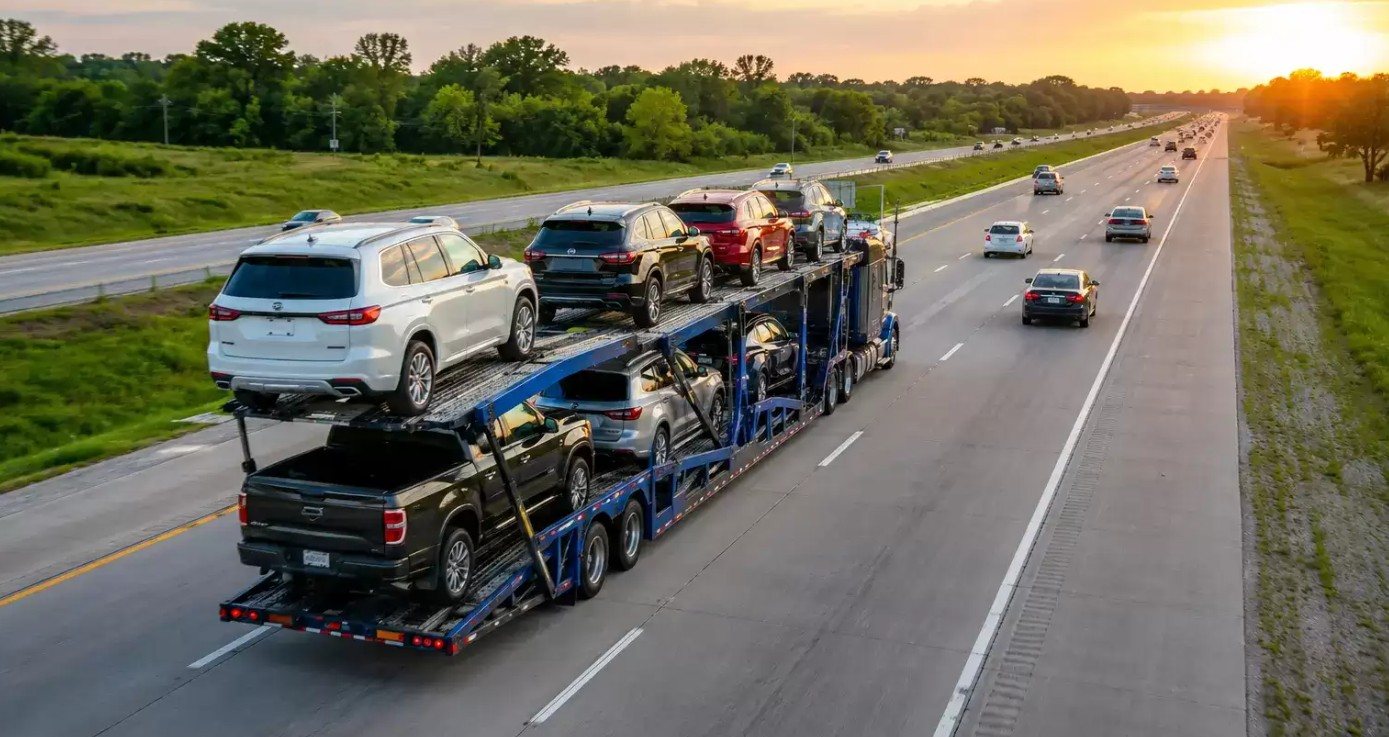
Gulf Coast auto transport from the I-10/I-65 crossroads — vetted, insured carriers, upfront pricing, no deposit to book.
Licensed Broker & Fully Insured
FMCSA Registered
Vetted Carrier Network
Real-Time Tracking & 24/7 Support
50+States Served
100%Insured Transport
24/7Support & Tracking
Mobile is the Gulf Coast's quiet freight powerhouse: a deep-water port city sitting exactly where I-10's coast-to-coast traffic crosses I-65's run up the middle of the country. Add a fast-growing ship-and-aircraft manufacturing base and the beach corridor down in Baldwin County, and you get an auto transport market with far more truck traffic than most cities its size.
Quick answerShipping a sedan to or from Mobile runs $250–$450 on nearby Gulf and Alabama lanes, $350–$650 to Atlanta, Nashville, or Texas, and $750–$1,250 to the Midwest or Northeast on open transport, with pickup usually inside 1–4 days. Hurricane season and Mardi Gras both bend the schedule in ways this page explains — price your exact route in about two minutes.
Ship Guy coordinates car shipping across Mobile, the Eastern Shore, and the entire central Gulf Coast from our office on North Water Street, a few blocks from the river. Because we sit on the I-10 corridor, most of the trucks we book aren't making a special trip — they're already passing through between Florida and Texas with space to fill, which keeps Mobile pricing friendlier than its size would suggest.
Shipping here has its own rhythm, though, and it's worth understanding before you book: a hurricane season that can compress weeks of demand into two days, a port that connects the city to overseas buyers and sellers, and — unique in America — a Mardi Gras that closes downtown streets to trucks for the better part of three weeks. All covered below, along with current lane rates.
Typical pickup1–4 days
Nearest listed laneNew Orleans, LA · $215–$350
Longest listed laneNew York, NY · $820–$1,200
Enclosed option+40–60% over open
Local desk(251) 299-9724 · 6a–11p CT
Updated July 25, 2026 · rate figures: July 2026 board.
The Baldwin Beaches: Snowbird Season on the Alabama Coast
East of the bay, the beach towns run a seasonal economy the rest of the page’s calendar has to respect: Gulf Shores and Orange Beach fill each winter with Midwest and Canadian residents on the classic snowbird clock — southbound arrivals firming October through December, condo and beach-house calendars setting delivery dates, and spring returns booking as the season closes in March and April. The craft is the two-way one our snowbird program runs on every wintering coast: round-trips planned as a single conversation, counter-flow savings named upfront, and community gate-and-elevator logistics gathered at booking for the towers along the beach road.
Fairhope and Point Clear add the settled version — retiree arrivals who came for a season and stayed for good, estate moves handled with patience, and the Eastern Shore’s live-oak streets receiving on corner-meet courtesy. The beach season and the hurricane almanac share a coastline but not a calendar; the winter residents arrive precisely when the Gulf goes quiet, which is the kind of scheduling wisdom the whole trade could learn from.
Popular Mobile Car Shipping Lanes & Current Rates
The routes we book most from the central Gulf Coast. Figures are for a sedan that runs and drives, on open transport.
RouteApprox. distanceEst. transitEst. open rate*
Mobile, AL → New Orleans, LA~145 mi1 day$215–$350Get price
Mobile, AL → Birmingham, AL~260 mi1 day$270–$415Get price
Mobile, AL → Atlanta, GA~330 mi1–2 days$320–$500Get price
Mobile, AL → Nashville, TN~450 mi1–2 days$420–$620Get price
Mobile, AL → Houston, TX~470 mi1–2 days$420–$620Get price
Mobile, AL → Dallas, TX~600 mi2–3 days$520–$720Get price
Mobile, AL → Chicago, IL~925 mi3–4 days$700–$1,000Get price
Mobile, AL → New York, NY~1,200 mi3–5 days$820–$1,200Get price
*Sedan estimates as of July 2026. SUVs and pickups typically run 10–25% more; oversized and lifted vehicles are quoted case by case, and a non-runner adds $100–$200 for winch loading. Your quote locks the number for your dates.
Best time to book from here
Hurricane season asks flexibility June–November; Mardi Gras weeks reroute downtown handoffs; Baldwin-beach snowbird arrivals firm October–December with spring returns. Softest windows: late January, holidays cleared and the coast quiet.
The I-10 / I-65 Junction: Why Mobile Punches Above Its Weight
Auto transport pricing is mostly a question of how many trucks already want to be where you are. Mobile does unusually well on that test. Every carrier working the Gulf corridor between Jacksonville and Houston rolls through on I-10; every carrier connecting the coast to Birmingham, Nashville, and the Midwest picks up I-65 here. The city is a junction, and junctions get cheap, fast service because a booking in Mobile rarely requires a detour — it fills a spot on a truck that was coming through anyway.
The practical effects show up in two places. First, the short lanes are startlingly affordable: New Orleans is close enough that shipping can undercut the cost of a one-way rental plus fuel and a day of your time. Second, pickup windows run short — one to four days is typical, and the east-west lanes often match inside 48 hours. Where you'll feel a difference is on thin lanes headed somewhere carriers don't naturally go from here — the Mountain West, say; those work fine, they just reward a flexible pickup window.
Reading the map before you book
One quirk worth knowing: Mobile’s carrier traffic is overwhelmingly east–west. Lanes that follow I-10 — Florida, Louisiana, Texas — and the I-65 spine north are the ones that match fastest and price best. Booking somewhere off those spokes, like Denver or the Carolinas coast, works fine but behaves like a connecting flight: the car may route through Atlanta or Dallas on a relay, adding a day and a handoff. Ask how your car is routed — a good broker answers in one sentence, and the answer tells you a lot about the quote.
The Port of Mobile: Shipping Vehicles In and Out of the Country
Mobile's port is one of the busiest in the nation by tonnage, and its roll-on/roll-off capability has made the city a genuine gateway for vehicles crossing the water — exports headed to Latin America, Europe, and West Africa, and imports arriving for buyers across the Southeast. If your shipment touches the ocean, the land leg is where we come in.
Exporting: we pick up anywhere in the U.S. and deliver to your freight forwarder's warehouse or the RO/RO terminal, timed to their receiving windows — ports don't accept vehicles whenever a truck happens to show up, so the coordination matters. Your forwarder handles the ocean booking, title work, and customs; our job is having the car standing at their dock, paperwork clean, on the day they need it.
Importing: once your vehicle clears customs and is released, we collect it at the port and run it anywhere in the country. Buyers who've done this through congested coastal ports are usually pleasantly surprised at how quickly a release turns into a pickup here.
One honest note: we are not a freight forwarder and won't pretend to be — the ocean leg, customs brokerage, and export title work belong to licensed forwarders, and if you don't have one yet we're happy to point you toward the process. What we guarantee is the domestic leg being exactly where it needs to be, exactly when.
The Airliner and the Shipyard: Mobile’s Industrial Book
Two heavyweight builders anchor this market’s relocation trade, and the page owes them more than a passing line. At Brookley Aeroplex, Airbus runs its U.S. final assembly operation — single-aisle airliners built start-to-finish on Mobile Bay — and the campus moves talent the way aircraft programs always do: engineering and program staff on contract cycles, a supplier orbit expanding with every rate increase, and a genuinely international workforce whose European rotations bring arrival logistics most Gulf markets never see — purchase deliveries for staff landing from Hamburg and Toulouse, ship-versus-buy counsel answered honestly, and paperwork patience for newcomers to American titling. On the river, Austal’s shipyard builds vessels for the Navy with a workforce in the thousands, and the program-award rhythm ripples hiring waves onto our board the way the trade press telegraphs them.
The craft serving both runs to manufacturer standard: documentation an aerospace quality office would co-sign, schedules honored like delivery milestones, and the discretion defense-adjacent work expects without asking. A city that assembles airliners and warships within sight of each other holds its vendors to builder’s tolerances; the west-side plants a few hours up the interstates — and the engineers who circulate among all of them — complete an industrial column that ships steadily in every season.
Hurricane Season on the Gulf: How Shipping Really Works June Through November
Anyone who's spent a summer on Mobile Bay knows the drill: most of the season is uneventful, and then a cone shows up on the forecast map and the whole coast starts moving at once. Auto transport follows the same pattern, so it pays to know how the industry behaves before you're watching that cone yourself.
When a storm threatens
Dispatching into a watch or warning zone stops — no responsible broker sends a ten-car trailer toward a landfall. Pickups already on the calendar get pulled earlier or pushed until after the storm passes, and we call you the moment the plan changes rather than leaving you to wonder. After landfall, expect a few days of congestion as carriers work around closures and downed lines, then a rapid return to normal.
If you want the car out ahead of a storm
Book at the first credible forecast, not when the evacuation order comes. Outbound capacity on I-65 north evaporates within hours once the coast starts leaving — every truck fills, rates spike, and by the time contraflow is being discussed, the realistic options are down to driving it yourself. A car shipped to a relative in Birmingham or Nashville three days early costs a normal rate; the same idea a day before landfall often can't be executed at any price.
The insurance angle worth knowing
A vehicle in transit is covered by the carrier's cargo policy, and a vehicle already delivered inland is out of the surge zone entirely — both better positions than a car parked at sea level in a flood-prone neighborhood. For owners of collector or secondary vehicles, pre-positioning the car away from the coast for hurricane season altogether is a strategy plenty of our Gulf customers quietly use every year. Full walkthrough: how insurance & claims work.
Mardi Gras Logistics: Yes, Really
Mobile threw America's first Mardi Gras, and the modern version is a two-to-three-week season of parades ending on Fat Tuesday — wonderful for the city, mildly complicating for anyone trying to move a vehicle through downtown while it's happening. Barricades go up along the parade route in the afternoons and evenings, streets inside the route become unreachable for a 75-foot carrier, and towing enforcement along the route is famously enthusiastic.
None of this stops shipping; it just moves it. During parade season, downtown and Church Street East pickups get scheduled for mornings, or shifted a few blocks outside the barricade perimeter to a spot the driver can actually reach — we keep the parade calendar on the wall and plan around it as a matter of routine. If your building is inside the route and your dates are fixed, mention it at booking and we'll set the handoff somewhere sensible from the start. And if you're shipping a car into Mobile during the season: welcome, and don't park it on the route.
Open or Enclosed on the Gulf Coast?
The honest answer for most Mobile shipments is open — but the Gulf climate adds one consideration the brochures skip.
The right call for most
Open Transport
Gulf humidity and the odd afternoon downpour are a rinse, not a risk — vehicles arrive needing a wash at most, exactly as they would after a week in your driveway in August. With the I-10 corridor's deep open-carrier supply, this is the fast, economical default for daily drivers.
Deepest truck supply on every lane out of Mobile
Handles sedans through full-size pickups and SUVs
Typical cargo coverage $100K–$250K per load
For the special ones
Enclosed Transport
Where enclosed earns its premium here: collector and show vehicles headed to the estates of Fairhope and Point Clear, restorations coming out of the region's shops, and any car whose next stop is a concours lawn rather than a commuter lane. Soft straps, liftgates, and zero road film.
Roughly 40–60% above open rates
Cargo coverage typically $250K–$1M
Fewer trucks on Gulf lanes — book a week or two ahead
The salt-air footnote: transit exposure is too brief to matter, but if your vehicle will live near the water afterward, long-term salt air is the real corrosion story — worth a garage, not an enclosed trailer. Ship it open, spend the difference on a good cover. Details: open transport and enclosed transport.
What a Mobile Quote Is Actually Made Of
Two numbers live inside every honest auto transport quote: the carrier’s pay — the lion’s share, and the part that moves with the market — and the broker’s coordination fee. On a Mobile lane, the carrier side is set by a simple auction that runs all day, every day: how much does it take for a truck already rolling I-10 or I-65 to commit one of its ten spots to your car, on your dates, at your addresses?
That auction explains the patterns you’ll notice shopping quotes here. Popular directions clear cheap because a dozen trucks are bidding for the load; a Friday-only pickup in a cul-de-sac in Semmes clears higher because you’ve narrowed the bidders to whoever happens to fit. Fuel prices flow straight through — diesel up a quarter shows up in next week’s lane rates. And a quote hundreds below everyone else’s isn’t a better auction result; it’s a number no truck has agreed to yet, published to win your booking before the renegotiation call.
What you control: the width of your pickup window (the single biggest lever), the accessibility of your handoff spot, and the season you ship in. Give the auction room to work — a three-day window, a truck-friendly meeting point — and Mobile’s corridor economics do the rest.
Who Ships Cars in Mobile? The Six Shipments We See Most
The Coast Guard family. The Aviation Training Center rotates crews through Mobile on orders, and PCS vehicle moves — inbound from every corner of the country, outbound the same — are a weekly fixture. Report dates rule everything; we schedule backward from them.
The online buyer. A truck found on a Texas listing, an SUV won at a Southeast auction — the vehicle is real, the seller is eight hundred miles away, and we’re the bridge: pickup coordinated with a stranger on your behalf, condition photos before loading, delivery to your driveway.
The beach-house rotation. Baldwin County vacation-home owners cycling vehicles between their primary residence and the Gulf Shores garage, spring and fall, year after year. These become standing arrangements — same lane, same season, one phone call.
The export. Vehicles bound through the port for buyers overseas, delivered to forwarders on receiving-day schedules, covered in the port section above.
The student. South Alabama and Spring Hill bring their own August-and-May rhythm, a gentler version of the college-town wave — parents booking remotely, students signing locally, and everyone happier when delivery avoids move-in weekend itself.
The heirloom. The Chevelle inherited from an uncle in Ohio, the convertible retiring to Point Clear — the shipments where enclosed transport earns its keep and where the pickup call usually starts with a story. We like those.
From Downtown to the Eastern Shore: Where We Pick Up and Deliver
Both sides of the Bay, the beach corridor, and everything up the I-65 spine.
Carriers run the I-10 Bayway between Mobile and the Eastern Shore all day; the old Causeway is the scenic route, not the truck route. For Daphne, Fairhope, and Point Clear addresses under live oak canopies, drivers typically set a meeting point on US-98 or a nearby commercial lot — a two-minute arrangement that saves your trees and their trailer roof.
Beach-season and winter-resident timing
Gulf Shores and Orange Beach see their own mini-migration: winter residents arriving in late fall, vacation-home owners rotating vehicles at the start and end of summer. It's gentler than the Florida or Arizona swings, but the same rule applies — ship against the flow when you can, and book a couple of weeks ahead when you can't.
Industry moves: shipyards, aerospace, and the plants up the road
Between the shipbuilders on the river, aircraft assembly at Brookley, and the auto plants within a few hours’ drive, Mobile sees a steady stream of relocating engineers and contractors. If your employer is moving you in or out, we work with fixed report dates all the time — tell us the date that matters and we build the shipment backward from it.
Why Ship with Ship Guy in Mobile
Licensed & bonded
FMCSA broker authority with the required $75,000 surety bond — look us up in SAFER before you book. We’d rather you check than wonder.
Downtown, on Water Street
Blocks from the river, staffed seven days a week by people who know which streets close for parades and what a Bayway backup does to a delivery window.
Corridor relationships
The same I-10 carriers pass through Mobile week after week — we know which ones treat customers well, and those are the ones that get your car.
Storm-season straight talk
When weather threatens, you get a phone call and a plan, not silence. No deposit until a carrier is assigned, in any season.
How much does it cost to ship a car to or from Mobile?
Mobile sits on I-10 between New Orleans and Florida, so regional lanes are cheap: figure $250–$450 to New Orleans or Birmingham, $350–$650 to Atlanta, Nashville, or Houston, $700–$1,000 to Chicago, and $820–$1,200 to the Northeast for a sedan on open transport. Enclosed adds roughly 40–60%. Request a free quote for your exact route and dates.
How long does car shipping from Mobile take?
Pickup typically happens within 1–4 days. Transit runs about a day to New Orleans or Birmingham, 1–2 days to Atlanta or Houston, 3–4 days to the Midwest, and 3–5 days to the Northeast.
Can you deliver across the Bay to Daphne, Fairhope, or Spanish Fort?
Yes — the Eastern Shore is part of our everyday coverage. Full-size carriers cross on I-10; the one wrinkle is that some Eastern Shore neighborhoods with tree-canopied streets need a meeting spot on a main road like US-98, which the driver arranges in minutes.
What happens to my shipment if a hurricane is coming?
We stop dispatching into watch and warning zones, and pickups already scheduled get moved up or pushed past the storm — we call you either way. If you want the car out of the area ahead of a storm, book the moment the forecast turns: outbound trucks fill within hours once evacuations start.
Can you ship my car overseas through the Port of Mobile?
We handle the U.S. land leg — pickup anywhere in the country and delivery to your freight forwarder or the roll-on/roll-off terminal at the Port of Mobile, with receiving hours and paperwork coordinated in advance. Your forwarder books the ocean crossing; we make sure the vehicle is at their dock on schedule.
Does Mardi Gras affect pickups downtown?
During parade season — roughly two to three weeks ending on Fat Tuesday — downtown Mobile's parade route closes to trucks for hours at a time, afternoons and evenings especially. Downtown pickups still happen; they just get scheduled around the parade calendar, usually mornings, or moved a few blocks outside the barricades.
Can you ship boats, golf carts, or beach gear along with the car?
Boats and golf carts, yes — they're regular freight on Gulf Coast lanes, quoted separately from the car. Loose cargo inside the vehicle is limited to about 100 lbs below window level and isn't covered by carrier insurance, so keep it light and never ship anything valuable inside the car.
Where is Ship Guy located in Mobile?
Our office is at 11 North Water Street #155, Mobile, AL 36602, downtown near the waterfront. Doors and phones are open daily, 6:00 AM to 11:00 PM — the local number is (251) 299-9724.
Get a free, no-obligation quote in about 60 seconds — or call and talk to a real specialist right now.
Licensed & insured
No upfront deposit
24/7 support
Ship Guy is a licensed, bonded auto transport broker (MC #1457715 • USDOT #3932149) with a local office at 11 North Water Street #155, Mobile, AL 36602 • (251) 299-9724 • open 7 days, 6 AM–11 PM, serving Mobile, the Eastern Shore, and the central Gulf Coast. Verify our operating authority anytime in the FMCSA SAFER database. Rate estimates on this page reflect current lane conditions and are refreshed quarterly. Learn how insurance & claims work and who we are.
Written & reviewed by [Full Name], [Title], [X] years in vehicle logistics • Last updated: