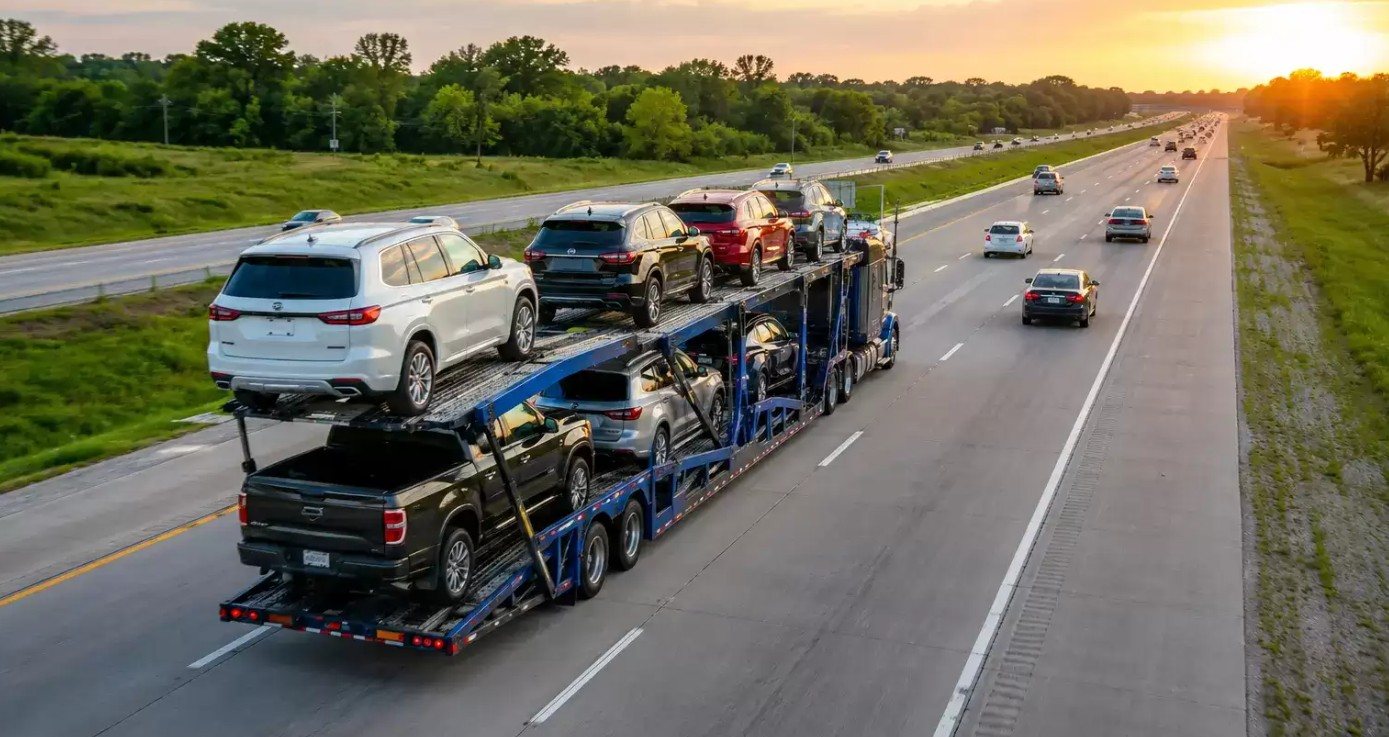
The Horse Capital’s vehicle logistics — calendar-bred, farm-lane fluent, and punctual to trainer standard.
Licensed Broker & Fully Insured
FMCSA Registered
Vetted Carrier Network
Real-Time Tracking & 24/7 Support
50+States Served
100%Insured Transport
24/7Support & Tracking
Lexington runs the world’s most elegant single-industry logistics: the thoroughbred economy, whose farms, sales, and seasons set the Bluegrass calendar the way harvests set farm country everywhere else. We move the industry’s vehicles — never its horses, a distinction this page honors properly — along with everything else a compact, prosperous crossing city ships: the university’s tides, the Toyota corridor’s families, and the daily traffic of a metro seated where I-64 crosses I-75 with six cities inside a day’s reach.
Quick answerLexington ships from the heart of the Bluegrass at the I-64/I-75 crossing: $205–$395 around a six-city one-day ring, $390–$860 to the Southeast, the seaboard, and Florida’s horse country, and $1,010–$1,460 to the far coast, pickup in 1–3 days. The local craft runs on the equine calendar — sales weeks, meet mornings, farm-lane customs — all decoded below. Price your lane in two minutes.
Ship Guy works the Bluegrass from Harrodsburg Road — the city inside New Circle, the farm country out every pike, the Georgetown corridor north, and the horse world’s global calendar throughout. Below: the crossing economics, the equine industry’s vehicle logistics explained by people who know a yearling sale from a claiming race, the farm-lane access custom, and the rate table with the Ocala lane horse country actually books.
Typical pickup1–3 days
Nearest listed laneLouisville, KY · $205–$335
Longest listed laneOcala, FL · $600–$860
Enclosed option+40–60% over open
Local desk(859) 517-5360 · 6a–11p ET
Updated July 25, 2026 · rate figures: July 2026 board.
Lexington Shipping Lanes & Current Rates
The Bluegrass crossing’s working routes — note the Ocala row, because horse country ships to horse country on a lane all its own. Sedan baseline, open trailer.
RouteApprox. distanceEst. transitEst. open rate*
Lexington, KY → Louisville, KY~80 mi1 day$205–$335Get price
Lexington, KY → Cincinnati, OH~85 mi1 day$205–$340Get price
Lexington, KY → Knoxville, TN~175 mi1 day$235–$380Get price
Lexington, KY → Indianapolis, IN~190 mi1 day$240–$390Get price
Lexington, KY → Nashville, TN~210 mi1 day$245–$395Get price
Lexington, KY → Columbus, OH~190 mi1 day$240–$385Get price
Lexington, KY → Atlanta, GA~380 mi1–2 days$390–$590Get price
Lexington, KY → Charlotte, NC~400 mi1–2 days$395–$595Get price
Lexington, KY → New York / New Jersey~700 mi2–3 days$480–$720Get price
Lexington, KY → Ocala, FL~800 mi2–3 days$600–$860Get price
*July 2026 snapshot, running sedan; SUVs and trucks add 10–25%, dimensional quotes for oversized, winch service $100–$200 where needed. Sales-week and meet-season bookings near the track and farm belt favor morning windows — reserve the big weeks the way the industry does: early and precisely.
Best time to book from here
Sale seasons and campus tides shape spring and fall peaks; equine calendars book early. The quiet-value months: deep summer and midwinter.
The Crossing and the Ring: Bluegrass Market Mechanics
Central Kentucky’s shipping geography is quietly excellent: I-75 carries the great north-south river between the Midwest and the Southeast, I-64 crosses it east-west at the city’s edge, and the resulting position puts Louisville, Cincinnati, Knoxville, Indianapolis, Nashville, and Columbus all inside a single transit day — a ring that makes regional moves book like appointments. Through-traffic on both interstates keeps the longer lanes liquid, and the corridor partnership with Louisville eighty miles west (our Louisville page maps that junction’s own gifts) means the two markets pool equipment daily — capacity in the Bluegrass is really the corridor’s capacity, which is to say: ample.
The market’s texture is prosperity at compact scale: a metro small enough to serve entirely, wealthy enough to keep the premium tiers busy, and professional enough — between the horse industry, the university, the medical centers, and the plant corridor — that relocation machinery runs year-round rather than seasonally. Matches come in one to three days, the enclosed trade stays warm through the equine calendar, and the whole operation runs with the punctuality a town full of trainers considers ordinary courtesy.
The Horse World’s Garage: Equine-Industry Vehicle Logistics
First, the distinction that keeps everyone honest: bloodstock moves with licensed equine carriers — specialized equipment, trained handlers, an entire profession built around precious animals — and anyone offering to fold a horse into a car-hauler quote should be shown politely to the gate. What the industry ships with us is its rolling stock: the farm trucks and managers’ vehicles that turn over with the operations, the veterinary practices’ fleets, the seasonal staff arriving for foaling and sales seasons from every hemisphere, and the trainers’ and owners’ personal vehicles migrating with the racing calendar.
The calendar writes the patterns. Sales seasons land the global industry at Blue Grass Airport — September’s yearling sale above all — and the fly-in crowd’s positioned vehicles run our fly-and-drive playbook at full dress: delivery timed to arrival day, pickup after the final session, hotel and farm-stay addresses handled by the local craft. The Ocala lane deserves its rate-table row: Kentucky and Florida horse country trade personnel, families, and vehicles constantly as operations winter south and summer north, and the 800-mile run books here like a commuter route with paddocks at both ends. Book the seasonal legs the way the operations do — ahead of the migration, not amid it — and the lane treats you like family. And farm turnover — managers changing operations, staff following stallion seasons — keeps a steady professional-relocation current that ships exactly like the corporate trade elsewhere, with better stories at the handoff.
The industry’s culture sets our service bar: horse people live by feed times and vet schedules, treat punctuality as baseline character, and document everything. A broker serving this town either matches the standard or loses it; matching it, we’ve found, improves every other customer’s shipment too. Rising standards, like rising bloodlines, lift the whole barn. It’s also simply good business: an industry that references everything references its brokers too, and word in this town travels at a gallop. We intend to keep giving it good news to carry.
September: When the World Comes to Buy
One week each September, this mid-sized city becomes the global center of an industry: the yearling sale draws buyers, agents, and bloodstock professionals from six continents, hotel rates rival Derby week’s, and Blue Grass Airport handles a season’s worth of arrivals whose calendars are measured in hip numbers and session times. The vehicle logistics around it are our densest fortnight of the year: positioned cars delivered to arrival days, farm-stay and hotel addresses coordinated across the county, the consignor community’s support vehicles shuttling between operations, and departure pickups timed to final sessions with the precision the whole week demands.
The craft the fortnight teaches: book the big weeks the way the industry does — early and exactly, because the fly-and-drive calendar fills weeks out; morning windows rule near the sales grounds and the farm belt while the sessions run; and flexibility is a virtue the week doesn’t reward — this is the one stretch of the Bluegrass year when a precise window beats a cheap one, and everyone in town already knows it. The January and November sales run the same playbook at gentler volume, and the whole cycle repeats with the reliability that makes horse country’s calendar the easiest kind to serve: printed, honored, and ancient. Serving it well is less about heroics than about respect: the calendar was here first, and it will outlast us all. In the meantime, we keep its appointments — sales week to foaling season, tip-off to post time — and consider the keeping a privilege of the address.
Why the Farm-Lane Custom Exists: A Short Geography of Stone and Shade
The pikes radiating from Lexington are among America’s loveliest working roads — dry-laid stone walls running to the horizon, tree canopies the farms have tended since the plank-road era, historic lanes engineered for hooves and carriages — and every foot of that loveliness is why seventy-five-foot equipment stays on the main lines. The walls sit close; the canopies hang low; the lanes turn on radii a rig can’t honor; and the farms themselves prefer it this way, having spent generations keeping heavy traffic away from fence lines that horses live along.
So the custom formalized what courtesy invented: farm shipments coordinate through the farm office, meet at the pike junction or the main-road gate, and keep the historic lanes to the pickups and horse vans they were widened for. Nothing about it costs the customer more than a few minutes’ drive, and everything about it preserves the landscape that makes the Bluegrass worth shipping to in the first place. Some markets’ access craft is about towers and docks; ours is about walls that predate the republic — and we’d rather reschedule a truck than rearrange one stone.
The Bluegrass Shipping Year
The region’s calendar, run as one narrative: winter ships gently — foaling season keeps the farms inward-focused, the occasional ice morning earns its shift-a-day respect, and January’s horse sales bring the year’s first fly-in wave. Spring opens the taps: the April meet, graduation’s campus tide, and the professional-relocation season arriving together, with the pikes at their postcard best and morning windows at their most popular. Summer runs on relocations and the Ocala lane’s northbound returns as Florida operations summer their people here. And fall crowns it: September’s sale, the October meet, the campus cycle’s bookend, and the southbound Ocala wave — the market’s richest quarter, booked earliest by everyone who’s lived one.
Through all four movements, the constants hold: the one-day ring prices like local freight, the corridor pooling with Louisville keeps capacity ample, and the punctuality standard never changes — because in a town where the whole economy answers to feed time, the shipping trade learned long ago to arrive when it said it would. That, more than any lane or rate, is what the Bluegrass actually buys from us: a window kept the way this region keeps everything else it values. Precisely.
Campus, Corridor, and Commonwealth: The Other Currents
The university moves its tide at flagship scale each August and May — the standard playbook, run on the wide corridors off campus, with basketball season adding downtown atmosphere that dispatch schedules around like beloved weather — and the medical center’s match-day and fellowship cycles layer the professional version on top, predictable to the week and booked accordingly. The Georgetown corridor north carries the manufacturing current per the callout: plant and supplier families relocating on launch cycles, shift-aware handoff windows, and the employer-paperwork fluency industrial HR expects.
Beyond the metro, the Bluegrass reach ships on regional sense: Frankfort’s capital trade a half-hour west, the bourbon corridor’s towns on the parkway customs our Louisville page details from its end, and the small-town belt toward the mountains served on scheduled runs with meet-in-town handoffs where the roads turn scenic. One office, the whole region, and a booking calendar that reads every calendar in it — equine, academic, industrial, and legislative — before quoting a window.
The medical center’s cycles deserve their sentence: match-day and fellowship arrivals land on the national calendar’s predictable weeks, ship with professional precision, and join a regional healthcare economy whose recruiting reach — the whole eastern half of the state looks here for care — keeps the physician-relocation current running steadier than the metro’s size would suggest. Predictable clusters, professional standards: the easiest bookings the trade knows, and this town generates them on schedule.
Open or Enclosed in the Bluegrass?
The region ships open for daily life and enclosed for its treasures — and few markets this size keep the premium tier this busy.
The daily answer
Open Transport
Farm trucks, campus cars, corridor relocations: open trailers on the crossing’s depth, across four gentle seasons whose worst habits are a summer storm and the occasional ice morning. The ring’s pricing makes regional moves nearly frictionless.
Six-city one-day ring at short-haul rates
Corridor pooling with Louisville keeps capacity ample
Cargo coverage typically $100K–$250K
The paddock-money answer
Enclosed Transport
A wealthy, horse-proud region keeps serious garages: the collections behind the stone walls, the sales-season arrivals’ personal exotics, and the classics bound for shows ship enclosed with liftgate patience and documentation to bloodline standard.
Roughly 40–60% above open rates
Sales weeks book the premium tier early
Cargo coverage $250K–$1M, higher arranged
Bluegrass rule: the farm truck rides open down the pike; the trophy rides enclosed past the walls. Full comparison: open vs. enclosed.
Inside New Circle and Out the Pikes: Where We Pick Up
The city’s neighborhoods and the farm country beyond — each with its Bluegrass-practical answer.
The pikes out of town run between stone walls older than the interstate system, under tree canopies the farms have tended for generations — and none of it was measured for seventy-five feet of trailer. Farm shipments meet at the pike junctions, the crossroads store, or the main-road gate, coordinated with the farm office and kept to the minute. The walls stay standing; the schedule stays sacred; everyone stays friends.
Sales weeks and meet mornings
Keeneland’s April and October meets bring the crowds; the sales weeks bring the world — September’s yearling sale especially, when the global industry lands at Blue Grass Airport with checkbooks and schedules. Track-adjacent and farm-belt handoffs run mornings during the big weeks, fly-and-drive windows book early, and the whole town keeps time like a paddock judge.
The Georgetown corridor
Fifteen minutes up I-75, the plant that anchors central Kentucky’s manufacturing economy moves families through the region on launch cycles and career ladders — and the commuter belt between ships on manufacturing time: shift-aware windows, employer-format paperwork, and a booking calendar that inhales two weeks after every staffing announcement.
Full FMCSA brokerage credentials backed by the $75,000 surety bond — look us up in SAFER the way this town looks up pedigrees: before the handshake.
Calendar-bred dispatch
Meets, sales, foaling seasons, launch cycles, tip-off times — the Bluegrass runs on interlocking calendars, and ours reads them all before a window leaves the barn.
Farm-country fluency
Pike junctions, gate meets, farm-office coordination — the stone-wall country served the way it prefers: precisely, respectfully, and never down the wrong lane.
Trainer-grade punctuality
A town that lives by feed times recognizes kept windows — and nothing is owed until a carrier is assigned, in any season the calendar runs.
Find Us on Harrodsburg Road
Our Lexington office sits on the south side’s main corridor — New Circle minutes away, the pikes radiating toward the farms, and the whole Bluegrass in working range. Daily on the local line, Eastern time.
Ship Guy Auto Transport — Lexington
Address2424 Harrodsburg Rd, Suite 1205 Lexington, KY 40503
What does it cost to ship a car to or from Lexington?
Sedan on open transport: about $205–$340 to Louisville or Cincinnati, $240–$390 to Nashville, Indianapolis, or Columbus, $280–$450 to Knoxville or St. Louis, $390–$590 to Atlanta or Charlotte, $450–$680 to Chicago or DC, $480–$720 to New York/New Jersey, $620–$880 to Florida, and $1,010–$1,460 to the West Coast. Enclosed adds 40–60%. The I-64/I-75 crossing keeps the Bluegrass connected in every direction.
How fast is pickup in the Lexington area?
Typically 1–3 days. Two interstates cross at the city's edge, the Louisville and Cincinnati corridors run daily, and central Kentucky's terrain — parkway access, real driveways, a compact metro — is easy work. Farm-country addresses out the scenic pikes follow their own custom, covered below.
Do you ship horses?
We ship cars for the horse world, not the horses themselves — equine transport is its own licensed specialty with its own equipment, and the bloodstock deserves exactly that. What we move constantly: the industry's vehicles — farm trucks, managers' and vets' cars, seasonal staff relocations, and the fly-in crowd's positioned vehicles around the sales. If it has hooves, call an equine carrier; if it parks at the barn, call us.
How do the Keeneland meets and sales weeks affect scheduling?
Predictably and pleasantly: April and October race meets bring crowds; the sales weeks — September's especially — bring the world's horse industry to town, filling hotels and the airport with buyers, consignors, and their logistics. Handoffs near the track and the farm belt shift to mornings during the big weeks, fly-and-drive deliveries at Blue Grass Airport book early, and the whole rhythm runs like the well-bred calendar it is.
Can a carrier reach the horse farms out the pikes?
By the farm-lane custom: the scenic pikes' stone walls, tree tunnels, and narrow historic lanes were laid out for carriages, not car haulers, so farm shipments meet at the pike junctions, the nearest crossroads store lot, or the farm's main-road gate — arranged with the farm office and honored to the minute, because around horses, everything runs on schedule.
What about the Toyota corridor up in Georgetown?
A fifteen-minute run north and a steady trade: the plant and its supplier network move professional families through the region constantly, and the commuter belt from Georgetown down through the north side ships on the manufacturing-relocation machinery — start dates, employer formats, family fleets sequenced. When the plant staffs a launch, our calendar knows before the news does.
Does UK's calendar move the market?
Twice a year, on schedule: August's arrival tide and May's departure run the standard campus playbook — parents booking remotely, students signing locally, handoffs on the wide corridors off campus, and move-in weekend left to the minivans. Basketball season adds only atmosphere; game nights concentrate traffic downtown for a few hours, which dispatch simply schedules around like weather with a fight song.
Where is Ship Guy located in Lexington?
2424 Harrodsburg Rd, Suite 1205, Lexington, KY 40503 — on the south side's main corridor. Local line (859) 517-5360, staffed daily 6:00 AM to 11:00 PM Eastern.
Get a free, no-obligation quote in about 60 seconds — or call and talk to a real specialist right now.
Licensed & insured
No upfront deposit
24/7 support
Ship Guy is a licensed, bonded auto transport broker (MC #1457715 • USDOT #3932149) with a local office at 2424 Harrodsburg Rd Suite 1205, Lexington, KY 40503 • (859) 517-5360 • open 7 days, 6 AM–11 PM, serving Lexington and the Bluegrass, inside New Circle and out every pike. Verify our operating authority anytime in the FMCSA SAFER database. Rate estimates on this page reflect current lane conditions and are refreshed quarterly. Learn how insurance & claims work and who we are.
Written & reviewed by [Full Name], [Title], [X] years in vehicle logistics • Last updated: