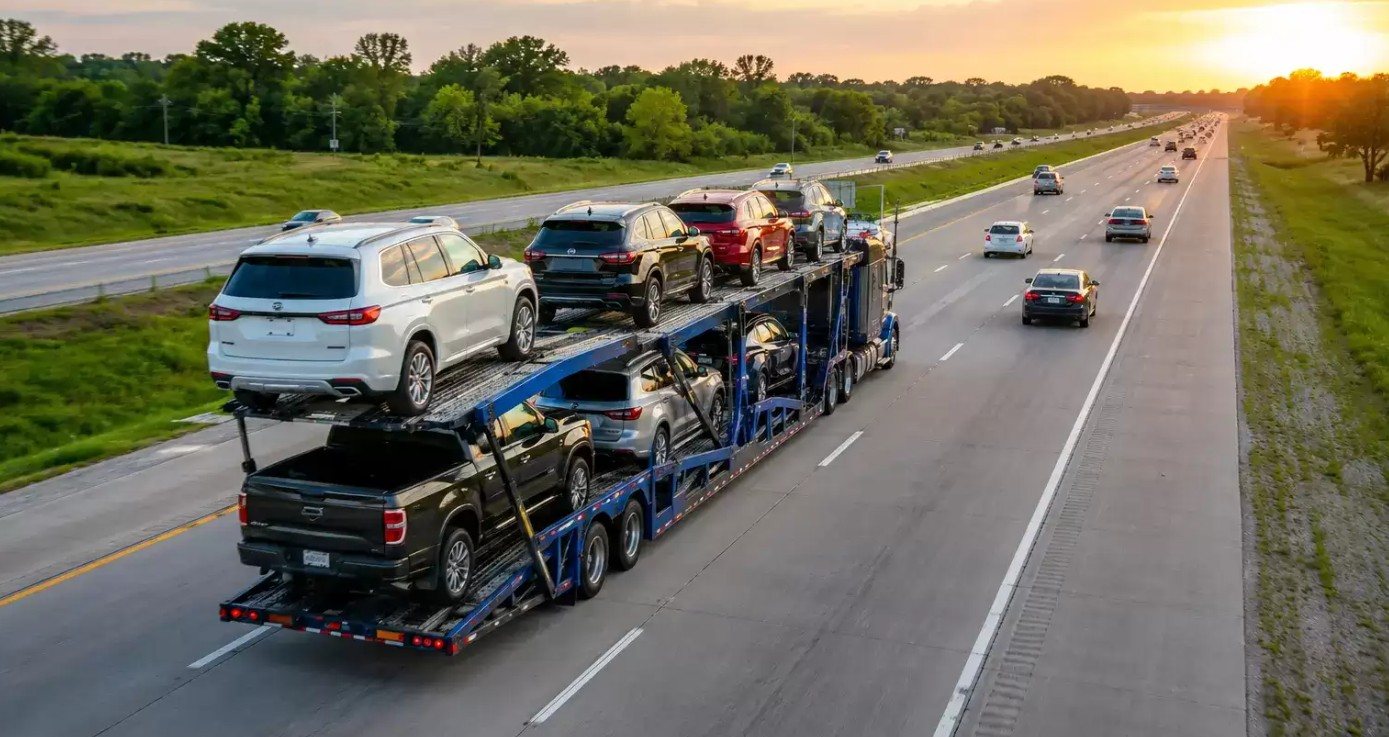
The busiest car shipping market in America, handled by people who know its streets — vetted carriers, daily departures, no deposit to book.
Licensed Broker & Fully Insured
FMCSA Registered
Vetted Carrier Network
Real-Time Tracking & 24/7 Support
50+States Served
100%Insured Transport
24/7Support & Tracking
Los Angeles is where American auto transport is biggest, cheapest per mile, and hardest to do well — all three at once. More vehicles enter and leave this basin by truck than any other place in the country: relocations in both directions, the port complex feeding two oceans of trade, an entertainment economy that moves cars like props, the EV capital of the hemisphere, and a collector scene with no equal. The trucks are everywhere. The trick, in a city famous for having no room, is the last hundred feet.
Quick answerLos Angeles is the highest-volume auto transport market in the country, and it shows in the numbers: $300–$550 across the Southwest and to the Bay, $750–$1,200 to the Northwest, Rockies, and Texas, and $1,050–$1,550 coast-to-coast for a sedan on an open trailer — with pickup often inside 24–48 hours. The catch is never finding a truck; it’s finding where 75 feet of truck can meet you in this city, and that’s exactly what we’re good at. Price your lane in two minutes.
Ship Guy runs greater Los Angeles from our office on Westwood Boulevard — from the canyons to the flats, San Pedro to the Valley, and every lane out of the basin. This page is the full local playbook: real rates on the eleven lanes we book most, the neighborhood-by-neighborhood access system that makes LA pickups painless, what’s genuinely different about shipping EVs and exotics, how the ports fit in, and the timing patterns — seasonal and daily — that a national call center quoting “Los Angeles” as one giant dot will never tell you.
Typical pickup1–3 days
Nearest listed laneLas Vegas, NV · $300–$475
Longest listed laneNew York, NY · $1,150–$1,550
Enclosed option+40–60% over open
Local desk(323) 685-4924 · 6a–11p PT
Updated July 25, 2026 · rate figures: July 2026 board.
Los Angeles Auto Transport Lanes & Current Rates
Both directions on the lanes America ships most. Sedan, running condition, open trailer; enclosed and expedited quoted on request.
RouteApprox. distanceEst. transitEst. open rate*
Los Angeles, CA ↔ Las Vegas, NV~270 mi1 day$300–$475Get price
Los Angeles, CA ↔ Phoenix, AZ~370 mi1–2 days$300–$500Get price
Los Angeles, CA ↔ San Francisco Bay Area~380 mi1–2 days$350–$550Get price
Los Angeles, CA ↔ Portland, OR~960 mi2–4 days$700–$950Get price
Los Angeles, CA ↔ Denver, CO~1,015 mi3–4 days$800–$1,100Get price
Los Angeles, CA ↔ Seattle, WA~1,135 mi3–5 days$750–$1,050Get price
Los Angeles, CA ↔ Dallas, TX~1,435 mi3–5 days$850–$1,150Get price
Los Angeles, CA ↔ Houston, TX~1,550 mi3–5 days$900–$1,200Get price
Los Angeles, CA ↔ Chicago, IL~2,015 mi4–6 days$1,050–$1,400Get price
Los Angeles, CA ↔ Miami, FL~2,730 mi5–7 days$1,150–$1,500Get price
Los Angeles, CA ↔ New York, NY~2,790 mi5–8 days$1,150–$1,550Get price
*Rates reflect July 2026 lane conditions for a standard sedan; count on roughly 10–25% more for SUVs and trucks, oversized and lifted vehicles quoted by dimensions, non-runners add $100–$200 for winch loading. Directional demand moves these numbers week to week — a firm quote locks yours.
Best time to book from here
Volume never really rests; production cycles and port rhythms keep every month liquid. Marginally softer pricing midwinter; coastal lanes run deepest in summer.
Why LA Is the Best Market in America to Ship From (and Into)
Every price advantage in auto transport comes down to truck density, and no market on the continent approaches this one. Greater Los Angeles anchors the I-10 southern transcontinental, the I-5 West Coast spine, and the I-15 run to Vegas and the Mountain West; it hosts the country’s largest port complex, its biggest concentration of dealers and auctions, and a population that generates relocation freight in both directions every single day. Carriers don’t detour to Los Angeles. They live here.
For you, that density buys three things. Speed: 24–48-hour pickup is routine, and same-day happens weekly. Price discipline: with this many trucks competing, no single carrier sets the rate, and quotes cluster tight around a real market number — which makes wildly low outliers easy to spot for what they are (bait). And resilience: when plans change, a replacement truck exists, today, not next Tuesday. In thin markets a canceled carrier costs you a week; in LA it costs you a phone call.
The honest caveat runs the other direction: density means demand, and on peak corridors at peak times — eastbound in late summer, enclosed capacity during auction and awards seasons — even LA tightens. The lane never closes; it just stops discounting. The cure, as everywhere, is a few days of flexibility, which in this market converts to real money faster than anywhere else.
The Last Hundred Feet: LA Access, Neighborhood by Neighborhood
Finding a truck is trivial here. Finding where the truck can legally stand still is the craft.
A loaded car carrier is seventy-five feet long, thirteen and a half feet tall, and turns like the Queen Mary. Los Angeles — a city of canyon lanes, permit blocks, protected bike lanes, low ficus canopies, and parking enforcement that could balance the municipal budget — is the most demanding last-mile environment in American vehicle logistics. Which is why the working system here isn’t door-to-door in the literal sense: it’s near-door, at a spot chosen for the truck’s geometry and confirmed with you by text.
The system has rules of thumb every LA driver knows. Westside flats: wide boulevards and market lots, mid-morning, after street-sweeping hours. Downtown and Koreatown towers: a block with commercial loading or the building’s freight window, never the alley. Beach cities: inland a few blocks, off the permit grid. The Valley: easiest terrain in the basin — broad, flat, forgiving. And the Hills, always and forever: the boulevard below. None of this costs you service; it costs you a ten-minute walk or a short drive, and it’s the difference between a smooth handoff and a citation-collecting spectacle.
The Hills and the canyons
Hollywood Hills, Laurel and Coldwater, Bel Air, the Palisades: gorgeous streets that end car-carrier careers. Grades, hairpins, overhanging trees, and nowhere to turn around — every Hills shipment stages at the boulevard below, Sunset or Ventura or Sepulveda, and the last climb happens on the car’s own wheels. Non-negotiable, and every experienced Hills owner already knows it.
Permit blocks and alley buildings
Much of the flats has the opposite problem: Santa Monica and Venice permit zones, Koreatown and Downtown towers that load through alleys, Mid-City blocks where street parking is a contact sport. Solution’s the same shape — a wide commercial block or big lot nearby, set by text an hour out. LA ships from parking lots, and it works beautifully.
Traffic windows are real windows
Carriers plan LA like locals: surface pickups mid-morning or early afternoon, freeway repositioning outside the crush, and honest delivery windows instead of fantasy ETAs. When a driver says “between 10 and noon,” that’s the 405 talking, and the schedule respects it.
The South Bay port shadow
San Pedro, Wilmington, Long Beach: the neighborhoods around the port complex see constant vehicle drayage, and residential customers there benefit — trucks are always nearby, and port-adjacent pickups match faster than almost anywhere in the basin.
EV Nation: Shipping Electric Out of the EV Capital
No region ships more electric vehicles than Southern California, and EVs change the job in specific, manageable ways that a good carrier prices in from the start — and a careless one discovers at the weigh station.
Weight is the big one. A battery pack adds one to three thousand pounds over a comparable gas car, and a ten-car trailer’s axle limits are federal law, not suggestions. Two or three EVs on a load changes what else can ride along, which is why the exact model — not “a Tesla” — belongs on the order. Disclosed weight is a routine loading calculation; surprise weight is a rebooked shipment.
Charge state: 30 to 60 percent. Enough for loading, unloading, and delivery-day maneuvering; low enough to keep the pack in its happiest state for a multi-day ride. Full charge isn’t dangerous, just pointless; near-empty risks an awkward delivery if the truck arrives a day late to a car that spent the wait running sentry cameras.
Which brings up monitoring modes. Turn them off. A vigilant EV filming its own transport drains its battery, fills your phone with alerts of a truck driver doing his job, and helps no one. Note the charging gear too: mobile connector in the trunk if you’ll want it at destination, and know that transit itself needs none of it.
Rates for EVs run at or barely above comparable gas vehicles — the weight math is priced into the load plan, not surcharged at the curb, at least by carriers who knew it was coming. One more reason the model line on your quote matters.
Exotics, Classics, and the Enclosed Capital of America
Los Angeles supports the deepest enclosed-transport ecosystem in the country, because it has to: the collector garages of Beverly Hills and Hidden Hills, the auction consignments, the restoration shops, the studio fleets, and a steady traffic of seven-figure metal that treats an open trailer as unthinkable. If your car is low, rare, freshly restored, or simply beloved beyond its blue-book number, this is the market where the right trailer is never far away.
What the premium buys: hard-sided protection from weather, road debris, and curiosity; liftgate loading at shallow angles for splitter-and-diffuser clearances; soft straps over the tires rather than hooks under the frame; single-level trailers where nothing drips from above; and drivers who handle this class of vehicle exclusively. Cargo coverage on enclosed loads typically runs $250K to $1M, with higher limits arranged case by case — and for owners who prefer discretion, unmarked equipment and quiet handoffs are a normal request, not a special one.
Timing note for this market: enclosed capacity migrates. January’s Arizona auction week pulls trailers east, spring concours season scatters them nationally, and awards-season vehicle logistics tighten the local supply in ways the open market never feels. For a specific enclosed date in those windows, book two weeks out and it’s effortless. Details on the service itself: enclosed transport.
The Ports: LA/Long Beach and the International Leg
The San Pedro Bay complex — the ports of Los Angeles and Long Beach together — is the busiest container gateway in the hemisphere, and a major artery for vehicles crossing the Pacific in both directions. If your shipment touches the water, the pattern matches what we run at Gulf and East Coast ports: the ocean crossing, customs brokerage, and export title work belong to a licensed freight forwarder; the domestic trucking precision belongs to us.
Exporting — to Asia, Australia, the Middle East — we collect the vehicle anywhere in the U.S. and deliver to your forwarder’s facility or the RO/RO terminal on their receiving schedule, documentation matching to the letter, because a port doesn’t take vehicles on a truck’s whim. Importing, we pick up at the complex once customs releases the vehicle and run it anywhere in the country — including the steady stream of enthusiast imports that clear here, which usually graduate straight onto an enclosed trailer for the trip to their new garage. If you don’t have a forwarder yet, we’ll gladly sketch how the pieces fit before you commit to any of them.
LA Timing: Seasons, Directions, and the January Secret
Los Angeles doesn’t swing like a snowbird market — no October stampede, no April exodus — but it has patterns, and they’re worth money to know. Late summer is the national moving season, and eastbound loads out of LA firm up with it; book ahead in July and August or ship a week off the peak. Late fall softens everything, and it’s quietly the best-value stretch of the year in most directions.
Then there’s the January secret: every new year, a wave of people escapes winter into Southern California, filling westbound trucks and leaving carriers hunting for anything headed back east — which makes shipping into LA in deep winter one of the best directional bargains in the country, and eastbound out of LA briefly premium. If your dates can slide across that seam in either direction, tell us; the same car on the same lane can price meaningfully differently two weeks apart.
Weather, blessedly, barely rates a mention — no snow, no ice, hurricanes unheard of. The rare disruptions are the region’s own: a major wildfire closing a canyon corridor, a Pacific storm flooding the usual suspects for an afternoon. When one touches your shipment’s geography, the plan adjusts and you hear it from us first — the standing promise, in every season and every zip code.
Open or Enclosed in Los Angeles?
Both answers are more available here than anywhere else — which makes choosing refreshingly simple.
The volume answer
Open Transport
The commuter, the family SUV, the online purchase, the corporate relocation: open transport moves the overwhelming majority of LA vehicles, at the sharpest per-mile rates in the nation and with matches measured in hours. SoCal weather makes the open ride about as gentle as the method gets.
Deepest carrier supply in America — speed and price both show it
Multi-car family or dealer bookings routinely share one truck
Cargo coverage typically $100K–$250K
The capital’s specialty
Enclosed Transport
Nowhere matches LA’s enclosed ecosystem: liftgate trailers, single-level rigs, white-glove specialists, and discretion as a standard menu item. For exotics, classics, freshly restored metal, or anything whose value is partly emotional, the premium buys genuine peace of mind.
Roughly 40–60% above open; specialty service quoted individually
Best availability outside auction and awards season crunches
Cargo coverage $250K–$1M, higher arranged for exceptional vehicles
The LA rule: ship the daily driver open without a second thought; give the special one the trailer this city invented the standards for. Full comparison: open vs. enclosed.
Everywhere the Basin Reaches: Areas We Serve
From the canyons to the coast, the Valley to the ports — and the counties beyond.
Westwood / West LASanta MonicaVeniceBeverly HillsHollywoodHollywood HillsDowntown LAKoreatownSilver Lake / Echo ParkPasadenaGlendaleBurbankSherman OaksStudio CityWoodland HillsCulver CityInglewoodEl SegundoTorranceLong BeachSan PedroWhittierEast LAMalibu
And the wider region, daily
Orange CountySan Fernando ValleySan Gabriel ValleySanta ClaritaVentura / OxnardRiversideSan BernardinoPalmdale / Lancaster
Why Ship with Ship Guy in Los Angeles
Licensed & bonded
FMCSA broker authority, $75,000 surety bond, verifiable in SAFER in thirty seconds — table stakes we’re happy to have checked.
The last hundred feet, solved
Canyon staging, permit-zone workarounds, tower loading docks, port timing — a Westwood office that treats LA access as the craft it is, not an inconvenience to apologize for.
Depth on every lane
The nation’s busiest market means real choices among carriers — and we spend that choice on the ones whose service records earn it, not the ones a load board coughed up first.
From EVs to exotics
Weight-smart EV loading, liftgate enclosed service, port coordination, discreet handling on request — the full range this market demands, with no deposit until a carrier is assigned.
Find Us on Westwood Boulevard
Our LA office sits on the Westside between UCLA and the 10 — central to the neighborhoods, ports, and freeways this market runs on. Seven days a week on the local line.
Ship Guy Auto Transport — Los Angeles
Address2315 Westwood Blvd #1390 Los Angeles, CA 90064
LA is the busiest auto transport market in America, and competition keeps rates sharp: roughly $300–$500 to Phoenix or Las Vegas, $350–$550 to the Bay Area, $750–$1,100 to the Pacific Northwest or Denver, $850–$1,200 to Texas, and $1,050–$1,550 for cross-country runs to Chicago, Miami, or New York — sedan, open trailer. Enclosed adds 40–60%. A free quote locks your lane and dates.
How quickly can you pick up in LA?
Often within 24–48 hours. More carriers load and unload in greater Los Angeles every day than anywhere else in the country, so LA pickups fill trucks that are already here. The variable isn't finding a truck — it's finding a spot where 75 feet of truck can legally and physically meet you, which is the local skill this page is mostly about.
Can a car carrier really get to my street in the Hills / Venice / Downtown?
Usually not, and a driver who claims otherwise hasn't seen your street. Canyon roads, permit-parking blocks, alley-loading buildings, and low-hanging trees rule out direct door service across much of LA. The working solution is a nearby wide spot — a boulevard, a big lot, a park's edge — set by text with the driver. It's a ten-minute meet, and it's how the entire city ships.
What's different about shipping an EV from Los Angeles?
Weight and charge state. EVs run 1,000–3,000 lbs heavier than comparable gas cars, which matters on a multi-car trailer's axle math — always disclose the exact model so the carrier loads legally. Ship at 30–60% charge (safe, stable, enough for delivery maneuvering), send the mobile connector in the trunk if you'll need it on arrival, and turn off Sentry-type monitoring modes that drain the battery and film the driver all week.
Do you ship exotics and collector cars out of LA?
Constantly — this is the enclosed-transport capital of the country. Hard-sided trailers with liftgates, soft straps, and low-angle loading for anything with splitter-scraping clearance; discreet handling for owners who'd rather not advertise; coverage typically $250K–$1M on enclosed loads, higher arranged case by case for seven-figure cars.
Can you handle port shipments through LA/Long Beach?
Yes — the domestic leg on both directions. Exports: pickup anywhere in the U.S., delivery to your freight forwarder or the RO/RO terminal on their receiving schedule. Imports: once your vehicle clears customs and is released, we collect at the port and deliver anywhere in the country. The ocean booking and customs brokerage belong to your forwarder; the trucking precision is ours.
Is there a cheapest season to ship out of LA?
LA is less seasonal than snowbird markets, but patterns exist: late summer peaks with national moving season, January fills eastbound trucks with people fleeing winter into California (making westbound-into-LA the year's quiet bargain), and rates soften in late fall. Flexibility of even three or four days matters more than the month.
How do I time shipping when I'm flying out of LAX?
Have the car picked up a day or two before you fly, not the morning of — LA traffic plus a fixed flight is how horror stories start. Going the other way, we time delivery a day after you land, to an address or lot you can actually receive at. Tell us the flight and we'll build the buffer in.
Does wildfire season affect shipments?
Rarely, but honestly: when a major fire closes a corridor — a canyon route, a stretch of the 101 — pickups in the affected zone pause or relocate, and we call you with the plan rather than letting a truck sit in an evacuation area. Citywide, shipping runs normally even during fire events elsewhere in the region.
Where is Ship Guy located in Los Angeles?
2315 Westwood Blvd #1390, Los Angeles, CA 90064, on the Westside between UCLA and the 10. The local line, (323) 685-4924, answers seven days a week, 6:00 AM to 11:00 PM.
Get a free, no-obligation quote in about 60 seconds — or call and talk to a real specialist right now.
Licensed & insured
No upfront deposit
24/7 support
Ship Guy is a licensed, bonded auto transport broker (MC #1457715 • USDOT #3932149) with a local office at 2315 Westwood Blvd #1390, Los Angeles, CA 90064 • (323) 685-4924 • open 7 days, 6 AM–11 PM, serving greater Los Angeles from the canyons to the coast. Verify our operating authority anytime in the FMCSA SAFER database. Rate estimates on this page reflect current lane conditions and are refreshed quarterly. Learn how insurance & claims work and who we are.
Written & reviewed by [Full Name], [Title], [X] years in vehicle logistics • Last updated: