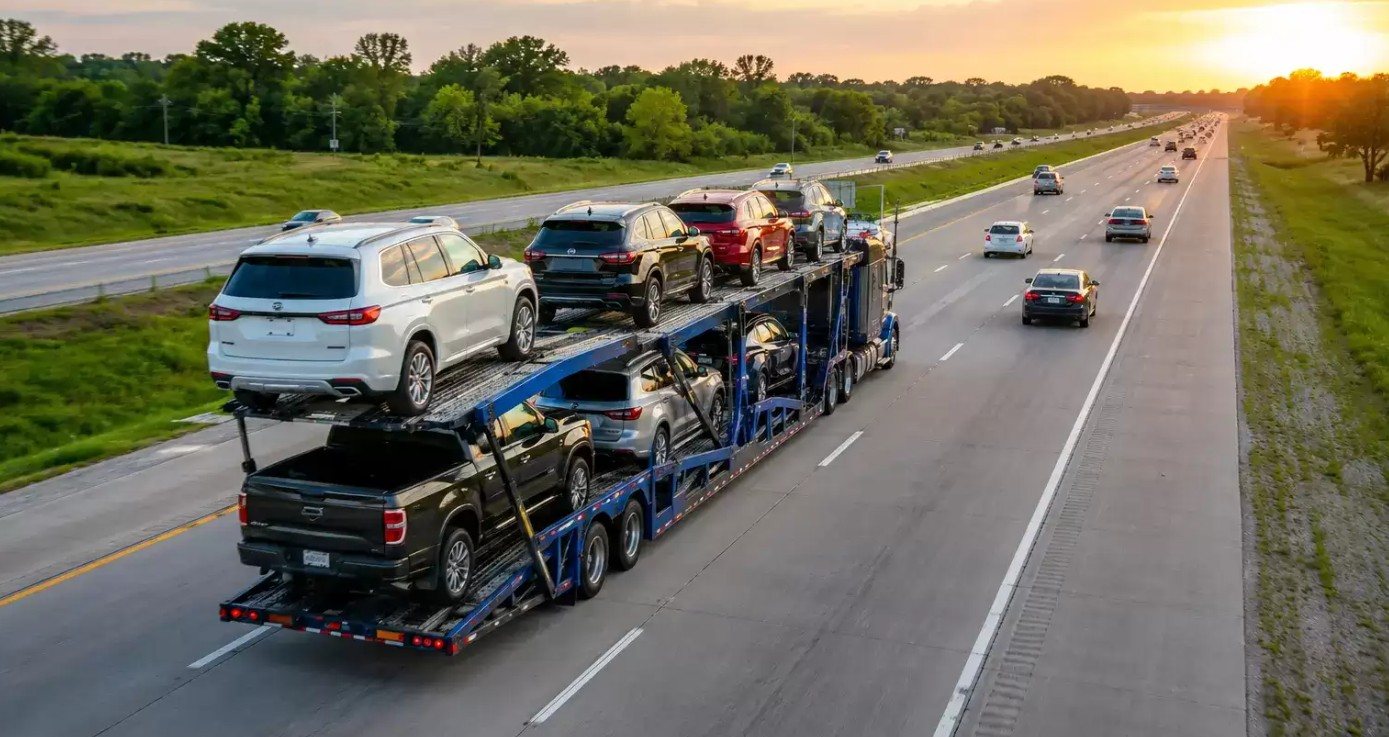
Capital-region car shipping from the junction of the West’s two great truck routes — mountain-smart, canopy-aware, no deposit to book.
Licensed Broker & Fully Insured
FMCSA Registered
Vetted Carrier Network
Real-Time Tracking & 24/7 Support
50+States Served
100%Insured Transport
24/7Support & Tracking
Sacramento is where Northern California’s geography does the shipping industry a favor: the state capital sits precisely at the junction of I-5, the West Coast’s spine, and I-80, the transcontinental that climbs the Sierra an hour east. Every carrier moving up the coast or across the mountains passes through — which makes the capital region a fast, fairly priced market with one dramatic seasonal exception that lives at 7,000 feet and goes by the name Donner.
Quick answerSacramento ships from the junction of the West’s two great truck routes — I-5 and I-80 — so a sedan runs $250–$600 within California and to Reno, $550–$975 up the coast or into the Great Basin, and $1,150–$1,700 heading east, with pickup in 1–3 days. The one seasonal asterisk is the Sierra in winter — Donner Pass makes its own rules, explained below. Price your lane in two minutes.
Ship Guy covers the capital region from our office on H Street — the city grid, the suburban ring from Roseville to Elk Grove, the foothills, and the Tahoe corridor. Below: the junction economics that keep this market liquid, the Sierra winter playbook for eastbound shipments, the receiving-end guide for the Bay Area wave, Tahoe and Gold Country delivery logistics, and the one access quirk unique to the City of Trees.
Typical pickup1–3 days
Nearest listed laneSan Francisco Bay Area · $250–$400
Longest listed laneNew York, NY · $1,275–$1,700
Enclosed option+40–60% over open
Local desk(916) 545-6313 · 6a–11p PT
Updated July 25, 2026 · rate figures: July 2026 board.
Sacramento Car Shipping Lanes & Current Rates
The capital region’s working routes, including the mountain-country lanes we run daily. Sedan baseline, open trailer.
RouteApprox. distanceEst. transitEst. open rate*
Sacramento, CA → San Francisco Bay Area~90 mi1 day$250–$400Get price
Sacramento, CA → Reno, NV~130 mi1 day$275–$425Get price
Sacramento, CA → Los Angeles, CA~385 mi1–2 days$375–$600Get price
Sacramento, CA → Portland, OR~580 mi2–3 days$550–$800Get price
Sacramento, CA → Boise, ID~550 mi2–3 days$550–$800Get price
Sacramento, CA → Seattle, WA~750 mi2–4 days$700–$975Get price
Sacramento, CA → Salt Lake City, UT~650 mi2–3 days$625–$875Get price
Sacramento, CA → Denver, CO~1,150 mi3–5 days$850–$1,200Get price
Sacramento, CA → Chicago, IL~2,050 mi4–7 days$1,150–$1,600Get price
Sacramento, CA → New York, NY~2,800 mi6–8 days$1,275–$1,700Get price
*July 2026 conditions, standard sedan; SUVs and pickups typically 10–25% more, oversized by dimensions, non-runners +$100–$200 for winch loading. Eastbound winter quotes include Sierra weather slack — a built-in day, not a hidden fee.
Best time to book from here
Capitol cycles and August family moves shape the peaks; valley heat pushes summer loading early. Best value: the deep-winter weeks between sessions.
Junction Economics: Two Interstates, One Fair Market
Auto transport pricing follows truck traffic, and Sacramento collects two of the busiest streams in the West. I-5 delivers the coastal flow — Seattle to San Diego and every dealer, auction, and relocation between — while I-80 carries the transcontinental trade toward Reno, Salt Lake, and the East. A city at the confluence never waits long for capacity: your booking fills a slot on a truck already coming through, which is the entire secret of good rates everywhere.
The junction shapes the market’s personality lane by lane. North-south moves are conveyor work — Portland and LA match quickly at corridor pricing, and the Bay hop is short-haul simple. The eastbound story is richer: Sacramento is the last full-service staging point before the Sierra, which means eastbound loads often assemble here — a structural advantage for local shippers, since your car boards at the front of the line rather than joining somewhere mid-mountain. And the Central Valley’s own agricultural trucking rhythm keeps equipment and drivers dense in the region year-round, a quiet depth that shows up whenever you need a truck on short notice.
The honest limit: lanes that leave both corridors — the desert Southwest diagonals, say — may route through the LA or Bay hubs first. As always, it’s a day and a disclosure, and we make the disclosure unprompted.
The Donner Factor: Eastbound Shipping and the Sierra in Winter
No other California market has a mountain range with veto power over its shipping calendar. From roughly November through March, I-80’s climb over Donner Summit answers to the weather: chain-control levels that slow commercial traffic to a crawl, and storm closures that stop it entirely — sometimes for an afternoon, occasionally for a day or more while Caltrans digs the pass out.
Here’s how the industry actually handles it. Carriers watch the same Caltrans reports every Tahoe skier refreshes, and they do not drive a loaded ten-car rig into a chain-control level that prohibits it — they hold in Sacramento or Reno, let the interval pass, and cross clean. For your shipment, that means eastbound winter quotes carry a built-in day of slack, delivery windows are honest about the mountains, and a closure triggers a phone call with the revised plan. Occasionally a southern reroute through Bakersfield and the 58 makes sense for time-critical loads; we’ll price it when it does.
Two practical notes for winter shippers. First, the pass cuts both ways — inbound cars from Reno and points east ride the same weather, so build the same patience into arrival plans. Second, if your dates are flexible, shipping the week before a forecast storm cycle beats the week of it by exactly the margin you’d expect; we watch the extended forecast at booking and will tell you when a two-day shift dodges a system entirely. The mountain always wins the argument — the trick is not scheduling one.
And a word for the summer crosser: the pass in July is pure pleasure — but the season brings its own watch item, wildfire. When a major incident touches the 80 or 50 corridors, closures and smoke management can reroute or pause mountain deliveries exactly as snow does, on less notice. Same protocol applies: we track the incident maps, the plan flexes, and the call comes from us before the question occurs to you.
Receiving the Bay Wave: The Capital as Destination
For years now, the region’s defining migration has run east up the causeway: Bay Area households trading bridge tolls for backyards in Elk Grove, Folsom, Roseville, and the city’s reviving grid. Our San Jose and San Francisco pages describe the departure end; this is the arrival manual, and it’s mercifully short, because arriving here is the easy part.
The move itself is a one-day lane — cars picked up in the Bay in the morning routinely deliver to a Sacramento-area driveway the same afternoon, at a short-haul rate that surprises people braced for Bay prices. Delivery logistics relax on contact: where the pickup end may have involved a staging corridor and a walk (see the San Francisco page for what that’s about), the receiving end is usually your actual driveway or the wide street in front of it, suburban-simple. Two-car households moving in one go should book both vehicles together — the ninety-mile lane makes same-truck pairing easy and the combined price kind.
The single receiving-end caveat is the canopy: land in one of the older tree-vaulted neighborhoods and your delivery meets you at the nearest wide block — the callout below explains, and the trees, we’d argue, are worth it.
The Government Move: Shipping on the State’s Clock
Capital cities have a shipment species all their own: the government relocation. Agency transfers between Sacramento and the state’s regional offices, new hires arriving for session-season starts, fellows and appointees on defined terms, and the civil-service two-step of promotion-then-relocation — together they give this market a steady professional bassline that most cities’ economies can’t match for predictability.
What government moves want from a shipper is precision without drama: a report date honored, documentation formatted for reimbursement systems that predate the internet, and invoices that survive an auditor’s gaze. We’ve shaped the process to fit — itemized paperwork on request, scheduling backward from the first day at the new desk, and patience with procurement rhythms that occasionally approve a move eleven days after it needed to happen. (When that happens, the junction’s carrier depth is what turns “eleven days late” into “shipped Thursday.”)
The same machinery serves the capital’s orbit: university medical and veterinary recruits bound for Davis, court and legal relocations, and the contractors who follow every budget cycle into town. If your move answers to a start date and a reimbursement form, you’re our most familiar customer — welcome to the file. One scheduling grace note the capital taught us: session-adjacent weeks concentrate arrivals in January and post-recess, so those windows reward booking a week earlier than the calendar alone would suggest.
The Reno Relationship: Two Cities, One Mountain, Endless Shuttling
A hundred and thirty miles of I-80 — and one opinionated mountain range — connect Sacramento to Reno, and the corridor behaves less like a shipping lane than a shared driveway. Households split between the two for work, family, and cost-of-living arithmetic; retirees migrate east over the hill and keep ties west of it; and a steady trade of vehicles bought on one side and driven on the other keeps the short lane busy in both directions all year.
The logistics are short-haul simple — often booked one day, delivered the next — with the pass as the only variable, and only in winter (the Donner section above governs). Two corridor-specific notes from experience: first, cross-state moves involving registration changes go smoother when the paperwork question is settled before the truck is booked, so the car lands where its new documents need it; we’ll flag the question, though the answers belong to the DMV on whichever side claims you. Second, the corridor’s auction-and-dealer trade — vehicles wholesaled between the markets — means share-a-truck opportunities are unusually common here; a flexible day on your pickup often pairs your car with the trade’s and trims the rate accordingly. Reno-bound retirees repositioning a household’s second vehicle make up the corridor’s gentlest regular trade — unhurried dates, easy addresses, and the pass timed like the locals they’re becoming. If your move fits that description, mention it: the unhurried booking is the one every dispatcher prices kindest.
The Tahoe Corridor: Cabins, Ski Leases, and the Seasonal Shuffle
Sacramento is the natural staging ground for the Tahoe basin, and the corridor up the 80 and the 50 carries a distinctive seasonal trade: second-home owners positioning a mountain vehicle for ski season, summer families reversing it, remote-work households who made Truckee year-round and needed the second car to follow, and the occasional Subaru inherited by a ski lease and shipped in from three states away.
Mountain delivery has its own etiquette. Truckee and the North Shore run as scheduled I-80 deliveries; South Shore rides the 50. Cabin driveways — steep, snow-banked, gravel, or all three — follow the junction-meet rule, typically a plowed lot in Truckee or at the highway turnoffs. In ski season we schedule around the weekend migrations (a Friday-afternoon delivery on 80 is a rookie promise), and in storm cycles mountain drops inherit the same weather slack as the pass itself. The reward for planning around all of it: your snow car waiting in the mountains the day the season opens, while the neighbors are still chaining up in the Nyack lot.
Open or Enclosed in the Capital Region?
Valley weather makes open easy most of the year — and the exceptions here are seasonal, not social.
The Valley default
Open Transport
Commuters, family SUVs, the Bay-exodus fleet, campus cars: open transport moves the region economically in a climate that cooperates — dry summers, mild winters on the Valley floor, rain as the only weather most shipments ever see. Junction supply keeps matches fast.
Two-interstate depth on every major lane
Same-day Bay-to-Sacramento delivery is routine
Cargo coverage typically $100K–$250K
The seasonal case
Enclosed Transport
The region’s classics — and there are many, from Gold Country barns to midtown garages — ship enclosed to shows and buyers, with liftgates for anything low. The distinctly local use: winter Sierra crossings for precious cargo, where walls beat cinders and road brine over the pass.
Roughly 40–60% above open rates
Winter pass crossings are enclosed’s best local argument
Cargo coverage typically $250K–$1M
Capital rule: on the Valley floor, open wins on math all year; over the mountains in January, the enclosed premium buys real protection from what Caltrans spreads on the road. For everything between those poles, ask — the two-minute conversation beats guessing in either direction. Full comparison: open vs. enclosed.
Grid, Suburbs, Foothills: Where We Pick Up
The capital’s three terrains, each with its own easy answer.
Sacramento’s magnificent canopy — the elms of East Sac, the sycamores of Land Park, Midtown’s green tunnels — is also thirteen feet of clearance nobody measured for a car hauler. Older-neighborhood handoffs shift to the wider cross streets as a matter of habit; the trees were here first and every good driver treats them that way.
Foothills and Gold Country
Auburn, Placerville, Grass Valley, and the ridge towns trade the Valley grid for winding two-lanes and long gravel drives — classic meet-at-the-highway territory, usually a lot near the 80 or 50 exits. In fire season we watch closures the way winter watches the pass; in both cases the plan flexes and you hear it first from us.
Davis and the campus lane
UC Davis sits fifteen minutes down the causeway, adding the familiar academic tide — September arrivals, June departures, parents booking from afar — to the regional mix. Campus-adjacent handoffs work best on the town’s wide peripheral streets, and never during move-in weekend, a rule that holds in every college town in America.
And up the hill, on the mountain schedule
AuburnGrass ValleyPlacervilleTruckeeTahoe CitySouth Lake TahoeReno, NVStockton
Why Ship with Ship Guy in Sacramento
Licensed & bonded
FMCSA broker authority backed by the $75,000 surety bond — both verifiable in SAFER, and we’d rather you looked than took our word.
Mountain-literate dispatch
Chain-control levels, closure protocols, storm-cycle timing — the Sierra is a variable we plan for on day one, not an excuse we discover in week two.
Junction depth, spent well
Two interstates’ worth of carrier choice, filtered through service records rather than load-board luck — the trucks that get your car earned the assignment.
Capital-to-cabin range
Downtown grid, suburban ring, Gold Country gravel, Tahoe snowbanks — one office that speaks all four dialects, with nothing owed until a carrier is assigned.
Find Us on H Street
Our Sacramento office sits downtown a few blocks from the Capitol — central to the grid, minutes from the 5 and the 80, and staffed every day on the local line.
What does it cost to ship a car to or from Sacramento?
Sedan, open trailer: around $250–$400 to the Bay Area, $275–$425 over the hill to Reno, $375–$600 to Los Angeles, $550–$800 to Portland, $700–$975 to Seattle, $850–$1,200 to Denver or Salt Lake country, and $1,150–$1,700 heading to Chicago or the East Coast. Enclosed adds 40–60%. A free quote pins your exact lane and dates.
How fast is pickup in the Sacramento area?
Generally 1–3 days. Sacramento sits where I-5 meets I-80 — the West's two great truck rivers — so carriers pass through constantly, and the region's flat, wide street grid makes local stops easy work. Suburban pickups in Roseville, Elk Grove, or Folsom are among the easiest assignments in Northern California.
Does winter affect eastbound shipments over the Sierra?
It can, and we plan for it. From roughly November through March, I-80 over Donner Summit runs chain controls and occasionally closes outright during storms; carriers hold in Sacramento or Reno until Caltrans reopens the pass. Eastbound winter shipments carry a built-in day of weather slack — and when a closure hits, you hear it from us with the revised plan, not from a tracking page.
Can you deliver to Tahoe, Truckee, or the foothill towns?
Yes — the Tahoe corridor is a signature lane here. Truckee and North Shore addresses run as scheduled deliveries up I-80 (weather permitting in winter); South Shore goes via 50. Steep cabin driveways and snow-country lanes follow the meet-at-the-highway-junction rule, and in ski season we time deliveries around weekend traffic, which anyone who's driven 80 on a Friday will endorse.
I'm moving up from the Bay Area — anything different about this market?
Mostly good news: your shipment rides the same NorCal carrier pool at a short-haul price, and delivery on this end is dramatically easier than pickup was on that one — driveways exist here. The one local wrinkle is the tree canopy in the older neighborhoods; if you're landing in East Sac, Land Park, or Midtown, expect a handoff on a wider block nearby rather than under century-old elms.
Is there a state-government moving season?
A gentle one. Legislative session rhythms, agency transfers, and the January-and-summer clusters of state hiring produce steady relocation traffic — predictable, paperwork-friendly moves we run on report dates like any professional relocation. It never strains capacity; it just keeps the market pleasantly busy year-round.
How does summer Valley heat affect shipping?
Modestly — Sacramento summers run hot but shipping adapts the way locals do: early loading, shade staging, tire-pressure attention on triple-digit days. The prep item that matters is a healthy battery; heat is harder on weak ones than winter is. Compared to a desert market, the Valley's heat is a footnote, not a chapter.
Where is Ship Guy located in Sacramento?
1029 H St UNIT 1480, Sacramento, CA 95814 — downtown, blocks from the Capitol. Local line (916) 545-6313, staffed daily from 6:00 AM to 11:00 PM.
Get a free, no-obligation quote in about 60 seconds — or call and talk to a real specialist right now.
Licensed & insured
No upfront deposit
24/7 support
Ship Guy is a licensed, bonded auto transport broker (MC #1457715 • USDOT #3932149) with a local office at 1029 H St UNIT 1480, Sacramento, CA 95814 • (916) 545-6313 • open 7 days, 6 AM–11 PM, serving the capital region, the foothills, and the Tahoe corridor. Verify our operating authority anytime in the FMCSA SAFER database. Rate estimates on this page reflect current lane conditions and are refreshed quarterly. Learn how insurance & claims work and who we are.
Written & reviewed by [Full Name], [Title], [X] years in vehicle logistics • Last updated: