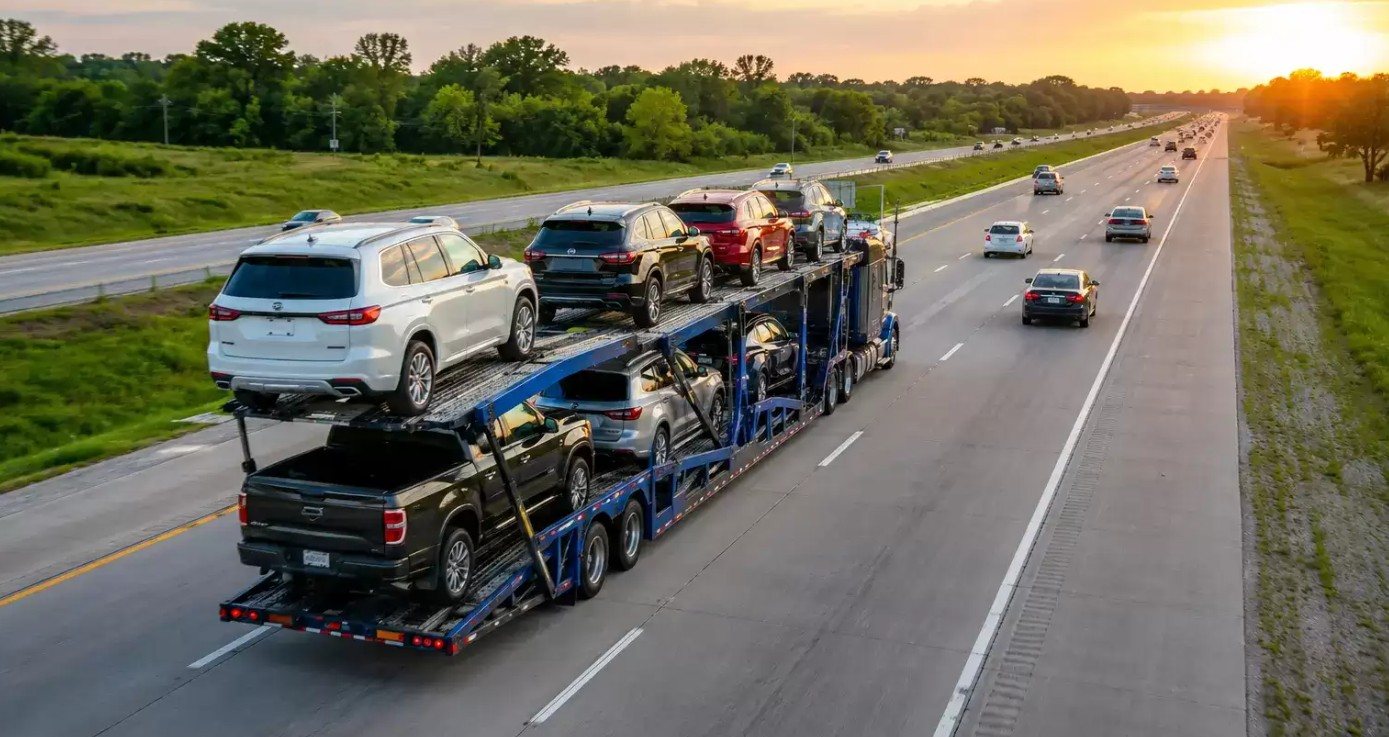
The Metroplex at deal speed — crossroads-deep, landing-wave fluent, and audit-grade documented.
Licensed Broker & Fully Insured
FMCSA Registered
Vetted Carrier Network
Real-Time Tracking & 24/7 Support
50+States Served
100%Insured Transport
24/7Support & Tracking
Dallas ships from the crossroads that built it: four interstates converge on the Metroplex, one of the world’s great hub airports connects it, and a corporate landing wave keeps rewriting the northern corridor’s skyline one headquarters announcement at a time. The market runs as a single Dallas–Fort Worth pool spanning thirty-plus municipalities, the dealer-and-auction economy keeps wholesale equipment dense, and the craft — corporate choreography, hub fly-and-drives, ice-day honesty, collector-grade enclosed work — matches a region that does business at full Texas volume and expects its vendors to keep up.
Quick answerDallas ships from a four-interstate crossing: $210–$400 around the Texas Triangle and up to Oklahoma, $360–$880 across the South, the mountains, and the Midwest, and $920–$1,420 to the coasts — pickup in 1–3 days on the Metroplex’s one-market pool. Corporate landings, hub fly-and-drives, ice-day honesty: the Big D’s book, below. Price your lane in two minutes.
Ship Guy works the Metroplex from Oak Lawn — the Uptown towers and the Park Cities, the platinum corridor north through Plano and Frisco, the mid-cities to Fort Worth and its west side, and the crossroads’ reach in every direction. Below: the four-interstate economics, the one-market Metroplex thesis, the landing wave’s machinery, the hub craft, and the North Texas year with its short honest winter chapter.
Typical pickup1–3 days
Nearest listed laneAustin, TX · $210–$340
Longest listed laneLos Angeles, CA · $920–$1,340
Enclosed option+40–60% over open
Local desk(469) 378-8895 · 6a–11p CT
Updated July 25, 2026 · rate figures: July 2026 board.
Dallas Shipping Lanes & Current Rates
The crossroads’ working routes — four interstates, one very busy dispatch board. Sedan baseline, open trailer.
Dallas, TX → Los Angeles, CA~1,435 mi4–5 days$920–$1,340Get price
*Metroplex board, July 2026, sedan basis; SUVs and pickups price 10–25% up, oversized units quote dimensionally, winch loading adds $100–$200 where a vehicle won’t drive on. Corporate-landing announcements ripple booking clusters into the northern corridor with each headline; summer family season books two to three weeks out.
Best time to book from here
Corporate landings cluster year-round; summer stacks the school-calendar wave. January’s post-holiday board runs the Metroplex’s best value.
The Crossroads Economics: Distribution Capital of the Southwest
Geography dealt the Metroplex a logistics royal flush: I-35 carries the continent’s north-south spine through the region, I-20 crosses the southern tier coast to coast, I-30 opens the mid-South, and I-45 drops to Houston and the Gulf — and the convergence made this one of America’s natural distribution capitals long before the corporate wave noticed. For vehicle shipping, the inheritance is depth on every heading: the Texas Triangle’s rows running at single-day shuttle rhythm, Oklahoma City closer than most suburbs admit, the mountain West and the Midwest each a corridor away, and the coasts riding the long-haul lanes at continental pricing kept honest by constant competition.
The wholesale economy compounds the depth: the region’s dealer-and-auction circuit cycles enormous volume through multi-car equipment daily, which keeps carrier density high, match times short, and recovery capacity always within a corridor cycle. Markets this deep forgive planning mistakes that thinner ones punish — but they reward fluency even more, and fluency is the product this page sells: corridor by corridor, suburb by suburb, window by kept window. Depth is the market’s gift; fluency is our end of the bargain.
One Metroplex: Two Skylines, Thirty Municipalities, One Pool
The Dallas–Fort Worth question gets a freight answer simpler than the cultural one: the carrier pool spans the whole Metroplex as one market, a booking from either downtown draws identical depth, and the mid-cities corridor — Arlington, Irving, Grand Prairie, the airport’s own city-sized footprint — ships as the connective tissue it is. Fort Worth’s west side and its stockyards-to-cultural-district character, Dallas’s east-side neighborhoods and northern arcs, and the constellation of municipalities between all resolve to the same dispatch grammar: name the suburb, get the window, keep the appointment.
The receiving map runs the full Texas range: Uptown and Oak Lawn towers on dock-and-appointment choreography, the Park Cities’ canopy streets on corner-meet courtesy, the platinum corridor’s master plans on gate-code system, the established suburbs driveway-simple, and the exurban edges — growing faster than the maps print — on junction meets that turn new construction into practiced routine. Two proud cities, thirty-plus jurisdictions, one very busy pool: the Metroplex’s founding arrangement, and ours. Thirty-plus city halls, one dispatch grammar — federalism, freight edition. It works for the same reason the original does: everyone benefits, nobody blinks. Two hundred years of American practice and thirty years of Metroplex freight agree on the design. Rare consensus, durable result — the Metroplex specializes in both when the incentives align, and freight aligned them decades ago.
The Landing Wave: Corporate Texas and Its Fleets
No American region has landed corporate headquarters like the northern corridor this past decade, and each announcement ships a workforce behind the press release: executive arrivals sequencing household fleets to start dates, relocation programs moving hundreds of families on coordinated calendars, and the California lane — the wave’s great tributary — running among the country’s busiest corporate-migration corridors in the southbound direction. The machinery is relocation-provider standard run at Texas volume: provider invoicing formats, start-date precision, school-calendar clustering each summer, and the second-car-follows-the-furniture sequencing every experienced transferee learns to request.
The wave’s texture rewards a fluent desk: the announcement-to-booking-cluster lag runs a few months and our board hears the music early; the platinum corridor’s master-planned geographies ship on gate codes gathered at booking; the boomerang and counter-flow currents keep the northbound and westbound legs priced at bargain depth for flexible dates; and the international assignments a global corporate base generates fold into purchase-delivery and newcomer machinery practiced daily. Corporate Texas measures vendors quarterly; we’ve made the scorecard every quarter we’ve served it, and the streak is the pitch. Quarterly reviews keep vendors honest; we’ve simply never needed the reminder. Scorecards favor the prepared; preparation is the entire Dallas playbook, ours included. Practice like you play; dispatch like you promised; repeat quarterly forever. Somewhere in Frisco a new campus just broke ground; our board penciled the booking cluster before the rebar arrived. Anticipation is not magic; it’s just reading the same business journals everyone else skims, plus twenty years of pattern.
The Hub Craft: DFW, Love, and the Fly-and-Drive
A hub airport the size of a city makes the fly-and-drive a Metroplex institution: land at DFW or Love, meet your delivered vehicle minutes from the terminals, and skip the rental counter entirely. The pattern serves the region’s whole cast — corporate travelers running it weekly, relocating families landing for house-hunting trips with the car already positioned, the crew-base population cycling on schedule, and the connecting-city logic that lets even complex itineraries end with your own keys in your own ignition. Dispatch needs the flight number and nothing else; the window builds itself around the arrivals board.
The hub’s deeper dividend is resilience: when weather or breakdowns bend a schedule anywhere in the middle of the country, the crossroads’ four-interstate geometry lets loads re-route the way the airline re-routes connections — and the customer experiences the whole adjustment as a phone call and a kept revised window. Distribution capitals absorb disruption for a living; this one taught its vehicle trade the same reflexes, and your booking inherits them free of charge. Resilience is the crossroads’ oldest export; we just retail it by the shipment. Wholesale pricing on peace of mind — the crossroads’ best standing offer. No expiration date, no fine print, no haggling required — though this being Dallas, we’ll happily entertain the sport of it. Negotiation is recreation here; the terms just happen to be good before you start.
The Wholesale Engine and the Collector’s Metroplex
Beneath the corporate headlines, the region’s vehicle economy runs an engine room few markets match: the dealer-and-auction circuit cycles wholesale volume through multi-car equipment daily, franchise groups shuttle inventory across the four-interstate map on standing schedules, and the online-retail era’s buy-here-deliver-there commerce runs purchase deliveries at industrial cadence — documented to reassure buyers who never met their sellers, timed to auction gate hours, and priced by a wholesale market whose competition never sleeps. The engine’s dividend reaches every residential booking: carrier density stays high, match times stay short, and the equipment mix stays deep enough that the odd request — the lifted truck, the low splitter, the inoperable project — finds its trailer without drama.
Above the engine room, the collector’s Metroplex keeps the enclosed tier polished: Texas wealth built garages worth whispering about from the Park Cities to Westlake, the auction calendar cycles significant metal through the region on dates the trade circles in advance, and the craft runs to provenance standard — liftgate patience, documentation an appraiser would co-sign, and the discretion that seven-figure garages consider a basic utility. From the wholesale lane to the white-glove bay, the market’s whole range works one dispatch board; that range is the Metroplex’s signature, and ours. Volume taught us speed; the collections taught us patience; the combination is the whole résumé. References available from both ends of the market, and most of the middle. Headlines announce arrivals; the mid-cities’ kept Tuesdays decide who stays hired. We’ve stayed hired. Ask any relocation coordinator in the platinum corridor who answers on the first ring; the shortlist is short, and we’re on it.
The North Texas Year
The calendar, straight through: spring runs the year’s liveliest weather — storm season’s afternoon drama pausing ramps briefly and hail forecasts occasionally arguing a garage-kept car waits a day (spring’s one genuine counsel, offered free with every April quote) — and heeded, in our experience, by exactly the customers who own the nicest paint — alongside the corporate wave’s spring transfer cycle; summer peaks the family season on school calendars with heat that counsels morning loading through the deepest weeks; fall ships the market’s sweetest months — mild air, steady corridors, the auction calendar’s autumn crescendos; and winter runs mild with the ice-day exception per the callout: a few glazed mornings, a civic pause, a next-afternoon melt, and back to some of the friendliest shipping weather in the trade.
Through every season, the constants: four-interstate depth on every heading, the one-market pool answering from any municipality, the hub’s arrivals board feeding the fly-and-drive, and a dispatch culture built for a region that expects vendors to move at deal speed and document at audit grade. Big D does both without apology; so, professionally, do we. Deal speed without audit grade is recklessness; audit grade without deal speed is bureaucracy; the Metroplex demands both and gets them.
Open or Enclosed in the Metroplex?
The crossroads ships open at distribution depth; the enclosed tier serves the collections Dallas wealth built.
The corridor answer
Open Transport
Corporate landings, Triangle errands, the wholesale circuit: open trailers on four-interstate depth, through a climate whose winter chapter runs a few honest ice mornings and whose spring asks only hail-forecast awareness.
Four interstates’ depth on every heading
One-market pool across thirty municipalities
Cargo coverage typically $100K–$250K
The Preston Hollow answer
Enclosed Transport
The collector culture Texas wealth built, the auction calendar’s significant metal, and executive garages from the Park Cities to Westlake: enclosed walls, liftgate patience, and documentation to provenance standard.
Roughly 40–60% above open rates
Auction weeks book enclosed windows early
Cargo coverage $250K–$1M, higher arranged
Metroplex rule: the commuter rides open through the crossing; the trophy rides enclosed to its next showcase. Full comparison: open vs. enclosed.
Uptown to the Stockyards: Where We Pick Up
Both skylines, the platinum corridor, and everything between — each with its practiced answer.
Uptown / Oak LawnDowntown DallasPark CitiesPreston HollowLakewood / East DallasOak Cliff / Bishop ArtsPlanoFriscoMcKinneyIrving / Las ColinasArlingtonGrand PrairieFort WorthSouthlake / WestlakeDenton
Four interstates, one board
I-35 runs the continent’s spine, I-20 crosses the southern tier, I-30 reaches the mid-South, and I-45 drops to the Gulf — and their convergence makes the Metroplex one of America’s natural distribution capitals: equipment on every heading daily, wholesale volume cycling constantly, and pricing disciplined by a corridor competition few markets match. The crossroads built the city; the dispatch board just inherited the map.
The landing wave’s choreography
Every headquarters announcement in the northern corridor ships a workforce behind it: executive fleets sequenced to start dates, family moves clustering on the school calendar, and the California lane running the corporate migration at a volume that reshaped the whole regional market. The choreography is rehearsed — announcement, hiring wave, booking cluster, kept windows — and our board has danced it enough times to hear the music early.
Ice-day honesty
North Texas winter arrives as ice, not snow: a few mornings each season, freezing rain glazes the bridges and the whole Metroplex sensibly stands down for a day — a civic tradition we schedule around rather than argue with. Windows near ice events carry a built-in day, the melt usually clears by the next afternoon, and the other eleven-plus months ship on weather most markets would trade for. Honest chapter, short chapter.
FMCSA brokerage authority behind the $75,000 surety bond, verifiable in SAFER before you sign anything — deal-room diligence, freight edition.
Metroplex-whole fluent
Both skylines, thirty municipalities, the platinum corridor’s gate codes, the hub’s arrivals board — one market’s full grammar, spoken from Oak Lawn.
Crossroads depth
Four interstates’ constant cycle behind every booking — distribution-capital matches, wholesale-economy density, recovery in hours.
Deal-speed dependable
Windows at closing pace, documentation at audit grade, and nothing owed until a carrier is assigned — terms that survive a Dallas negotiation.
Find Us on Oak Lawn
Our Dallas office sits in Oak Lawn minutes from Uptown — the tollway north, the mixmaster south, and the whole Metroplex from Frisco to Fort Worth in working range. Daily on the local line, Central time.
Ship Guy Auto Transport — Dallas
Address3500 Oak Lawn Ave Ste 1210 Dallas, TX 75219
What does it cost to ship a car to or from Dallas?
Figure roughly, sedan on open transport: $210–$340 to Austin or Oklahoma City, $235–$380 to Houston, $250–$400 to San Antonio, $360–$560 to Memphis, $430–$645 to Albuquerque, $520–$770 to Kansas City or Nashville, $560–$830 to Denver, $600–$880 to Atlanta or Chicago, $860–$1,250 to Phoenix or the Southeast coast, and $980–$1,420 to either seaboard. Enclosed carries the usual 40–60% premium. Four interstates cross here; the pricing shows it.
How fast is pickup across the Metroplex?
Usually 1–3 days on one of the country's great distribution markets: I-35, I-20, I-30, and I-45 all converge on the region, the dealer-and-auction economy cycles wholesale volume constantly, and the Dallas–Fort Worth pool works as one market — equipment loading in Plano serves Arlington the same afternoon. Windows quote by corridor and suburb, not just by the two downtown skylines.
Do Dallas and Fort Worth ship as one market?
Functionally yes: the Metroplex's carrier pool spans both cities and the thirty-plus municipalities between, a booking from either downtown draws identical depth, and the mid-cities corridor ships as the connective tissue it is. Cultural differences are real and cherished — cattle east of nowhere, as both sides joke — but the freight never noticed the rivalry.
What's the corporate-relocation wave like here?
The market's defining current: headquarters and regional offices keep landing in the northern corridor — Plano, Frisco, Irving, the whole platinum arc — and each arrival ships a workforce: executive fleets sequenced to start dates, family moves clustered on school calendars, and the California lane running as one of the country's busiest corporate-migration corridors. The machinery is relocation-provider standard; the volume is Texas-sized.
Is DFW airport useful for fly-and-drive?
One of the world's great hubs makes it a Metroplex staple: land at DFW or Love, meet your delivered car minutes from the terminals, skip the counter. Corporate travelers run it weekly, relocating families use it for house-hunting trips, and the flight number is all dispatch needs to build the window.
What's the deal with North Texas ice?
The honest winter chapter: this region's cold events arrive as ice, not snow — a few times each season, freezing rain glazes the bridges and the whole Metroplex collectively pauses for a day, by wisdom rather than panic. Windows around ice events carry a built-in day's flexibility, handoffs resume as the melt clears (usually by the next afternoon), and the other eleven-and-a-half months ship on some of the friendliest weather in the trade.
Do you handle the collector and auction scene?
Fluently: Dallas wealth built one of the Southwest's great collector cultures, the auction calendar cycles significant metal through the region, and the enclosed tier runs deep — liftgate patience, provenance-grade documentation, and the discretion executive garages expect. Wholesale dealers work our multi-car equipment on the same corridors daily.
Where is Ship Guy located in Dallas?
3500 Oak Lawn Ave Ste 1210, Dallas, TX 75219 — Oak Lawn, minutes from Uptown and the tollway. Local line (469) 378-8895, staffed daily 6:00 AM to 11:00 PM Central.
Get a free, no-obligation quote in about 60 seconds — or call and talk to a real specialist right now.
Licensed & insured
No upfront deposit
24/7 support
Ship Guy is a licensed, bonded auto transport broker (MC #1457715 • USDOT #3932149) with a local office at 3500 Oak Lawn Ave Ste 1210, Dallas, TX 75219 • (469) 378-8895 • open 7 days, 6 AM–11 PM, serving Dallas, Fort Worth, and the whole Metroplex as one market. Verify our operating authority anytime in the FMCSA SAFER database. Rate estimates on this page reflect current lane conditions and are refreshed quarterly. Learn how insurance & claims work and who we are.
Written & reviewed by [Full Name], [Title], [X] years in vehicle logistics • Last updated: