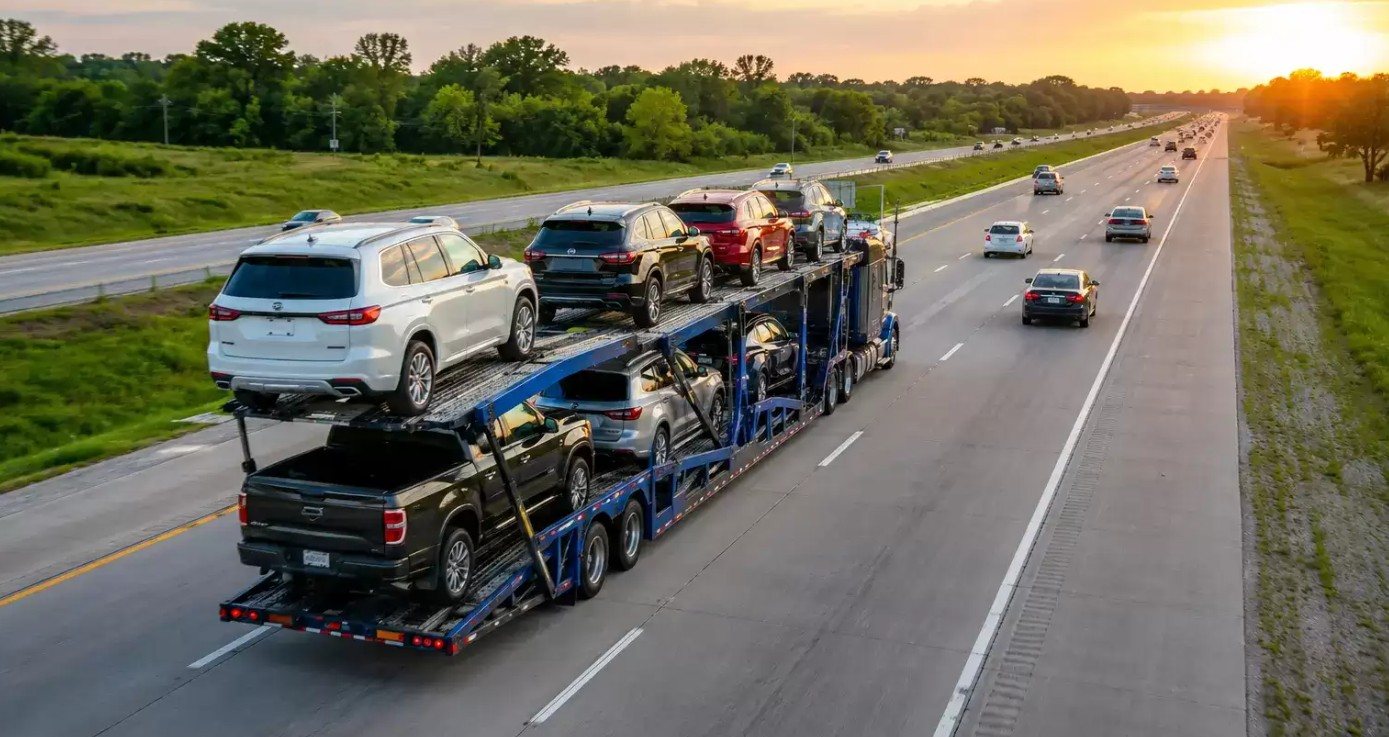
The Bayou City at continental scale — loop-literate, assignment-fluent, and candid as the coast requires.
Licensed Broker & Fully Insured
FMCSA Registered
Vetted Carrier Network
Real-Time Tracking & 24/7 Support
50+States Served
100%Insured Transport
24/7Support & Tracking
Houston ships at the scale it does everything: the largest metro on the Gulf, the energy capital of the hemisphere, home to the world’s largest medical complex, and a carrier market deep enough that the Texas Triangle’s lanes run like transit routes. The craft here is fluency with bigness — loop-literate dispatch across a metro wider than some states, assignment-cycle machinery for an industry that rotates the globe, flood-aware habits a storm coast earned honestly, and a no-zoning sprawl that taught the trade to navigate by corridor and courtesy in equal measure.
Quick answerHouston ships at continental scale: $215–$380 around the Texas Triangle’s shuttle lanes, $310–$1,050 across the South, the Midwest, and down to Florida, and $900–$1,300 to either coast — pickup in 1–3 days from one of America’s largest carrier pools. Energy assignments, TMC calendars, flood-aware craft: the Bayou City’s book, below. Price your lane in two minutes.
From Bissonnet inside Beltway 8, Ship Guy runs the whole metro — the Energy Corridor’s rotations, the Medical Center’s calendars, the master-planned arcs from the Woodlands to Sugar Land, the bay side down to the island, and the Triangle’s constant trade. Below: the continental-scale economics, the energy desk’s machinery, the TMC current, the flood-aware chapter written plainly, and the Gulf year in the Bayou City’s accent.
Typical pickup1–3 days
Nearest listed laneAustin, TX · $215–$350
Longest listed laneLos Angeles, CA · $900–$1,300
Enclosed option+40–60% over open
Local desk(346) 615-4970 · 6a–11p CT
Updated July 25, 2026 · rate figures: July 2026 board.
Houston Shipping Lanes & Current Rates
The Bayou City’s working routes — the Triangle rows lead because Texas trades with Texas first. Sedan baseline, open trailer.
Houston, TX → Los Angeles, CA~1,550 mi4–5 days$900–$1,300Get price
*Gulf Coast board, July 2026, sedan figures; larger vehicles carry 10–25% premiums, oversized units price by their dimensions, and winch loading runs $100–$200 for non-starters. Hurricane-season windows June–November carry contingency flexibility; energy-cycle surges ripple assignment volume without warning — book to your start date, not the news.
Best time to book from here
Energy cycles ripple volume without regard to season; June opens the Gulf-watch months. Softest board: February, cycle-quiet and storm-free.
Continental Scale: The Triangle, the Port, and the Pool
Three structures give Houston its market depth. The Texas Triangle — the Dallas, Austin, San Antonio circuit this metro anchors from the Gulf corner — carries some of the country’s heaviest intrastate traffic, and the rate table’s Texas rows read like shuttle fares because functionally they are: single-day transits, constant equipment, and booking lead times in days. The port’s processing economy keeps vehicle-logistics infrastructure humming at industrial scale, with the import trade’s volume feeding carrier density the whole region draws on. And the pool itself — one of America’s largest carrier markets by any measure — means matches land fast, recovery lands faster, and pricing stays disciplined by more competition than any Gulf market offers.
The currents run continental: the corporate migration Texas keeps winning (California arrivals sequencing household fleets into the master-planned arcs), the energy rotations per their own section, the international city’s constant global churn — this is among the most diverse metros in the hemisphere, and the purchase-delivery and newcomer trades reflect it daily — and the outbound legs to both coasts riding the long-haul corridors at continental pricing. Big markets forgive nothing and reward fluency; this page is the fluency, priced honestly. In a market this size, honesty scales better than anything else we could offer.
The Energy Desk: Assignment Cycles and the Global Rotation
The industry that named this city runs the most international relocation trade in American shipping, and serving it is a Houston specialty with its own grammar. Domestic transfers ship on the corporate machinery at its most polished — provider invoicing, assignment-date scheduling worked backward, household fleets sequenced into the Energy Corridor’s and the west side’s neighborhoods. Overseas rotations get the conversation run honestly: for most international assignments, storing or selling beats shipping a vehicle abroad, and we say so before anyone spends a dollar — then handle the storage coordination, the return-leg booking, or the assignment-end repatriation when the rotation cycles home. The expat arrivals landing from every producing basin bring the newcomer’s needs — purchase deliveries documented to reassure, registration questions answered plainly, and the patience of a desk that has onboarded arrivals from a hundred countries.
The cycle’s rhythm is the trade’s weather: price surges ripple hiring waves and assignment volume without warning, downturns reverse them, and the machinery holds steady through both because start dates are start dates at any commodity price. Our counsel through every cycle is the same: book to your assignment letter, not the headlines — the desk that serves this industry learned long ago that the only calendar that matters is the one with your name on it. Crude has cycles; commitments don’t. The desk that learns the difference keeps the industry’s business through every barrel price. Boom hiring and bust repatriations both ship through this office; only the direction changes.
The Medical City: TMC Scale and Its Calendars
The Texas Medical Center is not a hospital district; it is a city of medicine — the largest complex of its kind on Earth — and the relocation trade around it runs at commensurate scale: match-day cohorts landing across multiple institutions simultaneously on the national calendar’s exact weeks, fellowship and research rotations turning on academic clocks, faculty recruitment drawing globally, and the clinical-trial and biotech orbit adding its program-timeline currents. The machinery is the credentialed standard this site describes in every institutional market, run here at a volume that keeps the medical column of our booking board full twelve months a year.
The craft’s local accents: campus-area handoffs run the practiced spots around a district denser than most downtowns, the parking-infrastructure realities get respected in every window, the international clinical arrivals fold into the newcomer machinery the energy desk already runs daily, and the midnight-arrival-before-orientation delivery is a request this market’s scale long ago made routine. Medicine at this magnitude runs on precision; the trade serving it either matches the standard or loses the account — and our account here, like the complex itself, keeps growing. Scale is Houston’s native condition; matching it is simply the price of serving here, gladly paid. Everything in Houston is bigger, including, we’d argue, the standard for keeping your word. We measure ours in kept windows per year; the number would fill a refinery ledger.
The Gulf Almanac: Season, Storm, and the Honest Chapter
Houston’s weather book runs simple most of the year — heat that counsels morning loading through deep summer, humidity as atmosphere rather than obstacle, and winters so mild the occasional ice morning makes the news — but the Gulf chapter deserves plain writing. Hurricane season, June through November: forecasts watched from a week out, windows near landfall threats carrying built-in contingency, evacuation-adjacent scheduling deferring to official guidance without argument, and the post-storm restart booking fast as the region’s formidable recovery machinery spins up. Most seasons pass with watched systems and zero disruption; the protocol exists because this coast paid its tuition and keeps the notes.
The flood-awareness inheritance shapes the craft year-round: low-lying addresses get staging alternatives named at booking, bayou-adjacent neighborhoods carry their own dispatch notes, and the used-purchase counsel from the FAQ bears repeating in prose — title and flood-database checks before buying from any storm region, this one included, because salvage metal travels nationally after every event and the five-minute lookup is the cheapest insurance in the industry. A candid page serves customers better than a glossy one; on this coast, candor is the local dialect anyway. Nobody on this coast trusts a forecast without error bars or a vendor without caveats; we supply both, clearly labeled. Engineering culture runs this town, and engineering culture reads the footnotes first; ours are written to be read. Peer review welcome; revision history available; conclusions reproducible at any loop.
The Sprawl’s Craft: No Zoning, Many Answers
Houston’s famous no-zoning geography built a receiving map like nowhere else — townhomes beside warehouses beside high-rises beside bungalows — and the craft answers it address by address: the master-planned arcs (the Woodlands’ forested plans, Katy and Sugar Land’s gated geographies, Cypress’s new growth) ship on the gate-code-and-HOA choreography gathered at booking; the inner-loop neighborhoods run corner meets where the live oaks narrow the streets and townhome courts complicate the turning radii; the bay side from Clear Lake to League City adds the aerospace corridor’s professional current and the marina geography’s gentle staging; and the island ships on the coastal almanac with the causeway as the practiced meet when the season argues for it.
The unifying custom is Texan and practical: name the address, and the answer arrives pre-solved — because a metro that never met a land-use plan it couldn’t ignore taught its logistics trade to carry the whole map in its head. Ours does, loop by loop, and the windows show it. Ask for a window by neighborhood and you’ll hear the difference immediately — the answer names your beltway before it names your day.
The Bay Side: Aerospace, the Island, and the Coastal Current
Southeast of the loops, the metro runs its coastal chapter: the aerospace corridor around Clear Lake moves engineering talent on program cycles that predate most industries’ existence — mission-timeline relocations, contractor rotations, and the international cooperation a spacefaring campus generates — while the bay communities from League City to Kemah add the marina geography’s gentle staging and the island itself ships on Galveston’s own rhythm: causeway meets when summer traffic argues for them, seasonal awareness in the almanac’s watchful months, and the historic district’s narrow streets taking corner meets by island custom.
The coastal current’s counsel mirrors every Gulf page in this site’s library, Houston edition: salt-adjacent vehicles earn the post-transit rinse, beach-house positioning books midweek ahead of summer weekends, and the bay side’s professional class — commuting to the corridor or the Medical Center on schedules our loop-literate windows already speak — ships on the same metro pool at the same metro depth. One market, many waters; the dispatch board charts them all. Bay, bayou, island, loop: four geographies, one standard, zero excuses. The metro never apologizes for its size; neither does the service that matches it.
Open or Enclosed on the Gulf Coast?
The Triangle ships open at shuttle depth; the enclosed tier serves the corner offices and the collections.
The loop answer
Open Transport
Energy transfers, TMC cohorts, Triangle errands, the California arrival wave: open trailers on one of America’s deepest pools, through a climate whose real chapter is seasonal, not daily. The default, priced by continental competition.
Texas Triangle at single-day shuttle rates
Hurricane-season contingency built in
Cargo coverage typically $100K–$250K
The corner-office answer
Enclosed Transport
Executive garages from River Oaks to the Woodlands, the collector culture oil wealth built, and the exotics of a city that celebrates arrival: enclosed walls, liftgate patience, and documentation to boardroom standard.
Roughly 40–60% above open rates
Collection and estate moves paced to the owner
Cargo coverage $250K–$1M, higher arranged
Bayou City rule: the commuter rides open on the Triangle; the trophy rides enclosed past the season. Full comparison: open vs. enclosed.
The Loops and the Arcs: Where We Pick Up
Inner loop to outer arc, bay to forest — each with its practiced answer.
A metro this size runs on its loops — the 610 core, Beltway 8’s middle ring, the Grand Parkway’s outer arc — and honest windows quote by them: a Katy pickup and a Clear Lake delivery are different mornings, not different cities, and dispatch that speaks loop saves everyone the discovery. Houston measures distance in minutes and traffic, never miles; so do we.
Flood-aware, purchase-wise
This coast’s storm history wrote two habits into our craft: operationally, low-lying addresses get staging alternatives named upfront and hurricane-season windows carry contingency language; commercially, we counsel every used-vehicle buyer shipping from this region to run the title and flood-database checks first — storm-salvage metal circulates nationally after every major event, and five minutes of lookup beats years of regret. We ship what you bought; we’d rather you bought well.
The world’s energy desk
No American city rotates talent globally like this one: assignment cycles move engineers and executives between here and every producing basin on Earth, expat arrivals land in the west-side corridors year-round, and the mobility machinery — provider invoicing, assignment-date precision, the honest overseas ship-versus-store conversation — runs as this market’s native language. The price of crude sets the volume; the professionalism holds at every price.
And the Gulf Coast’s reach, daily
GalvestonLeague CityBaytownSpringConroeRichmond / RosenbergBeaumontTexas City
Why Ship with Ship Guy in Houston
Licensed & bonded
Federal broker authority carrying the $75,000 surety bond — the SAFER lookup takes a minute, and an industry built on due diligence should expect nothing less.
Loop-and-cycle fluent
Beltways read like locals, assignment calendars read like mobility desks, storm season read like a coast that earned its notes — the whole metro’s grammar, spoken daily.
Continental depth
One of America’s largest carrier pools behind every booking — Triangle shuttles, coast-to-coast hauls, and recovery capacity measured in hours.
Candid at scale
Flood counsel given freely, overseas ship-versus-store answered honestly, and nothing owed until a carrier is assigned — big-market service, straight-talk terms.
Find Us on Bissonnet
Our Houston office sits on the southwest side inside Beltway 8 — the loops in every direction, the Medical Center twenty minutes east, the Energy Corridor north, and the whole metro’s sprawl in working range. Daily on the local line, Central time.
Ship Guy Auto Transport — Houston
Address9525 Bissonnet St Ste 1175 Houston, TX 77036
What does it cost to ship a car to or from Houston?
Open-transport sedan figures run roughly: $215–$350 to Austin or San Antonio, $235–$380 to Dallas or Corpus Christi, $310–$490 to New Orleans, $420–$640 to Oklahoma City or Memphis, $540–$800 to Atlanta, $560–$840 to Albuquerque, $640–$940 to Chicago, $700–$1,020 to Florida's peninsula, $780–$1,140 to Phoenix, and $900–$1,300 to either coast. Enclosed runs 40–60% over. The Texas Triangle's traffic keeps the near lanes shuttle-deep.
How fast is pickup across the Houston metro?
Usually 1–3 days across one of the largest carrier markets in America: the Texas Triangle's constant cycle, the port's processing volume, and the loop system's distribution geography keep equipment everywhere from Katy to Clear Lake. The metro's sheer size means the practical variable is which side of town — dispatch quotes windows by loop, not just by city.
How does the energy industry's calendar shape shipping here?
It's the market's signature current: the majors and the service companies rotate talent globally on assignment cycles, the Energy Corridor and the west side land expat arrivals year-round, and the trade runs on corporate-mobility machinery — relocation-provider invoicing, assignment-date scheduling, and the ship-versus-buy conversation for overseas rotations answered honestly (for most international assignments, storage-or-sell beats shipping; for domestic transfers, the car almost always travels). Price cycles ripple the volume; the machinery never changes.
What should I know about flood history and shipping in Houston?
Two practical things: first, our own craft is flood-aware — hurricane-season windows carry contingency language, low-lying pickup addresses get staging alternatives named upfront, and post-storm recovery scheduling is a practiced local drill. Second, for used-vehicle purchases shipping out of this region: check the title history and flood databases before you buy, because storm-salvage vehicles circulate nationally after every major event. We ship what you bought either way — but we'd rather you buy well, and the lookup takes five minutes.
Do you handle Texas Medical Center relocations?
At the scale the world's largest medical complex generates: match-day cohorts across multiple institutions at once, fellowship and research cycles on academic clocks, and international clinical talent arriving with the purchase-delivery needs newcomers have. Start dates run as contracts, campus-area handoffs run the practiced spots, and the density means our medical column stays full every month.
Can you serve the whole metro — Woodlands to Galveston?
One market, many loops: the master-planned north (Woodlands, Spring), the western arcs (Katy, Sugar Land, Cypress), the bay side (Clear Lake, League City) and the island itself all ship on the same metro pool, with the loop-and-corridor geography setting windows more than mileage does. Gate codes and HOA customs in the planned communities get gathered at booking, coastal deliveries watch the seasonal almanac.
What's hurricane season protocol?
June through November, the Gulf's calendar gets respect without drama: forecasts watched from a week out, windows around landfall threats carry built-in flexibility, evacuation-adjacent scheduling defers to official guidance, and post-storm recovery books fast as the market restarts. Most seasons pass with a few watched systems and zero disruption — but the protocol exists because this coast earned it.
Where is Ship Guy located in Houston?
9525 Bissonnet St Ste 1175, Houston, TX 77036 — southwest side, inside Beltway 8. Local line (346) 615-4970, staffed daily 6:00 AM to 11:00 PM Central.
Get a free, no-obligation quote in about 60 seconds — or call and talk to a real specialist right now.
Licensed & insured
No upfront deposit
24/7 support
Ship Guy is a licensed, bonded auto transport broker (MC #1457715 • USDOT #3932149) with a local office at 9525 Bissonnet St Ste 1175, Houston, TX 77036 • (346) 615-4970 • open 7 days, 6 AM–11 PM, serving Houston’s loops, the Gulf Coast, and the Texas Triangle. Verify our operating authority anytime in the FMCSA SAFER database. Rate estimates on this page reflect current lane conditions and are refreshed quarterly. Learn how insurance & claims work and who we are.
Written & reviewed by [Full Name], [Title], [X] years in vehicle logistics • Last updated: